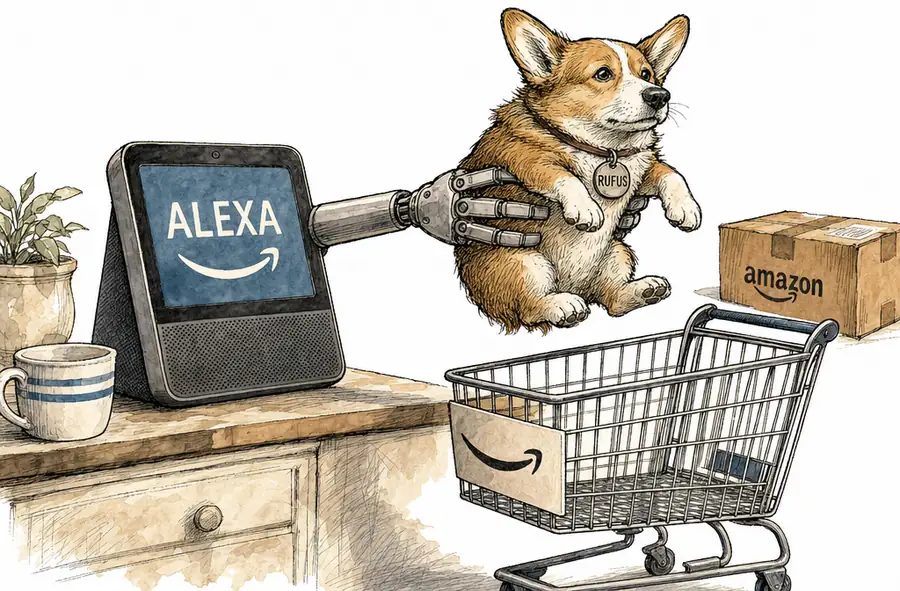
Amazon Retired Rufus. Alexa Took The Cart.
Amazon retired its standalone shopping chatbot Rufus and folded the surface into Alexa for Shopping. Two months after OpenAI killed Instant Checkout, the branded concierge wrapper has lost its anchor tenant.
Sir John Crabstone
Amazon retired Rufus on May 13. The standalone shopping chatbot, launched in beta in February 2024, has been folded into Alexa for Shopping, a single assistant that now occupies the app, the website, and the Echo Show. 250 million customers tried Rufus in 2025. The brand did not see its third birthday.
That a successful product can be retired tells you what the company decided about the category. Andy Jassy told the Q3 2025 earnings call Rufus was on pace to generate over $10 billion in incremental annual sales; this was not a write-off. Two assistants doing roughly the same things, one carrying the stronger brand: that arrangement does not survive a quarter inside Amazon.
The instructive line in the announcement is what Alexa for Shopping inherits. The new assistant carries Rufus’s recommendation engine across to surfaces Rufus could never reach: a speaker on the kitchen counter, a microphone in the car. It handles natural-language product comparison and the automated purchase from the same prompt the customer already uses to set a timer. Amazon decided the shopping concierge belongs to whichever assistant the customer already speaks to, not the one labelled “shopping.”
The chat pane was a transitional form.
OpenAI had provided the corroboration two months earlier. The company quietly retired Instant Checkout in March, citing a flexibility shortfall in the transactional layer and persistent difficulty onboarding merchants; it immediately replaced the feature with a revised shopping experience anchored to Target, Sephora, and Nordstrom. Both companies, in the same quarter, abandoned the same bet: that a branded transactional wrapper could stand as a product in its own right. The pattern is not about either company’s execution.
For brands, this redraws the integration map. Optimising product detail pages for Rufus was already a soft target; the work now graduates to writing for an assistant that spans Amazon properties and listens beyond them. The catalogue copy that reads well to a human shopper is the wrong artefact; Alexa needs structured answers it can return in one breath. The merchandiser’s question is no longer “what should I buy on this screen?” but “what does this customer want, given everything she has told a microphone this week?” Most of the answer lives in conversation transcripts no merchant has ever seen.
A smaller lesson, about naming. A branded chatbot announces that the AI is the product. The ambient version lets it disappear into the plumbing. The first framing flatters the engineering; the second flatters the customer. Amazon spent two years on the former and, to its credit, called the bet wrong before someone else did.
What remains for the rest of the industry is an awkward audit. Every retailer that funded a bespoke shopping concierge in 2024 now has to decide whether the chatbot was the product or the wrapper. The honest answer is rarely flattering. Most will pay to avoid asking.
Amazon’s instinct was to put the agent where the customer already lives. Everyone else has the same question and no microphone of their own. Rufus did not fail. The category around it shrank.