Amazon's Sellers Are 5.5 Percent of British Retail. Nobody Has Checked Since 2021.
The only public estimate of how much British retail runs through one marketplace's independent sellers is five years old and came from an aggregator that later filed for bankruptcy. Meanwhile Amazon has made cross-border listing a condition of its cheapest fulfilment rates, and no British statistic can register the change.
Admiral Neritus Vale
The most recent public estimate of how much British retail passes through one marketplace’s independent sellers is 5.5 percent, and it dates from 2021. It was produced by Thrasio, an Amazon aggregator working from SmartScout data, rather than by any statistical agency, and Thrasio filed for Chapter 11 protection in 2024. That count found 13,483 British sellers measured against total UK retail turnover including fuel, a figure reported across the European trade press at the time. Nothing has replaced it, which means Britain cannot say today whether the channel has doubled or thinned. What has changed since is that Amazon no longer invites those sellers to trade across borders but requires it. A listing requirement enforced through fulfilment pricing, applied to every enrolled seller on a fixed date, is trade policy that no legislature wrote.
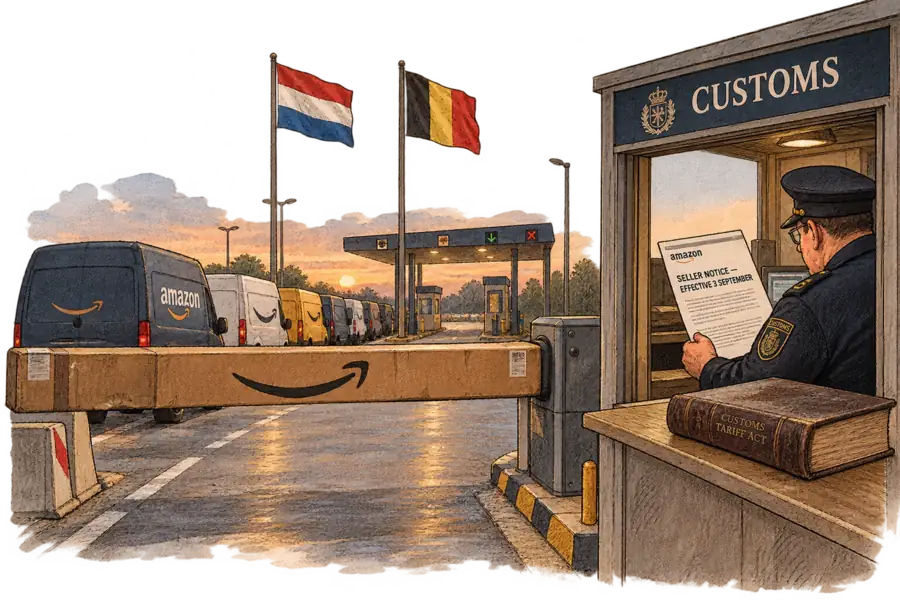
Amazon made cross-border listing a condition of its cheapest fulfilment rates on 3 September. Sellers enrolled in Pan-European FBA must hold an active offer in the Netherlands for every product, new and existing, with Belgium joining the list at enrolment from 26 February 2027. Reporting on how far the earlier Dutch rule reached is inconsistent — one account describes it as covering only newly listed items, another says the mid-2025 version already applied to existing ASINs — but the September update is unambiguous: it exempts nothing already in a seller’s catalogue. Sellers who decline are removed from the programme. Removal is not a reprimand but a price, since goods then ship at European Fulfilment Network rates, which one logistics operator puts at €1.50 to over €3.00 per unit above local fulfilment. Compliance costs less than refusal, which is what makes this a rule rather than an offer.
The tool that makes compliance feasible is the one that makes it consequential. Amazon’s Build International Listings service links a seller’s home store to target stores and, in the company’s own words, attempts “to translate and create product detail pages in a target store”. The same service synchronises offer prices across those stores from rules set once at source, and adjusts them for currency movement without further instruction. Machine translation of a product title is a clerical convenience. A price rule propagating from a single input into five national markets is not, because the merchant who sets it in Germany is setting shelf prices in Italy, Spain, France and the Netherlands in the same act. Run that across a seller base of any size and the effect on a national price level has stopped being a commercial decision anyone made.
A rule that moves prices in five countries, binds every enrolled merchant and takes effect on a published date is a trade measure by every test except the one that asks who wrote it.

Britain’s exposure to this runs in an awkward direction, which is part of why it goes ungoverned. The UK left Pan-European FBA when it left the customs union in January 2021, and Amazon stopped moving seller stock across the Channel in either direction. A British seller who wants European customers must now import inventory under an EU EORI number, appoint a customs broker as indirect representative, and name a responsible person for product-safety compliance. None of that is Amazon’s doing; it follows from the withdrawal agreement. What is Amazon’s doing is the layer above it, where listing footprint and price synchronisation change on the platform’s timetable rather than a legislative one. Two authorities now govern the same transaction. Only one of them operates under a duty to publish an impact assessment before changing the rules that apply — the other simply posts a seller bulletin.
The strongest objection is that none of this is coercion, because enrolment in Pan-European FBA is voluntary and any seller may leave. On that reading the listing requirement is a term of service, the price tools are an optional convenience, and the arrangement is a commercial contract like any other. For the objection to hold, the September change would have had to apply only to sellers choosing to enrol after it was announced. It did not. Amazon applied it to existing products in catalogues built under the previous rule, which converts a condition of entry into a condition imposed after entry. The exit remains real but it is priced, and a contract you can leave only by paying more per unit for the same service is built like a tariff.
The pattern extends past one platform, which is why the measurement gap matters more than any single rule. Amazon’s Dutch requirement is already in force; TikTok Shop has announced cross-border selling between eight EU member states and the UK, with a pilot starting 21 September and a broader rollout on 19 October. One firm has redrawn a trade route; the other has only scheduled one, on its own timetable, without asking a legislature. The most recent ONS retail bulletin, covering July, has no line capable of registering either change, and given the bureau’s usual five-to-six-week lag, no September edition exists yet to try. Its categories are store type and online against in-store, which cannot separate a retailer’s own sale from an independent seller’s. The channel is legible to the platform continuously and to the state not at all.
The remedy available to Britain is administrative rather than legislative, which is the strongest argument for taking it. The ONS already surveys retailers every month and already asks them to split online sales from in-store. Asking the same respondents to split own-account sales from marketplace sales adds a column to a form already in the field. If the channel keeps growing while that question goes unasked, the rules governing a material share of British retail will keep arriving as seller bulletins with effective dates attached. The cost of not asking is a share of national retail whose governing terms change unobserved. Extending an existing questionnaire is a modest administrative step; declining to take it means Britain goes on learning its terms of trade from another company’s release notes.