Amazon Shortened Every Return Window Except the One That Costs It Most
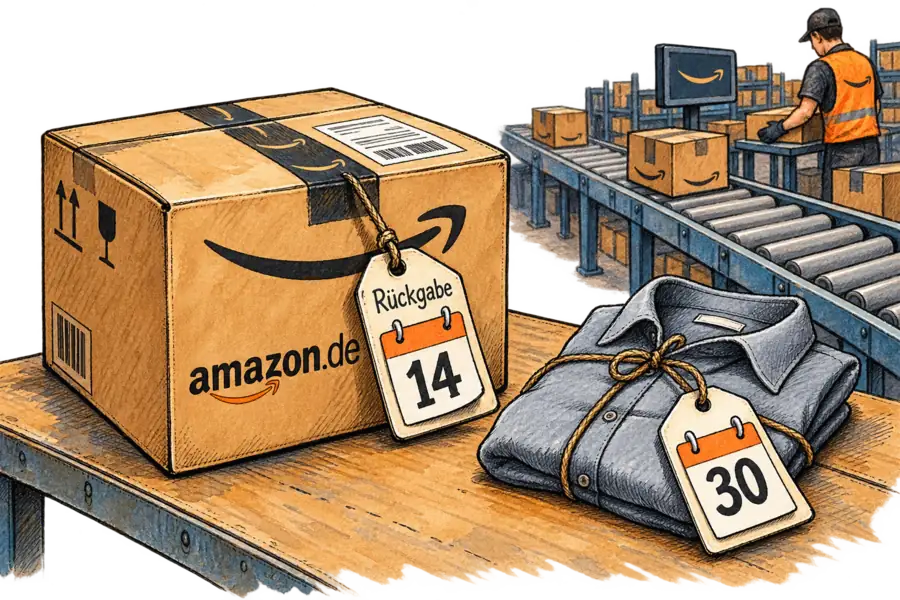
From 1 September Amazon's German marketplace drops its voluntary 30-day return guarantee to the statutory 14 days across sixteen categories, and exempts clothing, shoes, watches and jewellery. The line it drew is a fit diagnosis, and its own seller fee card draws exactly the same one.
Admiral Neritus Vale
From 1 September, Amazon’s German marketplace drops its voluntary 30-day return guarantee to the statutory 14-day withdrawal period across sixteen product categories, and clothing, shoes, watches and jewellery are not among them. TextilWirtschaft reported the change and the carve-out on 12 August; the seller-facing category lists ran at teltarif and the Händlerbund’s OnlinehändlerNews, and at teltarif. Furniture loses a fortnight, along with wine, pet supplies, luggage, luxury beauty, tyres and ten other groups. Anything delivered up to 1 October keeps the old thirty days, and after that the EU floor applies. Most of the exempt list resolves into one category — things a customer puts on their body. The remainder is Amazon’s own devices, Echo and Fire TV, and renewed products, walled off by a different logic: risk the company underwrites itself, not risk it hands to a fit decision.
Amazon exempted the categories where the return decision has nothing to do with time. A return window is a lever on deliberation, and it works by capping how long a customer may keep thinking. Pull it in furniture and you catch the buyer still measuring the hallway on day nineteen. In apparel there is nobody to catch: the trousers either fit or they do not, and the customer knows which within a minute of opening the bag. Amazon has stopped treating clothing returns as behaviour it can discipline and started treating them as a cost it has to carry.
Zalando ran the same experiment earlier and published the result. In January 2025 it cut its German return window from 100 days to 30, a reduction that would have been reckless if the long tail carried real volume. It did not, and Zalando said so: 90% of returns already arrived inside the first thirty days, as Business Insider Deutschland reported. A retailer gains from shortening a window only if returns are queueing at the back of it. In clothing they are not. Amazon’s carve-out and Zalando’s cut are the same finding read from opposite ends.
The harder evidence sits in Amazon’s fee card, where no shopper ever looks. Since June 2024 the company has charged sellers a returns processing fee on high-return-rate products across the catalogue, but only on units returned above a threshold set for each category, which Feedvisor’s current rate card puts as low as 2.9% in grocery. A threshold is a claim about what counts as normal. It says returns under the line are the price of trading, and returns above it are a fault in the listing, fixable by the seller and therefore billable to them. Apparel and shoes have no threshold at all; every return is charged from the first unit. Amazon operates two theories of the return, and it has filed clothing under the one with no baseline to beat.
Amazon holds enormous fit data on its own shoppers, and it has just written a policy that assumes none of it moves the base rate.
Amazon spent the preceding two years telling the market the opposite. Its size recommendation engine issues billions of suggestions a month on the company’s own account, and Amazon says customers are more likely to buy and to keep an item when a size has been recommended to them (About Amazon). On 31 January 2025 it retired Prime Try Before You Buy, the service that shipped members garments and charged only for what they kept. The stated reason was “increasing customer use of AI-powered features like virtual try-on and personalized size recommendations that help customers get the right fit”, as Retail Dive reported. Withdrawing the physical fitting room asserts that software substitutes for putting the clothes on, and nineteen months later the same company will not trim the apparel window by a fortnight. Both positions cannot be describing the same fit performance.

The strongest objection is that the carve-out is competitive rather than diagnostic. German online fashion has a floor set by Zalando at thirty days with free returns, so cutting Amazon’s apparel window to fourteen would surrender the checkout to a rival, and the exemption would then be telling you about market share and nothing about fit. For that reading to hold, Amazon would have to be sparing apparel only where a competitor enforces a longer floor, and only where customers can see the policy. The fee card is the test, and the objection fails it. Sellers see the returns processing fee and shoppers never do; no rival’s return policy is priced into it, and Amazon drew the same line anyway. It drew that line in a document written for its own margin, which is where a company stops posturing and starts forecasting.
German online fashion is where the cost of this decision lands. The EHI Retail Institute surveyed online retailers across Germany, Austria and Switzerland last summer and found that one textile seller in eight gets back more than half of everything it ships. That is the rate Amazon has now priced as permanent, and it is the rate fit-technology vendors have spent years promising to cut. Across the full sample, 7.3% of retailers use AI anywhere in returns management, which suggests the promise has not been bought on the ground either. The vendors have been selling a cure; the retailers have been budgeting for a chronic condition.
If fit is structural, the intervention point moves off the calendar and onto the garment. A KPMG study published in December 2025, run with EHI across 500 German shoppers, found 72.6% naming the wrong size among their reasons for sending something back, a shade behind quality defects. A corrected grading table, an honest fabric description and a photograph of the garment on a body resembling the buyer all act on that number. A return window does not. Amazon has not forecast that fit technology will fail; it has stopped underwriting the category against the chance that it works, and moved the exposure into fixed cost where it can be planned. Every other apparel retailer is now choosing between the same two things, and only one of them requires believing the deck.