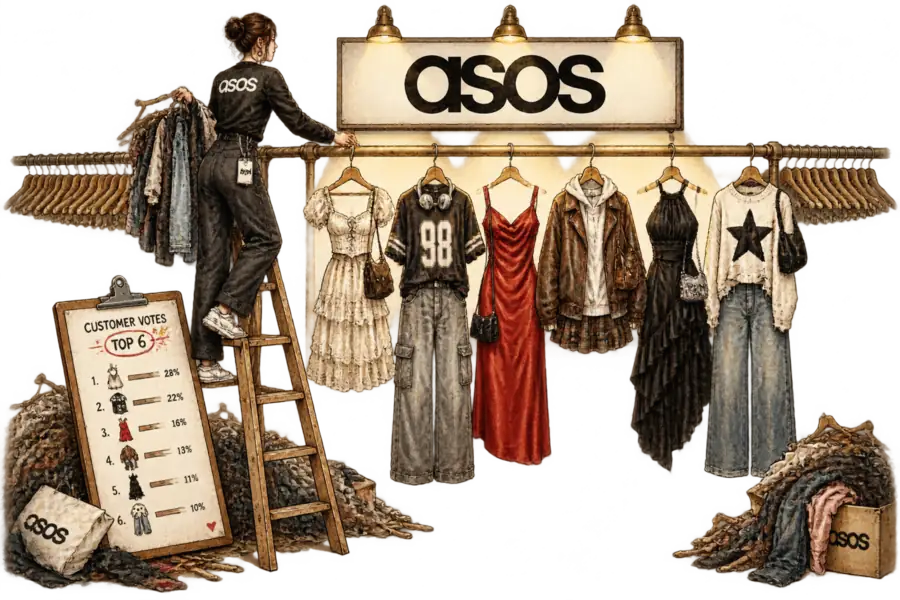
Asos Asked 1,952 Shoppers What They Wanted. The Answer Was Fewer Options.
Asos surveyed 1,952 UK shoppers and found 64 percent believe fashion offers too much choice and not enough guidance. Its own FY25 results describe the company's operating model as expanding the product range available on the platform.
Sir John Crabstone
Sixty-four percent of UK shoppers told Asos that fashion offers too much choice and not enough guidance. Asos has spent the past decade building machinery that does the opposite. Retrieval is the solved problem; editing is the contested one, and nobody has settled who pays for it.
The fieldwork is more damaging than the headline. Asos ran the survey with the polling platform Attest across July and August, sampling 1,952 UK consumers. Sixty-eight percent said knowing what to buy is easier than knowing how to wear it. A third had abandoned a purchase because they could not picture wearing it. Neither number describes a failure of search; the item was found, and the trouble began afterwards.
None of this is disinterested. The findings arrived eight days after Asos announced the relaunch of its magazine on Substack as a quarterly styling publication, and the campaign copy already quotes the same figures. A number that shows up in the marketing before the survey that produced it goes public has already left the realm of neutral evidence. It can still be true, and this set has the awkward distinction of being true against its sponsor.
Three months before the research appeared, Asos took the stylist it already ran in-app — alongside Virtual Try-On and Buy The Look — and put it inside ChatGPT. Its head of product described the app as bringing fashion discovery, styling advice and shoppable products into one conversation. The order of those nouns is the industry’s order of operations. Discovery gets built first because it can be measured, and styling gets the next round of investment once the funnel stops improving.
The narrowing already happened, on the balance sheet rather than the shop front. Asos ended FY25 with stock at around £400m, down about 60 percent from the £1.1bn it carried in FY22. Roughly a hundred new partner brands joined the platform in the same year, and the results statement describes its fulfilment models as “expanding the product range available on the ASOS platform”. It owns less and lists more, and has now published research complaining about the second half of that sentence.
Choice overwhelms nobody who already knows what they want.
The evidence for that comes from outside fashion. A meta-analysis of 99 observations covering 7,202 participants in the Journal of Consumer Psychology named preference uncertainty as one of four conditions governing whether a large assortment impedes choice. Overload tracks how clearly the chooser has articulated what they want, not the item count alone. Asos has surveyed exactly that population: shoppers who know what to buy and not what to do with it.
The trade read the finding as a mandate for stylist tools, which is the reading Asos paid for. Vanessa Spence, its EVP of brand and creative, frames the opportunity as helping people “feel like themselves”. That is a merchandising claim in a therapist’s vocabulary. What the survey implies is a buyer willing to say which of those hundred new brands should never have been listed.
Editing will be adopted because it costs the merchant nothing. Fifty-five percent of respondents had bought extra items to complete a look; 39 percent had bought clothes they rarely wore because they could not style them. One figure is revenue and the other is a return waiting to happen, and the stylist tool is sold on the first. A narrower display sits on top of a wider warehouse without disturbing it. What is offered as restraint is a presentation layer.
The shop will show fewer things without stocking fewer things. Editing done on the way to the screen can be withdrawn on a slow Tuesday, and no buyer will have to defend the reversal. Asos now knows what its customers want. It has not yet been asked to give anything up.