Barbour Priced a Store Refresh at Four Hours
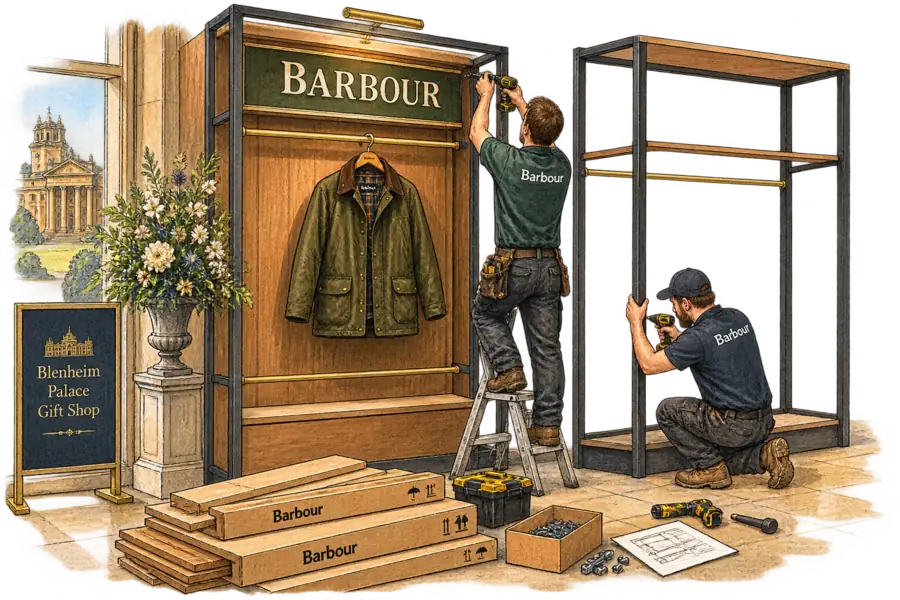
Barbour is the first brand to install ReFrame, a modular display system a two-person team can put up in one to four hours. The constraint on changing a store was never the idea; it was the fixture bill.
Sir John Crabstone
A shop changes at the speed of its fixture bill. Barbour is the first brand to install ReFrame, a modular display system built by the British design firm Ripple. Put two people on it and the fixture stops being the constraint, which is the whole argument.
The debut is not a flagship. The system went into Blenheim Palace, which Historic Houses counted at 980,678 visits in 2025, as a dedicated Barbour area inside the attraction’s existing shop. Concessions typically work this way: the brand owns the fixture, the host keeps the floor. Fixture spending is hardest to justify where you do not control the lease, which is exactly where a system that comes apart proves itself.
The framework stays fixed while shelves, rails, tables and light boxes move against it. FashionUnited puts the install at one to four hours for a two-person team, after three years of development. The bottleneck it addresses was never analytical. Retailers can already cut an assortment by store, week and weather; a wall built for four bays of outerwear holds four bays of outerwear until someone signs for a new one.
Ripple’s managing director, David Wolfenden, told Retail Technology Innovation Hub that retailers “are refreshing stores more frequently than ever before, but many are still replacing perfectly good fixtures every time layouts change.” He is right, and he undersells the point. That is not a waste problem — it is a permissions problem. A refit large enough to need capital approval hands the merchandising calendar to the finance director.
Every retailer now knows more about its customer than its walls will let it say.
Tenure makes the case sharper, though the trend behind the number cuts the other way. Re-Leased’s 2024 review of more than 95,000 UK commercial leases put the average retail lease at 49 months by the first quarter of that year, up from 37 a year earlier — landlords easing terms to fill space, not tenants winning shorter ones. Four years, near enough, is still short measured against how long a fixture scheme is meant to last.
Short tenure has already changed what gets built. Inditex has been rehearsing brand-specific formats on short-dated leases rather than committing to megastore footprints. Short leases only work if the fixtures can leave with you.
Barbour can afford refits. Turnover reached £350.8m in the year to April 2025, up 9%, with operating profit ahead 14.1%, as TheIndustry.fashion reported. What was scarce was never the capital. It was any appetite for committing it to a floor plan that might be wrong by Christmas.
Ripple sells the economy of it, promising a system that “pays for itself across the life of your retail programme”. True, and the smaller claim. The larger one is that refresh rate stops being a property decision and becomes a merchandising variable; that is the precondition for data-led assortment reaching a shop floor at all. Retailers have spent a decade buying software that tells them what to sell next week. Most of them still have walls that answer in five years.