Bare Nails Aren't a Trend. They're a Spending Report.
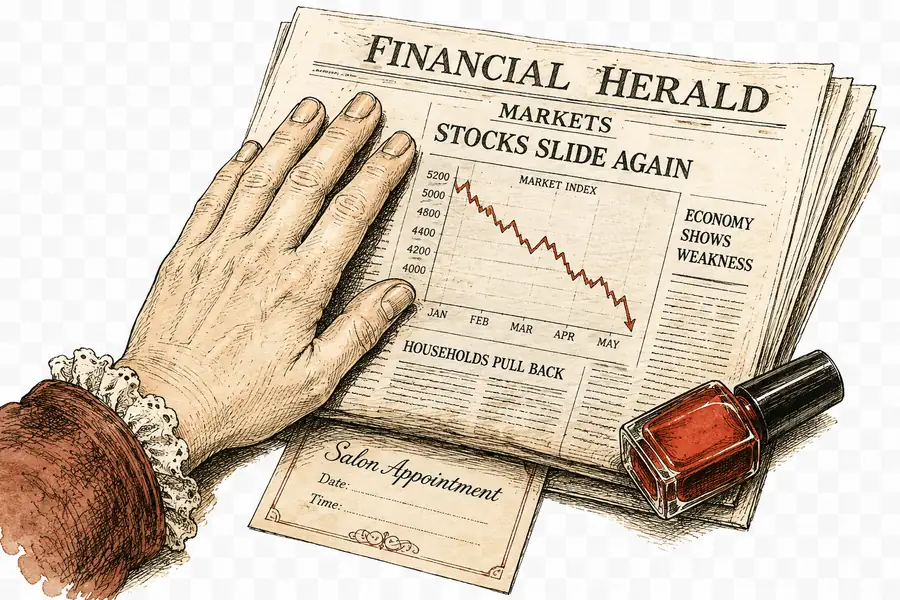
The swing from elaborate manicures to bare nails is being read as taste. It is closer to a spending signal: discretionary beauty trading down, visible in the salon chair a quarter before it reaches the data.
Sir John Crabstone
The bare nail is being sold to us as taste. It reads more honestly as a budget. The swing from the sculptured manicure to the naked one is discretionary beauty trading down, and it shows in the chair long before it shows in a quarterly report.
The aesthetic case is not empty. Glossy reports the counter-signaling case: a gel manicure “can hide a multitude of sins,” so the rarer status is to need none. The very rich can afford to look as though they have stopped trying, and the look is spreading fast — Spate data cited in that reporting put nude-nail interest up 53 per cent in a single quarter. But counter-signaling explains a few thousand women, then is borrowed as cover by the millions beneath them.
The instinct is to reach for the lipstick index, Leonard Lauder’s claim that lipstick sales climb when money tightens, the cheap treat outliving the dear one. The index never reliably held. Lipstick fell in 2008. It also measured the wrong thing. Lipstick is the small indulgence a shopper adds in a slump; the manicure is the standing cost she cancels, and a cancelled habit says more than a kept one.
What the aesthetic reading skips is the arithmetic of frequency. A winter coat is bought once a year; a manicure recurs every three weeks, which makes it the first cost a careful household stretches. A TD Bank survey, reported by the Globe and Mail, found two-thirds of Canadians planned to cut spending this year, up from 51 per cent. A Toronto salon owner watches clients push a three-week appointment to four and choose sheer shades that, as one shopper put it, “from afar, they don’t look too bad.” The look follows the budget, not the other way round.
That we can read it at all is a matter of visibility. A manicure is worn in public, where restraint cannot be hidden; a cancelled holiday and a postponed sofa leave no such mark on a person. The bare nail is the rare austerity measure the neighbours can see.
By the time a downturn reaches the spreadsheets, it has already reached the cuticle.
The aggregate is catching up. Circana put 2025 mass beauty growth ahead of prestige, 5 per cent to 4, with mass fragrance climbing 15 against prestige fragrance’s 5 — the move of a buyer reaching for the cheaper version of the same scent. The bare nail is that trade in miniature.
None of this is new in kind. We noted last month that the anxious shopper rearranged her cart rather than emptying it. The bare nail is where that rearrangement becomes visible. The test of the reading is reversibility: a forced thrift unwinds when incomes recover; a real taste does not. Watch whether the long manicure returns with the next good quarter.
The economists will name the downturn when the figures clear. By then the manicurists will have called it a quarter early, for the price of a four-week wait.