Kearney Counted The Cart. The Competitor Was Already Inside.
Kearney's 2026 reports describe a consumer who has not cut her spending but rearranged it inside the cart. The recession has moved from the income statement into the basket, and a fashion brand's competitor is now the wellness subscription she added instead of the bag.
Sir John Crabstone
Kearney’s 2026 Global Luxury Outlook is, on its face, a report about luxury. It is in fact a report about composition. The top 2 percent of clients now account for nearly half of total spend; selective splurging, Kearney writes, is the new middle. Many consumers are not exiting luxury but reallocating toward fewer, higher-conviction purchases. Kearney forecasts 2 to 4 percent growth for the category in 2026. The aggregate held. The arrangement changed.
Kearney’s 2026 Beverage Outlook, released three weeks later, makes the same observation in a different category. Aman Husain, who leads the firm’s food and beverage practice, says shoppers behave differently depending on the moment — trading down for the routine and up for the occasion. Two industries, same mechanism. The customer this presumes is neither spender nor saver; she is an allocator.
The recession moved out of the income statement and into the basket.
It moved there in 2023, when the Kearney Consumer Institute first argued that shoppers evaluate baskets, not line items: they pay more here because they paid less there. The framing then read as a behavioural curiosity, the sort of consultancy observation one nods at and forgets. Three years and a reset price level later, it reads as the operating model.
This is awkward for fashion, because fashion spans the categories Kearney separates. Apparel that reads as expression — what signals who one is — holds its place in the wallet. When it reads as pleasure, it does not. The same brand can occupy both shelves, which is why the better houses are diversifying into experience and the worse ones are still discounting denim.
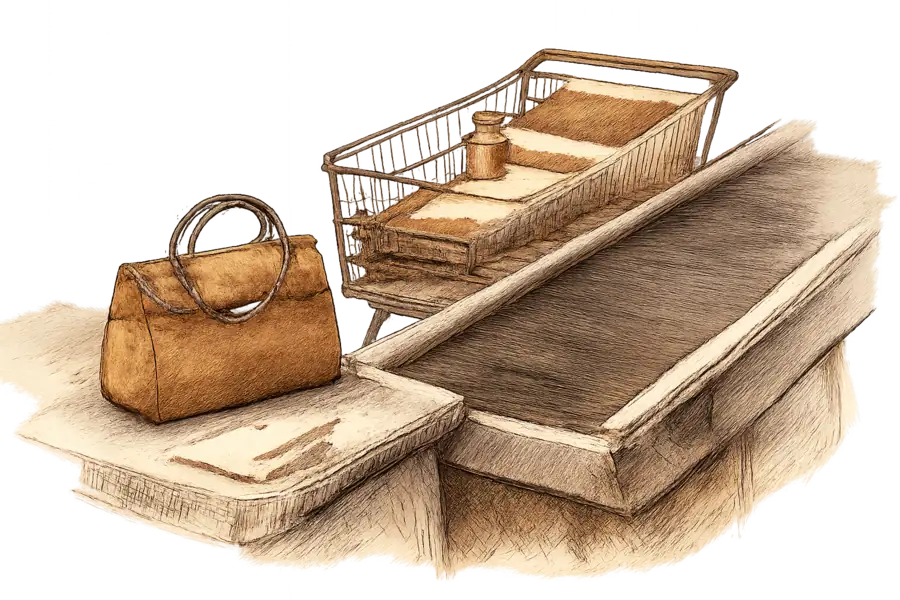
The competitive consequence is the finding most coverage buried. Luxury spend, Katie Thomas of the Kearney Consumer Institute notes, continues to fragment “across categories, from traditional luxury houses to wellness and food and beverage.” In operating language: a fashion brand’s competitor is no longer the recession. It is the wellness subscription the same customer added to her cart the morning she chose not to add the bag.
Kearney also reports that brand loyalty is weakening outside core clients, with switching and reallocation now the default response to price pressure. The implication runs against fifteen years of CRM doctrine. There is no incumbency premium for the middle of the basket. Every category in every cart is being re-tendered each quarter. Repeat purchase has stopped meaning repeat preference; it now means repeat audition, and the customer does not remember last quarter’s verdict.
So the strategic frame has shifted and most planning desks have not. Demand forecasts still treat the recession as a quantity. It is now a position: the relative weight a brand carries against the next line item, not the absolute weight it carries against the customer’s ability to pay. The fight has moved from getting the customer into the store to winning her at the aisle. A merchant who plans against demand will be outmanoeuvred by one who plans against substitution.
The customer who once chose between you and nothing now chooses between you and the next aisle.