Bloomingdale's Found the Luxury Shopper Everyone Else Reported Missing
Bloomingdale's comped 11.3 percent in the quarter ended 1 August while the brands on its floors described flat demand. Read against Bain's finding that monobrand selling space is shrinking, that gap describes a distribution failure rather than a missing customer.
Admiral Neritus Vale
Bloomingdale’s comparable sales rose 11.3 percent in the quarter ended 1 August, which management called the highest second-quarter volume in the brand’s 154-year history. In the same quarter, Kering’s CEO told investors the market remained “uneven and demanding,” with demand growing more selective — a house describing softness without using the word. Both statements are true. The industry has misfiled its own diagnosis: the customer did not leave the category, the category’s doors left the customer.
The number that disqualifies the demand explanation sits in the same release. Macy’s Inc. reported Bloomingdale’s alongside a 1.1 percent comparable gain at the Macy’s nameplate, which removes a broad American consumer recovery from the list of candidate causes. Same company, same country, same quarter, and 10.2 percentage points between the two floors. Whatever lifted the luxury and premium banner was not available to the mid-market one. Appetite at the top of a market does not reorganise itself in ninety days; access does.
Bain and Altagamma supplied the demand-side story and, in the same document, the evidence against it. Their November 2025 study counted the global luxury consumer base 60 million people below its 2022 level, and the sector has quoted that contraction ever since as proof the aspirational buyer walked away. Bain’s own report calls this a pullback, not a departure, and the two are not the same failure: a pullback from price still leaves an appetite that a wider assortment can catch, while a pullback from access means the customer was never shown the door. Further down the same release is a line almost nobody repeated: monobrand stores shed 25,000 square metres of selling surface in six months. Counting fewer buyers after closing the places they bought in is not a finding about appetite. It is a receipt.
A monobrand boutique is one brand wide — when it lifts entry prices, the customer has nowhere to move inside the store except out of it.
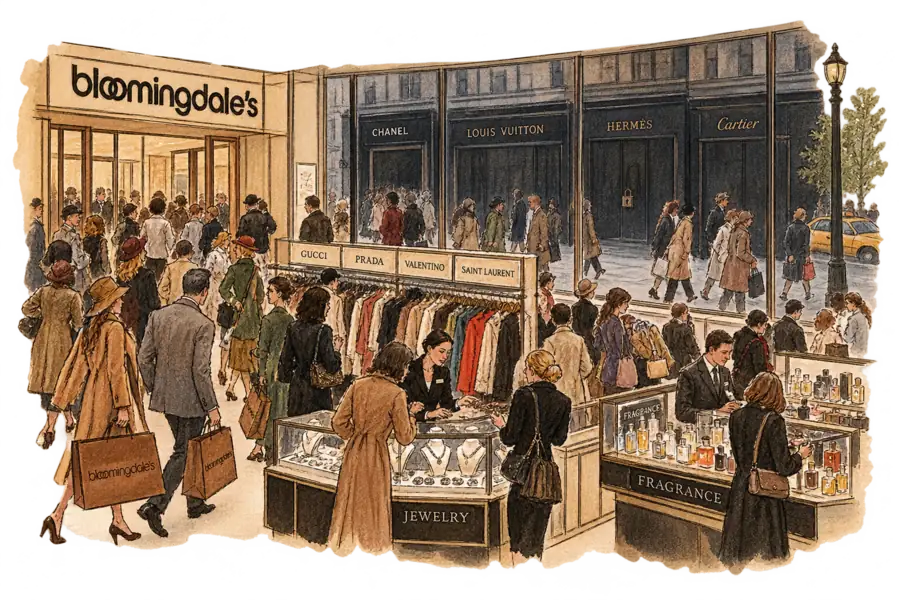
Bloomingdale’s widened its reach in the same period its sector withdrew, with US department stores cutting about 10 percent of their space since 2024 on Bain’s count. On the earnings call, management said the quarter brought Ulla Johnson, Proenza Schouler and Dries Van Noten onto the floor and expanded distribution of Chanel fine jewellery, Christian Louboutin and Prada footwear. Brands that believe the buyer has gone do not add wholesale doors. Growth arrived in ready-to-wear, menswear, fine jewellery, fragrance and tabletop at once, and that combination is the tell. Fragrance is an entry-price category and fine jewellery is not; a floor growing both in one quarter has a customer moving along its price ladder rather than stepping off it. Glossy’s luxury briefing named the mechanism: a dual premium-and-luxury assortment lets a shopper cross price points without leaving the building.
Reach is not only assortment, and the rest of the quarter is a list of ways to be findable. Bloomingdale’s ran events across the majority of its stores, expanded the client programme aimed at its highest-spending customers, and put an AI conversational shopping assistant on its digital channel. Each is a mechanism for placing a specific product in front of a specific person, which is work a monobrand boutique performs only for people who have already chosen the brand. The department store gets to make the recommendation before the brand is chosen, and that position used to be worth a wholesale margin. It is now worth a double-digit comp. We argued in April that the luxury flagship had turned its queue into a media placement the house subsidises; Bloomingdale’s is being paid for the selling floor the flagship stopped running.
The strongest objection is that this is inheritance rather than reach. Saks Global entered Chapter 11 in January and shed roughly a hundred stores before re-emerging as Exemplar Luxury Group, and displaced volume has to land somewhere. Grant the objection its full weight and it arrives at the same conclusion. Those shoppers had other doors available, because Chanel, Prada and Louboutin all run their own American stores and their own websites, and none of them closed. LVMH’s fashion and leather goods division managed 1 percent organic growth in the second quarter, and that was with what the group called “a rapid acceleration in the United States.” A buyer who walks out of a shuttered Saks, past the boutique and into a multibrand floor has said something precise about what the boutique is currently able to do.
What happens next depends on whether the houses read their own numbers as a verdict or as a receipt. If monobrand surface keeps contracting while multibrand floors that widen assortment keep compounding, wholesale stops being the channel luxury spent a decade demoting and becomes the one that sets its growth rate. What moves with it is worth more than the volume. Whoever decides whether a shopper can cross price points without leaving the building also decides whether the trade-down lands inside the brand’s range or outside it. Bain puts active luxury shoppers at 40 to 45 percent of the total addressable base this year, against roughly 60 percent in 2022, which describes dormancy rather than departure. A dormant customer is still an addressable one, and the distance between them and a till is set by the house, not by the cycle.