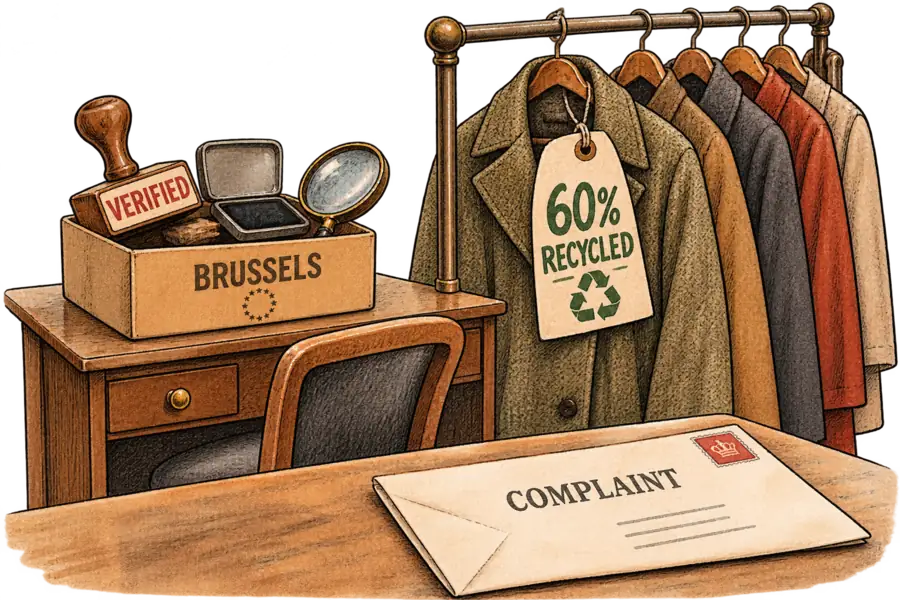
Brussels Moves to Drop the Green-Claims Verifier, So Proof Waits Until Someone Asks
The Commission's 2027 work programme slates the Green Claims Directive for withdrawal, which would end the plan for accredited verifiers to examine environmental claims before publication. Brands still owe proof of a specific claim; nobody inspects it until a regulator, consumer group or court asks.
Sir John Crabstone
The Commission intends to move the examination of a specific green claim on a European product page to the far side of publication, where it mostly happens after somebody asks. Its 2027 work programme, published on 4 November, lists the Green Claims Directive among the pending proposals it plans to withdraw within six months. The proposal stays formally pending until that happens, but it would have put the examiner first.
The annex blames the Council. Presidency efforts in 2025 “did not succeed”, it says, and the Council “failed to agree on a negotiating mandate in June 2024”.
That statement does not match the record. The Council adopted its negotiating position on 17 June 2024, Linklaters noted.
The position was undercut a year later. The Commission had announced its intention to withdraw the proposal when “the Italian government pulled its backing for the Council’s mandate”, EUWID reported. The annex that lists the withdrawal contains a claim a verifier would have struck.
Under the proposal, firms would have weighed impacts “from a life-cycle perspective” and submitted claims to “independent third-party verification”, Loyens & Loeff summarise. The directive that remains, EmpCo, “does not prescribe a specific methodology”. For now each brand picks its method; a regulator or court may grade it later.
EmpCo polices the adjectives. It bars a bare “eco-friendly” unless it rests on recognised excellent environmental performance, such as the EU Ecolabel, as we reported.
Since 27 September it has also required outside checks for labels and for pledges. Sustainability labels need a certification scheme or public authority behind them, and a pledge about future performance needs a plan “regularly verified by an independent third party expert”, the directive says. A sentence about a garment’s recycled fibre needs neither.
Marwa Zamaray of the consultancy Eco-Age told WWD that EmpCo lacks “a shared standard of proof”. Without one, every claim “becomes a legal judgement call, made by each brand alone and tested only once it’s in market”. Investment in traceability, Zamaray added, “gets harder to justify in the boardroom”.
One campaigner sees a transfer. The withdrawal, Nusa Urbancic of the Changing Markets Foundation told WWD, puts “the burden onto consumers, who now have to substantiate those claims themselves”.
Urbancic is half right. The Commission’s 2021 guidance puts “the burden of proof” on the trader, owed to enforcers “if the claim is challenged”, with “no equivalent obligation” to document it for consumers. The shopper is spared the proof, though EmpCo does require findings on pledge plans to be “made available to consumers”.
Withdrawal would leave the duty to hold proof in place and cancel the appointment to show it first.
The textile passport will not obviously fill the gap. The Commission’s textile page pencils in the delegated act for late 2027 and lists possible fields such as fibre composition, repair information and origin. On that outline, the passport carries the data the act requires; it does not check the claims a brand volunteers.
One vendor adjusted early. Carbonfact, which measures product-level environmental impact for fashion brands, calls itself in its Green Claims guide “your partner in a post-Green Claims market”. In that market nobody inspects an assessment before publication. It is evidence kept for a complaint.
A specific claim that looks right may never be checked by anyone.