The Chatbot Doesn't Need to Sell the Dress
David's Bridal started selling dresses through ChatGPT, but the conversion rate is beside the point. High-consideration bridal commerce adopts AI chat first because every unconverted conversation generates preference data the retailer can monetize.
Neritus Vale
David’s Bridal started selling wedding dresses through ChatGPT and Microsoft Copilot this week via Shopify’s Agentic Storefront integration, which surfaces its catalogue inside an AI conversation and routes purchases through the merchant’s own store. Ninety per cent of brides still prefer a physical store. That mismatch is the strategy. High-consideration verticals like bridal are adopting conversational AI commerce first because guided selling maps naturally onto chat. Every conversation generates preference data that funds a business whether or not the chatbot closes the sale.
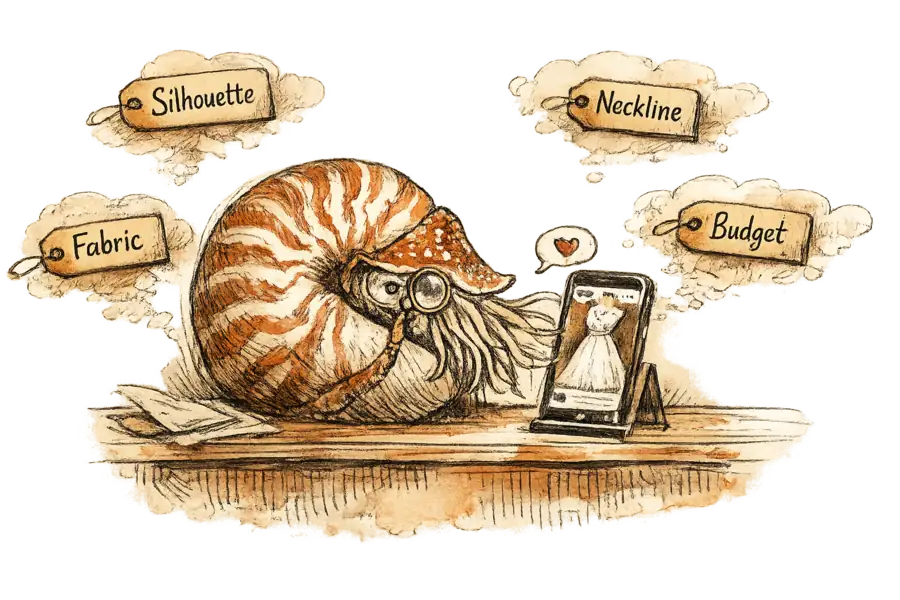
Bridal buying has a long research phase before the first store visit — weeks of unstructured browsing between a bride’s first Pinterest save and her first fitting appointment. Those weeks are filled with consultative questions about silhouette, neckline, fabric, and budget. Every one of those questions is a natural-language prompt. A chatbot that narrows a catalogue by five attributes in thirty seconds replicates the work a bridal stylist does in a first consultation. The interface maps to the buying process because the buying process was already conversational.
Shoppers arriving via LLM referral converted at 9.84 per cent when they engaged with on-site AI, against a 2.47 per cent baseline when they did not — a four-fold lift, according to Alhena’s 2026 State of AI Commerce report. Alhena sells the software being measured; its figures describe performance on its own platform, not the market broadly. That lift is not uniform: it scales with how consultative the category is. Beauty, where product questions are specific and answerable, leads at 5.36 per cent; fashion, where discovery is more visual, trails at 2.4 per cent. Bridal was not broken out, and the absence is revealing. The category combines beauty’s specificity with luxury’s deliberation timeline. The more answerable the shopper’s questions, the higher the conversion — and few shoppers arrive with more precise questions than a bride filtering by silhouette, sleeve, and train length.
The infrastructure beneath this experiment is commodity. Shopify’s Agentic Storefronts have opened a direct channel between its merchant base and ChatGPT users, making a bridal retailer’s catalogue one product-data audit away from appearing inside an AI conversation. David’s Bridal is among the retailers now on that platform. The barrier to entry is taxonomic — whether your silhouettes, necklines, and fabrics are structured for machine readability.
Every conversation that does not end in a sale still ends in data.
David’s Bridal claims roughly 90 per cent of U.S. brides touch its platform at some point during planning, a first-party data position no competitor can replicate. Its “Aisle to Algorithm” strategy, launched in March 2025, rebrands the company as a technology and media platform. The Pearl Media Network sells wedding vendors targeted access to engaged consumers. CEO Kelly Cook told Retail Dive that the company sees “a structural shift in how consumers discover and buy.” Adding ChatGPT as a channel multiplies the surface area for structured preference capture: every query about a mermaid hem or a sweetheart neckline is a labelled data point. The product attribute audit David’s Bridal ran to prepare its catalogue for AI is an investment in discoverability, and discoverability pays whether or not it converts.
What makes bridal data unusually valuable is the purchase graph behind the dress. A bride who discusses a mermaid silhouette today will need shoes, accessories, and bridesmaids’ dresses within months. David’s Bridal knows this: 62 per cent of female wedding guests buy new attire for the event. A single chatbot conversation about gown preferences can anchor a profile that follows the couple across an entire wedding’s worth of downstream purchases. Pearl Media Network monetizes that profile to vendors who want to reach consumers whose tastes are already known, and the longer the planning cycle, the more that knowledge compounds.
The strongest objection is that bridal commerce is irreducibly physical. A bride does not buy a fabric swatch; she buys the way a dress makes her feel when she turns in front of a mirror with her mother watching. If the emotional weight of the purchase resists compression into a chat window, the data-capture thesis fails, because brides will skip the chatbot and walk into the store cold. The Knot’s 2026 data offers a partial answer: AI adoption among engaged couples nearly doubled year over year to 36 per cent, concentrated in functional tasks such as writing timelines and answering etiquette questions, though couples also draw on AI for attire and décor inspiration. The chatbot captures the months of research that precede the fitting-room moment — and those months are where the commercially useful data lives.
Bridal is the test case for a pattern that will repeat across high-consideration verticals where the purchase cycle runs long and the questions are specific. If the model works here, jewellery, luxury furniture, and custom suiting will follow. The metric that matters is cost per structured preference signal. In a category where customers voluntarily spend months telling you what they want, that cost approaches zero.