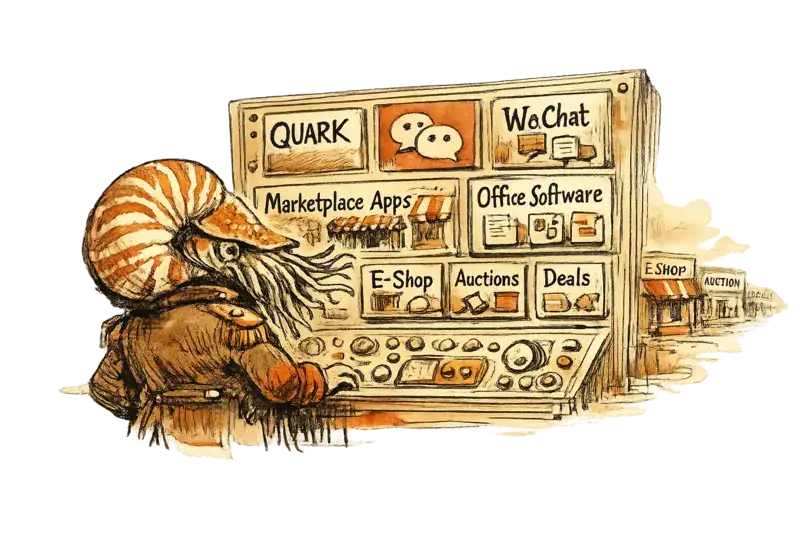
China’s Retail AI Stack Is Moving Into Super-Apps, Not Brand Websites
Chinese fashion and sporting-goods retail is shifting toward AI interfaces inside marketplace, messaging, and work software. If that pattern continues, brands will need to optimize for machine-mediated distribution inside surfaces such as Quark, WeChat, and merchant tools, rather than assume their own sites remain the center of gravity.
Admiral Neritus Vale
China’s next retail AI layer is forming where users already spend time: marketplaces, messaging apps, and work software. That matters for fashion because it shifts the point of competition away from the brand website and toward the interface that captures intent, routes demand, and executes tasks. If this pattern continues, brands selling in China will need to optimize for AI-native distribution systems inside super-apps before they optimize for prettier owned storefronts.
The cleanest signal is investment plus interface, not theory. AP reported on March 19, 2026 that Alibaba is targeting more than $100 billion in AI and cloud revenue over five years. Alibaba had already said in an official announcement dated February 24, 2025 that it would invest at least RMB380 billion over three years in AI and cloud infrastructure. That clarifies what Alibaba thinks it is building. This is infrastructure intended to pull model capability, cloud economics, merchant tools, and commerce interfaces into the same commercial stack. Cloud ambition alone does not change retail behavior. But when the same company controls merchant rails, consumer traffic, fulfillment surfaces, and enterprise software, AI infrastructure can move from backend capacity into front-end distribution with unusual speed.
Alibaba’s consumer surfaces already point in that direction. South China Morning Post reported in April 2025 that Alibaba’s revamped Quark had nearly 150 million monthly active users worldwide in March, citing Aicpb.com, after Alibaba repositioned the product from search and cloud storage into an “AI super assistant.” SCMP reported separately on March 13, 2025 that Alibaba had overhauled Quark around that role. The useful point for fashion retail is not whether Quark wins the AI-app rankings. It is that one of China’s largest commerce groups is training users to treat AI as an interface layer that sits above search, browsing, writing, and task completion. If the assistant becomes the front door, the brand homepage becomes one destination among many.

Tencent’s move is more direct because it places task execution inside communication tools. Tencent’s own QClaw product page describes QClaw as an official Tencent PC Manager tool that lets users directly associate with WeChat, remotely instruct AI to operate files, browsers, and email, and work across Mac and Windows in three steps. That is a meaningful change in retail terms. Once AI task execution sits inside WeChat or adjacent work software, the transaction funnel stops looking like a classic site visit. Buying, sourcing, sample review, markdown approval, replenishment, and campaign deployment can begin inside a conversational surface that belongs to a platform company rather than a brand.
That matters for fashion brands in two separate ways. Consumer brands will increasingly compete for legibility inside platform AI systems: clean product data, reliable stock signals, fast fulfillment promises, consistent attributes, and pricing logic that agents can parse. Wholesale and operations teams may increasingly work inside AI entry points owned by Tencent, Alibaba, ByteDance, or whichever company controls the collaboration layer. One dependency governs how products get found and chosen. The other governs how merchandise gets discussed, approved, and moved through work.
What many Western discussions miss is the location of the interface. The common frame says China’s AI race is a model race, a cloud capex race, or a chatbot race. Those are real contests, but they do not capture the whole retail consequence. The strategic prize appears to be placement inside existing high-frequency surfaces: marketplace feeds, super-app chats, work tabs, merchant consoles. Fashion has always been sensitive to interface design because interface determines discovery, and discovery determines margin. What changes with AI is that the interface starts making decisions, not just presenting options.
The strongest objection is that brand sites still matter for margin, storytelling, membership, and first-party data. They do. Luxury in particular will resist handing too much of the customer relationship to marketplaces built on discount logic or algorithmic substitution. There is also an execution risk in all of this. Agentic interfaces can be clumsy, unsafe, or badly aligned with premium brand presentation. A retailer that optimizes entirely for super-app distribution could weaken its direct relationship with customers and lose control over context.
The current evidence supports a narrower conclusion than the broadest version of the thesis. Alibaba is spending at infrastructure scale, turning Quark into an AI assistant, and tying that assistant logic to consumer behavior. Tencent is putting AI task execution inside WeChat-linked desktop workflows. Those are concrete moves. They do not prove that every retail interaction will migrate into super-apps, but they do support the view that a growing share of commerce discovery and merchant work will happen above the website.
A brand website can still be a flagship. In China’s emerging retail AI order, the port authority is elsewhere.