Debenhams Put the Marketplace and the Model Under One CTO
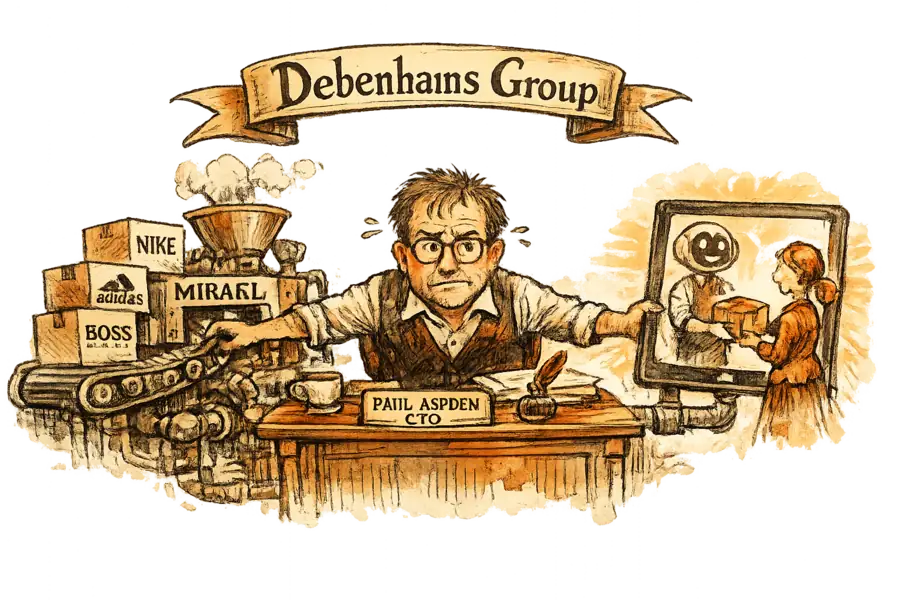
Debenhams Group has placed 'marketplace technology and AI innovation' under one CTO, a role that did not exist two years ago. The promotion now forces senior engineering hires to own both Mirakl plumbing and the model layer that recommends from it.
Sir John Crabstone
Debenhams Group promoted Paul Aspden to Chief Technology Officer on 20 April, with a mandate to scale “marketplace technology and AI innovation” as a single remit. Two years ago that sentence would have been two jobs. Chief executive Dan Finley wrote it as one.
Aspden’s background is the clue. Before Debenhams, he ran technology at JD Sports and at One iota, the retail plumber behind Superdry and Blacks, whose whole business was reconciling physical inventory with the web. That is the skill the marketplace model rewards: moving third-party catalogues onto a shared checkout without breaking either. Debenhams Group now runs its brand partners on Mirakl; how fast a new brand can list is how fast the group grows.
Aspden will also push Peak AI deeper into pricing, merchandising and inventory, and extend a PayPal partnership that routes AI-driven discovery through the PayPal app itself. He will oversee the AI Skills Academy the group built with Multiverse to train its own staff. That half of the mandate did not exist two years ago. A single senior engineering hire is now expected to own both the catalogue plumbing and the model layer that recommends from its shelves.
The numbers explain the promotion. Full-year adjusted EBITDA rose 36 percent to £53 million; second-half EBITDA grew 76 percent. The marketplace turned the business. Promoting the man who built it is correct; asking him to also steer the discovery surfaces that feed it is a different matter.
A CTO who understands Mirakl webhooks well enough to scale them, and OpenAI tool-use schemas well enough to plug the same catalogue into ChatGPT, is presently a population of roughly no one.
The industry has decided not to wait. John Lewis is routing its catalogue into Google Gemini and ChatGPT via Commercetools’ agentic layer, under a separate £800 million transformation budget.
Clarks turned itself into a marketplace on 16 April with a hundred third-party brands on day one. Every British retail board is now asking whether the two stacks should share an owner.
The risk is obvious. Marketplace engineering is the discipline of contracts with strangers, and it breaks in the boring ways: returns, VAT, settlement. Agentic commerce breaks in the interesting ways: a language model recommending an out-of-stock third-party SKU at a price the merchant never set. The failure modes do not resemble one another. Owning both means focusing on neither.
The honest reading is that Debenhams Group has noticed the two stacks touch the same data, and decided one person should own the overlap. It is a defensible structure while the catalogue is small enough for one engineer to hold in his head. It will not survive its own success; the first retailer whose agent quotes a price the marketplace cannot honour will split the role back into two.
Aspden’s promotion is less a job description than a wager on how long a single title can hold both halves of the stack together. The answer is probably longer than the sceptics think, and shorter than the board’s org chart assumes.