Five Models Were Asked Where to Shop. Alibaba Owns Second and Fourth.
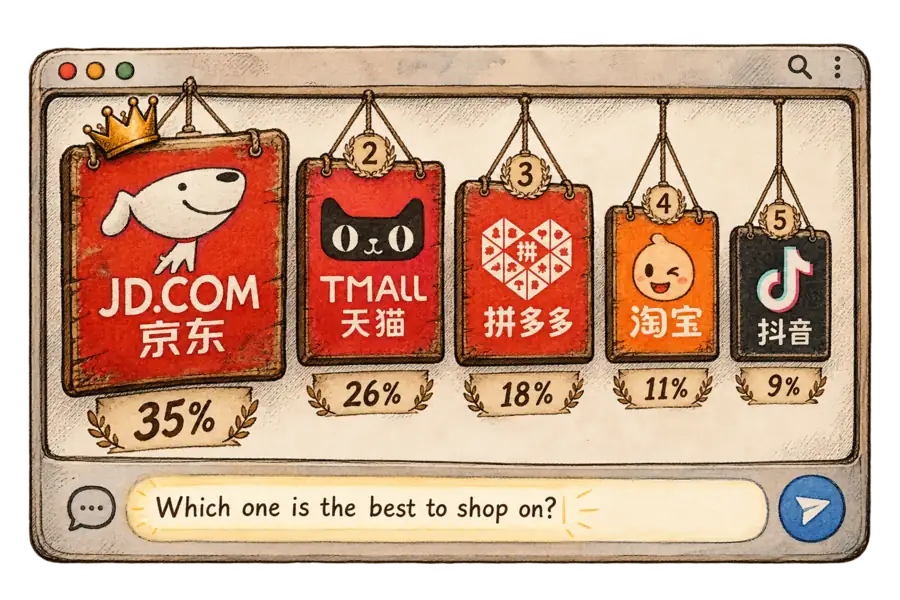
A Beijing think tank scored 16 Chinese marketplaces on how often five large models name them in shopping answers. JD.com leads at 92.42 per cent and Taobao sits fourth at 52.15, more than thirty points behind Tmall, which Alibaba also owns.
Sir John Crabstone
Five Chinese models were asked 150 shopping questions, and somebody kept score. Who Do the Large Models Recommend?, published on 20 August by Beijing’s Fourth Wave technology think tank, ranks 16 marketplaces by how often an AI answer names them. JD.com leads at 92.42 per cent; Taobao is fourth, at 52.15. The argument about AI visibility has been settled the way retail settles arguments, with a table.
Second place went to Tmall at 83.66 per cent, third to Pinduoduo at 69.39. Tmall and Taobao are businesses of one company, and the models put more than thirty points between them. They were not ranking companies. They were ranking names.
Alibaba’s Qwen was one of the five models under test, and Taobao still finished two places behind itself.
Fourth Wave ran the work with the Zhongguancun Tiancheng Innovation Research Center, using an agent of its own called DeepBrand against Doubao, Qwen, Yuanbao, DeepSeek and Ernie. The report grants that some models lean toward brands inside their own ecosystem. It also finds JD.com and Tmall holding the top two mention rates in all five. Home advantage, where it exists, moved nothing.
Below the leading five the table drops away, with Vipshop, Suning and Kuaishou’s commerce arm well off the pace. The report’s own reading is that comprehensive marketplaces score high, while instant-retail and fresh platforms score low outside the narrow questions they were built for. The instrument deserves the same scrutiny as the result: a mention rate scores the question list as much as the brand.
Being named often is not the same as being named well. Positive sentiment runs at 82 per cent for JD.com and 64 per cent for Taobao, with Tmall at 76 and Pinduoduo at 68, in the release as carried by NetEase. Taobao is mentioned less and described worse. Fourth place is the flattering half of the result.
The breakdown underneath that sentiment is where the mechanism sits. JD.com’s positives gather around self-operated logistics, after-sales returns and high-end brand coverage; Pinduoduo’s around low prices, its Billions Subsidy campaign and refunds. Their negatives gather in the same place as each other: third-party store service for JD.com, and white-label goods, unauthorised sellers and large-item after-sales for Pinduoduo. Both liabilities are the open-marketplace layer, the stock the operator never owned. Taobao is almost entirely that layer.
Each of those positives is a proposition a model can restate in one clause. Breadth is not, and breadth is what Taobao sells. The report closes by urging brands to build structured corpora, and a written archive is indeed the input retailers already hold, as we set out this morning. Taobao does not lack text. It lacks a sentence.
Western retail measures this too, and measures a different object. 5W’s Beauty AI Visibility Index ranks brands by citation share. Sephora slips in at third; Estée Lauder came eighteenth under its own name in July. Beijing has published the other table: the intermediaries alone, tiered and given a sentiment column. The shelf has been put on a shelf.
The platforms are answering in the only direction open to them. JD.com shipped App 16.0 on 9 September with a shopping assistant called Dongdong. Dahe Caili Fang counts six major Chinese marketplaces embedding AI shopping this year, and reads the rush as a defence against large models seizing the “consumption entry point.” Each is building the assistant it controls. Taobao can build the best one in China and still come fourth in everyone else’s.