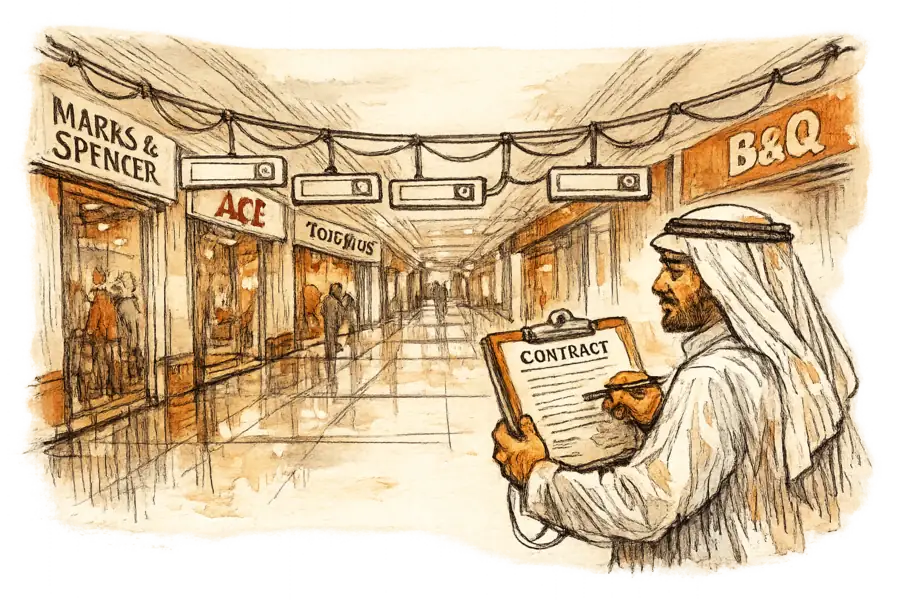
The Franchisee Picked the Search Engine
Al-Futtaim standardised eight of its retail e-commerce sites on a single AI search platform, setting how Marks & Spencer, ACE and five other licensed names are found across the Gulf. The brands that own those names were not in the room.
Sir John Crabstone
Marks & Spencer did not choose the search engine on its Gulf website. Its franchise operator did, and picked the same one for seven other storefronts. Al-Futtaim standardised eight retail e-commerce sites on Algolia, among them M&S, ACE, Toys “R” Us, Watsons and B&Q. In the Gulf, how a brand gets found is a term in somebody else’s contract.
The estate explains the logic. Al-Futtaim’s retail division carries more than 30 brands across 800-plus stores in 15 countries, nearly all of them Western names held under licence. Its remit was always to open shops and keep them stocked. It now also settles what a search box does with the word “jumper”.
The remit grew last September, when Al-Futtaim completed a SAR 2.52bn purchase of 49.95% of Cenomi Retail and named digital transformation among the partnership’s stated aims. Wassim Arabi, its president of retail, framed the deal around the Saudi consumer. The procurement decisions travelled with the shares.
Cenomi is not a small addition. It franchises 47 brands across more than 800 stores in 165 shopping malls, across eight countries. Al-Futtaim’s own tally of “30-plus brands” already credits Cenomi’s contribution, by the estate’s own footnote, so the two rosters cannot simply be added. What is certain is narrower and still striking: one purchasing office now sets search behaviour for both.
Read as a vendor story, the outcome is excellent. At ACE, Algolia records search orders up 221%, search revenue up 206%, search conversion up 41%, and the share of sessions using search climbing from 8% to 18%. Ankita Singh, Al-Futtaim’s conversion-rate optimisation manager, is the executive quoted explaining the choice. No licensor appears in the case study except as a logo.
The index has since changed job. Algolia launched Agent Studio in January 2026, layering agentic answers on a retailer’s existing index rather than replacing it, and opening that index to outside agents. The product aligns natively with the Model Context Protocol, the interface most outside agents already speak. Nate Barad, its VP of product marketing, calls the requirement “retrieval that is fast, governed, and resilient”. Governance sits with whoever signed.
We argued this morning that the right to decide what shoppers get asked is the asset changing hands. In a licensed market, the party holding it is not the party on the sign.
The name is licensed; the ranking comes with the operator.
Franchise agreements were not drafted for this. Practitioners note that older contracts predate online ordering entirely, and that silence about the digital channel is where the disputes begin. Brand books run to shelf heights and typefaces. None of them specifies a synonym list.
None of this is misconduct. A capable operator bought a good product and got a good number, and the shopper at ACE or M&S in the UAE is better served for it. But she is being served by a stack the brand on her receipt never evaluated. Those contracts renew. Someone will have to decide whether relevance is a procurement matter or a brand one.