Galeries Lafayette Let Its Third Floor to a Concert Calendar
A fan spent close to 400 euros in the Céline Dion pop-up before her first Paris date. Galeries Lafayette leased its third floor against a schedule published in March, which is the one demand forecast an apparel buy can never produce.
Sir John Crabstone
Anthony Cayer spent close to 400 euros on Céline Dion merchandise days before she was due on stage: an exclusive vinyl, macarons, a scarf, a sweatshirt. “It’s not an impulse buy, I’m owning it,” he told AFP. He was buying against a published timetable, and so was the department store that sold to him.
That timetable appeared on 30 March, roughly the notice a store has when it commits an autumn buy. Ten nights at Paris La Défense Arena were named the same day, the first of them 12 September, in a hall that holds up to 40,000. General sale opened eleven days later. No apparel buyer has ever been handed a forecast that names the evenings.
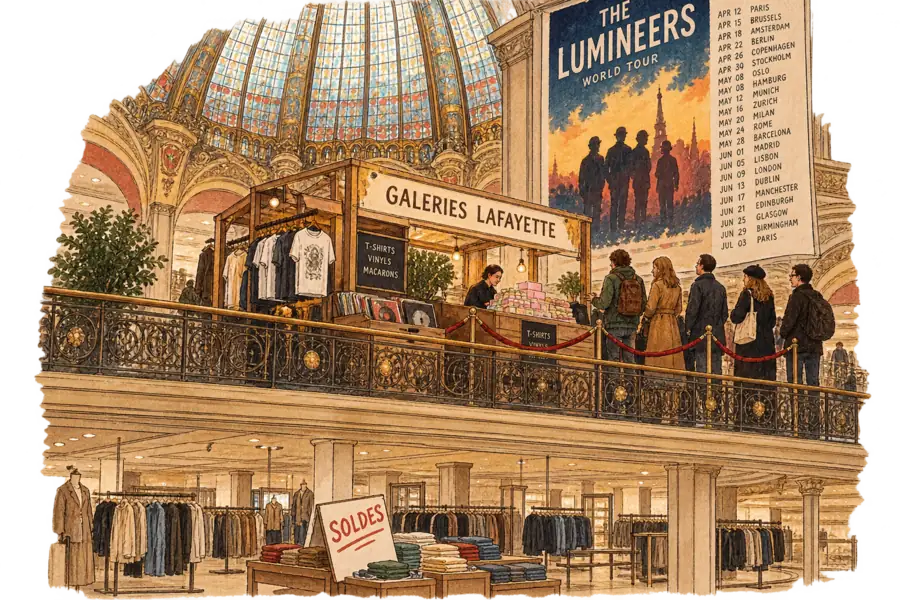
Galeries Lafayette cut its lease to fit. The pop-up opened on 3 September and closes on 5 October, thirty-three days on the third floor of the Coupole store. A&R Studios, the in-house creative arm of Universal Music France, built the room to resemble the singer’s dressing room. Of the eight products listed, two are T-shirts, one of them a Maje collaboration at 125 euros. A vinyl record has no size curve, and the macarons will be eaten long before anyone could discount them.
A tour date is the only demand forecast anyone is contractually obliged to honour.
Other brands queued against the same calendar. Pimkie put roughly 10,000 pieces online and sold more than half of them within days, a run its style manager put down to the buzz around the announcement. Buzz is what the trade calls demand it did not have to forecast.
The economics travel. Justin Bieber’s SKYLRK label took 15 million dollars across two Coachella weekends in April, against a previous festival merchandise record of 1.7 million. It sold out on site, then reopened online between the weekends to catch what the tents could not hold. The usual explanation is that fans are buying meaning. Nothing in that number required anyone to guess when the customer would arrive.
The trade is reading all this as a merchandise boom. MIDiA Research puts the global merchandise market at 16.3 billion dollars by 2030, with annual growth down to 1.6 percent by then. Nobody lets a floor to a category growing at 1.6 percent a year. The tenant worth having is the date.
There is a cost the rent conceals. When the run ends the licence lapses, and the floor reverts to whatever the buyers can think of. Certainty, in this trade, is always someone else’s property.
Galeries Lafayette has done this before. In June 2024 it gave its second floor to a Billie Eilish pop-up that ran seven days, opening four days before her two nights at the Accor Arena and closing the day after. Two years on, the same arrangement has taken another floor for nearly five times as long. Nobody has yet told the other floors when to expect anyone.