Gap Leased Its AI. The Brazilians Never Owned One.
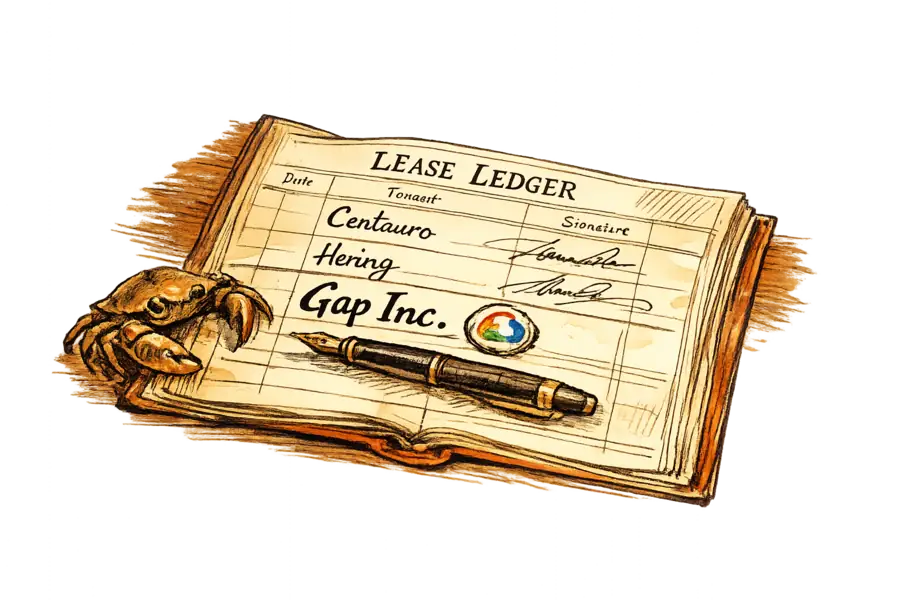
Gap Inc.'s October partnership with Google Cloud leases the AI layer rather than building it. Brazilian mid-size retailers were already on the same stack, and never pretended otherwise.
Sir John Crabstone
Gap Inc. has decided not to build its own AI. Its multi-year partnership with Google Cloud, signed in October, covers Gemini, Vertex AI, and BigQuery across Old Navy, Gap, Banana Republic, and Athleta. No financial terms were disclosed. The silence is the disclosure.
This is a lease, not a build. Gap has taken the view that the foundation-model layer is something it will never own, and has said so by arranging matters such that it cannot change its mind cheaply. Most American apparel houses prefer to leave the question open, running pilots that pretend to be exploratory while reserving the right to walk away. Gap has shut it.
LVMH still pretends otherwise. Its generative AI platform, built on Gemini and handling more than 1.5 million queries a month across 40,000 employees, rests on a layer that belongs to someone else. What LVMH has spent four years constructing is the data estate above it, which it describes as proprietary. Gap has skipped the estate. Kering, with less budget, appears still to be arguing about the foundations.
The question the industry keeps asking about AI is whether to build or buy, and Gap has answered by refusing to ask.
Meanwhile São Paulo has been watching without being asked. Grupo SBF’s Centauro runs conversational search on Gemini. These are not pilots.
Hering is on the same stack for virtual try-on, announced in São Paulo last September. Neither retailer paused to ask whether a proprietary model would have been wiser. Their budgets never offered the choice. São Paulo has learned to treat that as useful information.
Brazilian retail press treats the Gap deal as confirmation, not news. Google Cloud’s FlashBlack study found that none of 35 monitored Brazilian e-commerce sites offered multimodal search during Black Friday 2025. The finding describes the market, not the retailers in it. Where there is no native AI stack, foundation-model-as-a-service is not a strategy decision; it is the default. Gap has arrived at the same place, later.
What São Paulo grasped first was not that Google’s models would improve faster than anyone else’s. It was that merchandising, not infrastructure, is where the remaining margin lives. The conglomerates are still protecting the middle layer as though it were a trade secret, and staffing for it accordingly. It is a bill, and every quarter it compounds.
The question is not whether Gap was right. It is what happens to the houses still digging a moat when theirs turns out to be a rented aqueduct.