Givaudan Sold The Molecule, Then Sold The Story
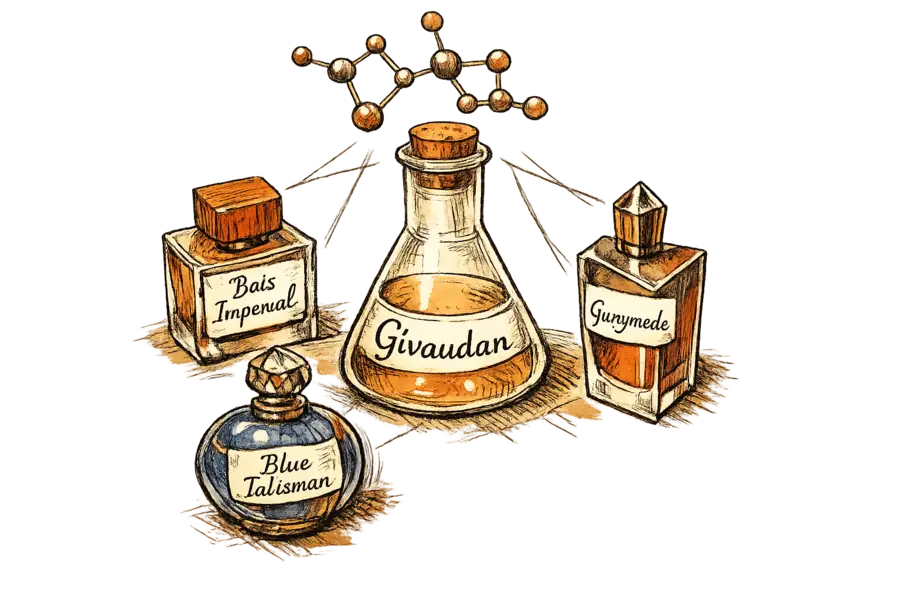
Akigalawood, a Givaudan captive worn by Bois Impérial, Ganymede and Blue Talisman, is now the load-bearing material in three different niche houses. The moat sits with the supplier, not the brand.
Neritus Vale
Akigalawood was not supposed to be a brand. Givaudan patented the molecule in 2010, derived it from patchouli waste via a biotech process, and licensed the result to perfumers who put it inside other companies’ bottles. Sixteen years on, the molecule does work the bottle used to do, and that displacement is the moat Givaudan has been engineering on purpose.
The captive is the legal instrument that makes this work. A captive is a patented aroma chemical owned by the supplier and licensed to the houses that compose with it; for the patent’s life, no competitor offers the molecule and no customer backsources it. Akigalawood’s protection runs to at least 2030, twenty years from the 2010 filing date; Glossy notes the window extends at least twenty years from the molecule’s commercial debut, which could push expiry to 2034. That window is long enough to outlast most niche launches the captive appears in. Givaudan, meanwhile, keeps collecting at the ingredient layer regardless of which brand wins the marketing campaign on top of it.
The commercial fingerprint shows the molecule outranking the bottle. Ex Nihilo’s Blue Talisman, built on Akigalawood, generated more than 40 percent of the brand’s 2025 US sales, according to Circana data reported by Glossy — one supplier-owned material carrying nearly half a niche house’s American business. The same captive signs Amouage’s Guidance line, which accounts for roughly a quarter of that house’s global sales. Marc-Antoine Barrois’s Ganymede and Essential Parfums’ Bois Impérial were both composed by Quentin Bisch, the perfumer who carries Akigalawood from one house to the next. None of these brands owns the asset that distinguishes them.
The bottle is the marketing now, and the molecule is the asset.

None of this is unprecedented. Geza Schoen’s Escentric Molecules bottled Iso E Super neat in 2006 and built a brand on a single chemical; niche perfumery has carried hero materials since the Calone aquatics of the early 1990s. What changed is the buyer who can name them. Fragrance communities now catalogue every Akigalawood launch by trade name, trace the substitution chains, and Fragrantica indexes the molecule across every perfume that deploys it. The vocabulary perfumers used to keep inside the lab now arrives ahead of the brand campaign.
Naming the molecule reorganises the discovery funnel. A buyer who searches Akigalawood on Fragrantica gets a ranked list of every perfume that features the captive; the discovery starts upstream of the brand. The same buyer, fluent in trade names, treats unfamiliar houses carrying familiar molecules as low-risk purchases. The brand premium for heritage compresses, and the brand discount for newness shrinks. For Givaudan’s customers, the captive is now a free distribution channel built on the supplier’s intellectual property.
Givaudan has structured its R&D to make the captive flywheel turn. Fine-fragrance sales rose 18.3 percent on a like-for-like basis in 2025 against an already high prior-year comparable, the kind of growth that funds the captive pipeline rather than starving it. The company commits roughly 8 percent of revenue to innovation each year, with biotech and green chemistry named as core innovation tools in its 2030 strategy. The flywheel is mechanical: a captive enters the perfumer’s palette, the perfumer carries it across houses, the supplier collects at the molecule layer wherever it is deployed. When Bisch carries the same Givaudan asset into Bois Impérial for one house and Ganymede for another, both brands sell their identity and Givaudan sells theirs.
The strongest objection is that this is niche-only and therefore peripheral. Mass-market and prestige fragrance still sell on heritage; Chanel No. 5 does not need to name an aldehyde, and the molecule discourse remains a minority interest. The condition that would have to hold for the thesis to fail is for the squeezed middle of brand-led fine fragrance to recover share against niche. That reversal is not in the data. Niche has been the growth tier in fine fragrance for several years, Givaudan’s 2025 numbers confirm it, and the molecule-literate buyer is not retreating to heritage houses.
The price is the substitutability of the brand. When the asset that distinguishes a niche house is owned by the supplier and shared with the supplier’s other customers, the bottle stops being the moat and becomes the wrapper. Bois Impérial and Ganymede are not identical, but they are recognisably siblings, and the next launch Givaudan signs with Akigalawood will join the family. The houses can keep selling stories or they can buy their own captives — the decision is not about marketing, it is about whether the brand wants to own the thing the customer is buying. Givaudan has been counting on the answer for sixteen years.