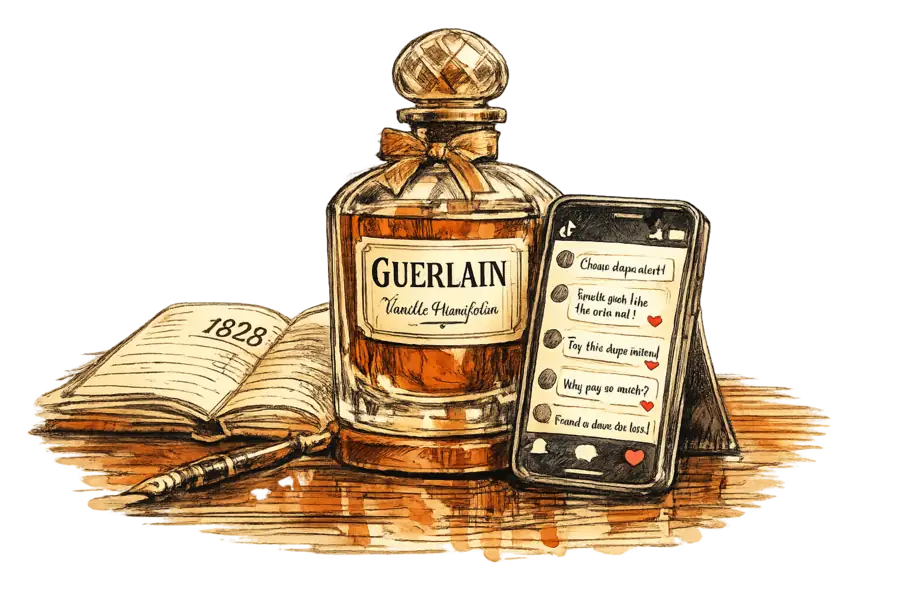
Guerlain Paid The Channel That Built The Dupe
Guerlain has, for the first time since 1828, paid creators to defend a $660 extrait against the dupe conversation that made it viral. The precedent matters more than the spend, and other maisons are watching.
Sir John Crabstone
Guerlain has, for the first time since 1828, paid an influencer to talk about its perfume. The maison’s debut paid fragrance campaign defends Vanille Planifolia, a $660 extrait that had been selling itself for five months. The precedent matters more than the spend.
The fragrance had already won by the metrics the maison cares about. It is the website’s top seller through winter and into spring, sales have tripled year-over-year, and the back-in-stock list has passed fifteen hundred names. More striking is what Guerlain claims about the TikTok conversation it has been watching: roughly 95% of participants concluded the scent cannot be duped.
Guerlain had paid creators before, but only for skincare. Fragrance was the category the maison had, until now, declined to support with paid spend; it was the proof that the rest of the catalogue had heritage to spend. It is now paying twelve creators to defend a verdict already returned in its favour.
That tells you what the campaign is for. An organic verdict does not compound. The next vanilla extrait will be cheaper, credibly close, and on TikTok before September. Bertrand Pochet of Guerlain USA insists the brief is awareness, not conversion. The polite reading is brand-building; the candid one is inoculation.
The irony is hard to miss. The dupe conversation that forced Guerlain to spend was hosted, produced and amplified on the platform now receiving the cheque. Aysha Harun and Paul Fino built the moment for free; the maison has answered by retaining twelve more, including Jena Frumes and her 10.9 million TikTok followers. The mechanism that threatens the value of the extrait is the mechanism the maison has hired to defend it. Channels carry whichever argument is funded.
Pochet’s defence of Guerlain’s prior restraint cited “limited distribution”; the brand was not pushing what it could not yet stock at scale. That phrasing dissolves the moment twelve creators step in front of a combined audience in the tens of millions. Limited distribution was the moat. The new posture is its opposite, wearing the same word.
Guerlain has not started running paid campaigns; it has stopped pretending it could afford not to.
The interesting question is who follows. Chanel, Hermès, Dior — every maison whose pricing depends on perceived irreproducibility has watched Vanille Planifolia hold its rank for five months. They have seen organic affirmation work, and they have seen its half-life. What Guerlain signed this month is not a campaign — it is a permission slip.