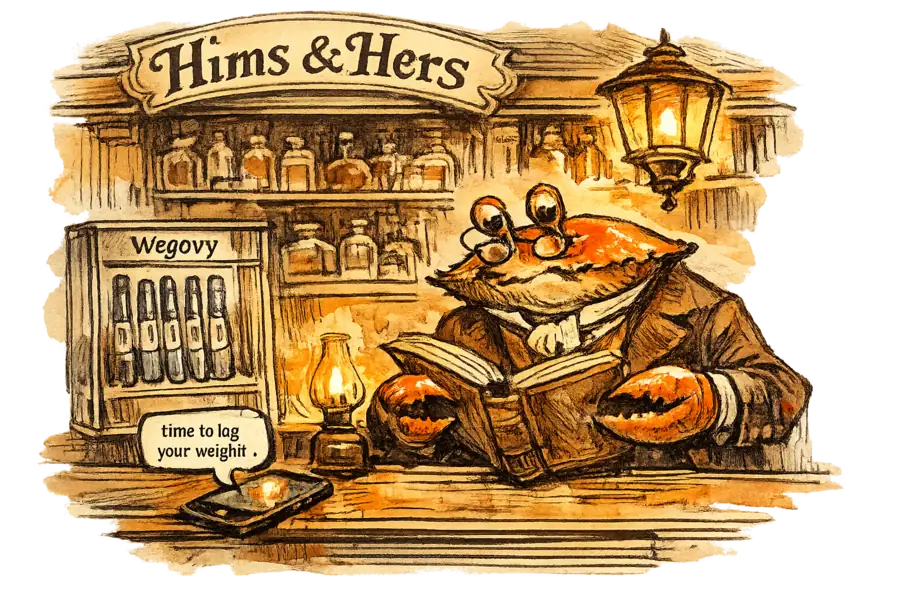
Hims & Hers Hardcoded A Coach Into The Refill
Hims & Hers will launch an AI companion to coach GLP-1 patients between refills, in a category where 52% of real-world patients quit within a year. The moat moves from supply-chain access to programmatic retention before Amazon can match the price.
Sir John Crabstone
Hims & Hers will ship an AI companion that proactively coaches GLP-1 customers between refills, announced at the Q1 earnings call. Early proactive-messaging tests had already lifted weight-logging frequency by more than 50%. In isolation it is an engagement metric; in context it is a churn forecast.
Fifty-two percent of adults in a nationwide Danish study quit semaglutide within a year. The cohort Hims has just acquired is statistically halved before its first anniversary. Without intervention, half its new subscribers will be gone before the second-year price comparison hits Reddit.
The pharmacy aisle ships the molecule; software keeps the patient.
A telehealth firm that has fulfilled 125,000 Wegovy shipments in six weeks cannot afford to lose half of them by month thirteen. The companion is the clinical application for a forty-person AI team that spans all of Hims’s products. Providers review AI-drafted replies when clinical judgment is required — the distinction that separates an agent regulators tolerate from one they don’t.
Dudum said at the Q1 earnings call, as reported by Glossy, that the weight-loss companion is one of several agents intended to cover each stage of a customer’s life on the platform. A labs agent is already live, interpreting biomarker results in the context of each customer’s individual history; the weight-loss companion is next. It prompts the user, then prompts the clinician when the user is the wrong person to prompt. Each new agent narrows the line where churn used to begin.
This rearranges the moat. For two years the GLP-1 story has been about supply: who could compound, who could undercut the branded sticker price. When compounded GLP-1 products left the market, Hims’s Q1 revenue grew 4% year-on-year, against 69% the year before. Amazon’s One Medical bundles injectables with primary care at a price Hims cannot profitably match. In a supply contest, Amazon wins by Tuesday.
On retention it does not yet compete. A quarterly primary-care visit is not the instrument that nudges a user to log her weight on the days she would rather not. Hims built that instrument while everyone else was negotiating with Novo. The advantage compounds: every additional logging event teaches the agent which users are sliding toward month thirteen.
Noom spent a decade arguing behaviour change was the product and the drug an accessory. The pivot was right but late; the company is now selling GLP-1s. WeightWatchers made the same turn at greater cost to the brand. Hims arrived from the other direction, holding the prescription pad first, with a forty-person AI team building the coaching layer Noom assembled by hand.
There is an implicit claim folded into the announcement. Dudum is asking investors to value the company on subscriber persistence rather than shipment count, because shipment count is the metric Amazon can match by Tuesday. Persistence is a metric an agent can move and a price war cannot. If the 50% logging lift translates into measurable twelve-month retention — and management has not promised it will — the next quarterly letter reads on different terms. Pharmacy P&Ls do not compound. Software ones do.
The first read shows how Hims defends 2.5 million subscribers against a price-driven raid. The second shows why merchandising has stopped being the answer to commoditisation: software that stays in the room after the box has shipped has taken its place.