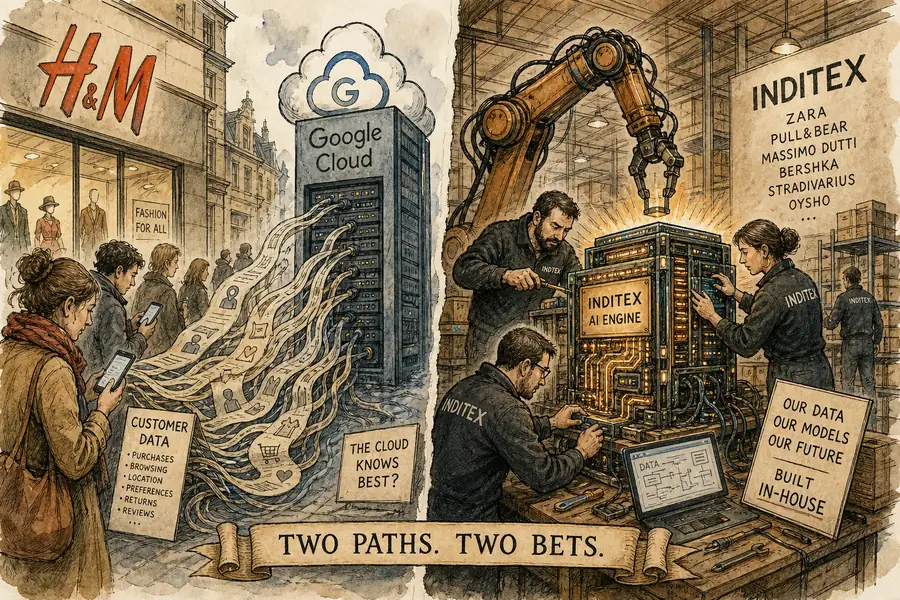
H&M's AI Answers to Google. Inditex's Doesn't.
H&M runs its data and its models on Google Cloud; Inditex spent its own billions building the core in-house and backing the robotics firm that automates its factories. The split decides which retailer keeps the advantage its customer data creates, and which one rents it.
Sir John Crabstone
Europe’s two largest fashion houses have reached opposite conclusions about artificial intelligence. H&M rents it; Inditex builds it. The split looks like a procurement decision; it settles which company owns the system that learns from its customers, and which one leases that system from a landlord who rents to everyone else.
H&M made its position plain in 2022. It gave Google Cloud the job of building its enterprise data backbone: one mesh that pulls every event from its stores, its website, its suppliers and its other labels into a single platform, with Google’s AI on top. It was built to run the supply chain and tailor what shoppers see. The data belongs to H&M. The platform that converts it into intelligence belongs to Google.
This was not carelessness. H&M kept more than 200 of its own data engineers and hired more. Its then chief technology officer called it sustainable growth ‘powered by advanced analytics and tech.’ He was right about how quickly the rest of the industry would follow.
Convention is on H&M’s side. In October 2025 Gap handed Google Cloud the same role, leaning on Gemini and Vertex AI across Old Navy, Banana Republic and its other labels. The capital-light retailer that rents its computing is supposed to be the modern one. Building your own is taken for vanity. The orthodoxy forgets what it is renting.
Rented capability is not a moat — it is an expense every rival is free to match.
Inditex came to the other answer. After the 2020 lockdowns, when no vendor’s platform satisfied it, the company built its own for about a billion euros, part of a 2.7 billion technology programme, and licensed the rest. It bought the commodity and built the core. H&M did the reverse.
The instinct goes beyond software. In 2025 Inditex backed Theker, a Barcelona robotics firm, in the largest seed round in Spain’s history; Theker’s robots already automate factory work that resisted machines for years. A service contract would have rented those robots. Inditex bought a piece of the company that makes them.
The difference is what improvement does. When H&M trains its models on Google’s platform, the platform learns what works in retail — and the next chain that signs pays for access to a sharper tool. Inditex’s gains stay in Galicia.
The two are building different companies. One is an excellent customer of Google; the other is a technology firm in the clothing business. It pays to stay one: around €1.8 billion in ordinary capital spending, technological integration among the named priorities. Renting is cheaper every quarter until the quarter it is not.