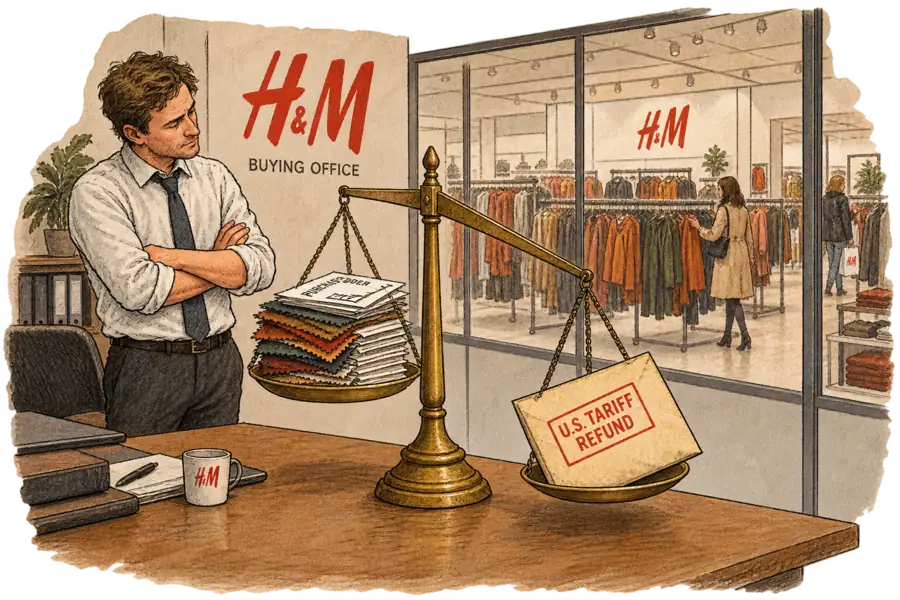
H&M's Profit Beat Was the Size of Its Tariff Refund
H&M's third-quarter operating profit rose 23% to SEK 6.04bn, roughly SEK 900m ahead of forecast, on sales up 1%. A one-off US tariff refund did most of the work, landing just as H&M's sourcing gains began to lap themselves, with September sales guided up only 1%.
Admiral Neritus Vale
Most of H&M’s 23% rise in third-quarter operating profit was a one-off refund of US tariffs. It arrived in the quarter when, by H&M’s own warning, its sourcing gains began to lap themselves. For a year, Daniel Ervér’s recovery has run through the buying office: he has credited the gains to work “especially within purchasing, cost control and more efficient operations,” WWD reported. This quarter the refund did the buyers’ work for them. Sales grew 1% in local currencies from June to August, and H&M expects the same rate in September. The shop floor is in no shape to take over.
The refund accounts for most of the beat. Operating profit reached SEK 6.04bn, about SEK 900m ahead of the mean forecast in an LSEG poll cited by Reuters. Inderes analyst Lucas Mattsson told Reuters that profit was “relatively in line” with expectations once the refund is adjusted for.
Take the refund out and the gross margin, the buying office’s own scoreboard, fell. H&M attributes a “positive one-off effect of around 1.6 percentage points relating to tariffs and imported goods that had increased the cost of sales in previous quarters,” TheIndustry.fashion reported. That is more than the entire margin widening it reported for the quarter. Net of the refund, the margin sat roughly half a point below the same quarter last year.
H&M had signaled in June that this was the quarter its buyers would start competing with themselves, as sourcing gains from the prior year rolled into the comparison base, and the refund made that contest impossible to read from the headline numbers.
H&M does not expect a second one: its head of investor relations, Joseph Ahlberg, told analysts the refund process “was concluded” in the third quarter, a call transcript published by Investing.com shows.
WWD and TheIndustry.fashion credited Ervér’s efficiency drive with a profit jump the refund mostly produced. WWD wrote that profits rose “as CEO Daniel Ervér’s efficiency plan takes hold”, and TheIndustry.fashion opened on “tighter purchasing and lower operating costs”. Both report the refund lower down. The cost cuts are real: selling and administrative expenses fell 1% to SEK 24.83bn. With the refund removed, gross profit slipped, so the cost line supplied the whole underlying gain. The purchasing half of the story belongs to last year.
The strongest case against this reading comes from RBC Capital Markets, cited by WWD: even with the tariff refund stripped out, underlying earnings were still 1% ahead of consensus. Chief financial officer Adam Karlsson told analysts that “better sourcing” and “strong cost control” drove the improvement, not the refund alone. Both claims sit inside the margin math above: a one-off worth 1.6 points on its own exceeds the entire margin widening H&M reported, which leaves little room for a genuine underlying gain this quarter, whatever the comparison shows once the base year rolls forward.
Grant the point, and the buying office’s contribution has still shrunk from a headline to a footnote. In the second quarter, H&M needed no adjustment to show sourcing work behind most of a 1.2-point rise in gross margin. This quarter’s improvement appears only after adjusting for the refund. By H&M’s own June warning, the big sourcing gains now sit in the base, so whatever the buyers add from here is measured against gains already banked.
The shop floor has not picked up the slack. Sales fell in Western Europe, H&M’s largest region, and WWD reported that shoppers in Germany and the UK stayed cautious. Inditex, whose reporting window overlapped H&M’s only in the first week of September, posted constant-currency sales up 9% for the six weeks to 7 September. “We are not yet where we want to be, but step by step, we are firmly building a faster and more flexible and customer focussed H&M,” Ervér told analysts, Reuters reported.
The fourth quarter removes the cushions. H&M’s outlook expects external factors to be “somewhat negative” for the quarter, and WWD pointed to Cyber Monday landing inside the period as one driver of heavier promotional activity. Conflict in the Middle East has already delayed some deliveries, Ervér told analysts. If September’s 1% holds through November, the margin will have to be earned against freight, heavier markdowns and last year’s sourcing gains, with nothing refunded to cover a miss.
Ervér can keep squeezing the cost line that produced this quarter’s underlying gain, or spend on the digital infrastructure and store upgrades meant to bring customers back. The refund paid for one quarter of not having to choose.