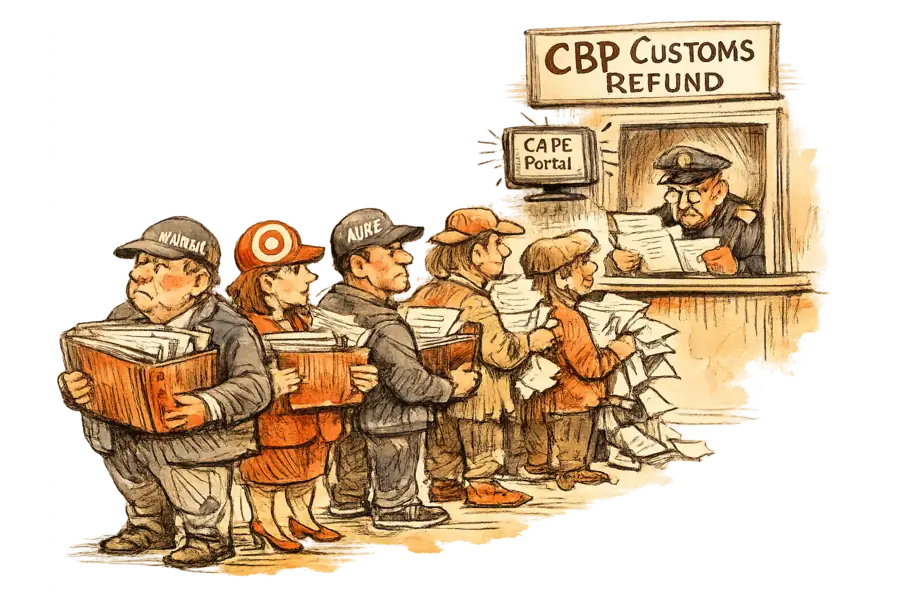
The Tariff Refund Is a Capability Test With a Cheque Attached
The CAPE portal's uneven rollout is sorting brands by customs infrastructure rather than refunding uniformly. The brands with in-house trade-compliance teams are being paid first; those who outsourced customs are discovering that a refund requires the department they never funded.
Sir John Crabstone
The CAPE portal opened on April 21. It crashed by noon and recovered by afternoon, which is the correct metaphor for the whole undertaking. Customs and Border Protection owes roughly $166 billion to some 330,000 importers after the Supreme Court voided IEEPA tariffs in February. The refund is not a windfall. It is a capability test.
The brands paid first are those that never outsourced the test. Walmart, with an estimated $10.2 billion owed, runs its own trade-compliance function. Target at $2.2 billion and Nike at $1 billion staff the same discipline. Their trade-compliance teams had written the entries, tracked the liquidations, and were already in their chairs when the portal opened.
Smaller labels outsourced customs to brokers for the same reason most mid-caps outsource payroll: marginal cost, non-core, and no career was built on it. Brokers now have queues of their own. A small denim label with four hundred entries is not near the top of anyone’s list.
The refund rollout has made visible a function most finance chiefs preferred not to see.
What retailers call trade compliance is, in practice, institutional memory: entry numbers matched to purchase orders, HTS codes stable across seasons, banking details kept current because someone is paid to keep them current. The brands that treated this as overhead are learning what it costs to be someone else’s client. Those who staffed the function are already drafting Q2 forecasts that book the refund as real, and the auditors will sign. Institutional memory is dull work until a federal portal demands to see it.
Consumer litigation is a separate queue. Plaintiffs’ firms have filed and threatened class actions against importers, seeking to recover for customers who paid higher prices on goods whose tariffs the court later voided. These suits buy optionality for a later fight over whether any of this reaches the consumer who paid the surcharge. That question goes unanswered by the portal, which is only equipped to pay the importer of record in the order the paperwork arrives.
The queue is not sorted by the size of the claim. It is sorted by a decision made years earlier — whether a CFO saw trade compliance as infrastructure or overhead. A refund within 90 days rewards the department no one praised when tariffs were merely an annoyance. Those who outsourced will wait for a broker to find the time, and some will still call it a windfall when it arrives.
The next earnings season will separate the CFOs who know their customs lead’s name from the ones who will now have to ask.