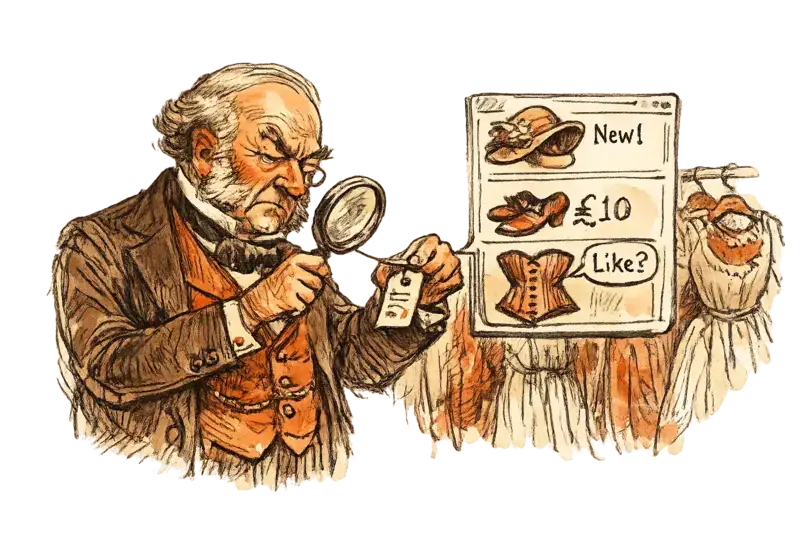
If ChatGPT Gets the Product Wrong, Fashion Still Gets Blamed
Retailers are treating ChatGPT storefronts as a new acquisition channel. The sharper fact is uglier: when the assistant misstates the product, shoppers still hold the brand responsible.
Sir John Crabstone
ChatGPT may recommend the dress. The shopper will still blame the brand if the assistant gets the product wrong. That is the point fashion retail keeps trying to evade.
The current argument around AI shopping has been framed as a channel fight. Will discovery move into chat, will checkout stay on-site, will OpenAI or the retailer own the transaction. Fine questions. The harder one sits underneath: who owns the mistake. On that count, the answer already looks settled.
YouGov reported in June 2024 that 54 percent of respondents across 17 markets said the company using a chatbot was most to blame when it gave incorrect information. Among U.S. adults, 74 percent said companies are responsible for chatbot errors. Retailers should read those numbers twice. The assistant may be the interface. The merchant remains the defendant.
This matters because the branded push into ChatGPT is no longer theoretical. Sephora has launched a U.S. pilot inside ChatGPT, with loyalty benefits already in view and payments planned later. OpenAI says Walmart has brought Sparky into ChatGPT as the company shifts its shopping product toward discovery. The same OpenAI post says Target, Sephora, Nordstrom, Lowe’s, Best Buy, The Home Depot and Wayfair have integrated with the Agentic Commerce Protocol through this revised approach. Nobody should pretend the retreat on checkout has slowed the march into the interface. It has merely changed the plumbing.
Much of the industry still speaks as if plumbing is the story. It is not. The story is responsibility without control.
OpenAI’s September 2025 launch post for Instant Checkout sold a neat arrangement: ChatGPT would act as a “digital personal shopper,” while merchants would remain merchant of record and keep control over fulfillment, returns, support and communication. Then came the March correction. In its product-discovery update, OpenAI said the first version of Instant Checkout lacked the flexibility it wanted and that merchants would use their own checkout experiences instead. The surrounding consumer research points in the same direction.
That retreat should not be read as a narrow checkout hiccup. It suggests that consumers distinguish between advice and commitment. They will browse with the bot. They are slower to trust it with the final act. Fashion knows why. A product page for a lipstick or a jacket is a promise made of details, and details are where generative systems fail.
The consumer research around retail AI keeps landing in the same place. A Bain & Company survey of 700 U.S. online shoppers found 56 percent rated inaccurate product information as very or extremely negative, while 57 percent said the same about obvious errors. Bain also found that 41 percent would feel comfortable using a generative AI tool from a brand they trust. There is the bargain in one line: trust belongs to the brand before the interaction, and the damage lands on the brand after it.
The handoff problem is just as clear in purchase autonomy. An Omnisend survey of 1,026 U.S. respondents found 66 percent would refuse to let AI make purchases on their behalf even if it got them a better deal. Consumers like help. They do not like surrender. Fashion retail keeps mistaking those two positions for one.
There is a second error in the current optimism. Executives speak as if a branded app inside ChatGPT restores control because the retailer’s catalog, loyalty logic and checkout rails remain attached. That misses the moment when judgment is formed. The recommendation arrives inside the assistant’s voice, not the brand’s owned environment. OpenAI’s own help documentation for shopping results says product results are selected independently, are not ads, and that the model can “occasionally make mistakes” when interpreting user intent. In fashion, “occasionally” is enough. If the assistant gets the product wrong, the shopper does not send an angry note to the model provider. She blames the merchant whose name was on the card.
What everyone else says is that discovery is moving into chat and brands must follow the customer there. True enough. Where they are wrong is in treating that move as a distribution upside first. It is a liability transfer first. The interface borrows the brand’s authority on the way in, then hands the reputational bill back on the way out.
That leaves retailers with a narrower brief than the rhetoric suggests. Do not ask whether ChatGPT can sell the product. Ask whether your product data, policy language and exception handling are strong enough to survive being paraphrased by a fallible intermediary. If not, the new storefront is just a polished way to scale disappointment.
Fashion will not be judged on whether the assistant spoke. It will be judged on what the assistant got wrong.