A Judge Enrolled the Importers Who Never Sued
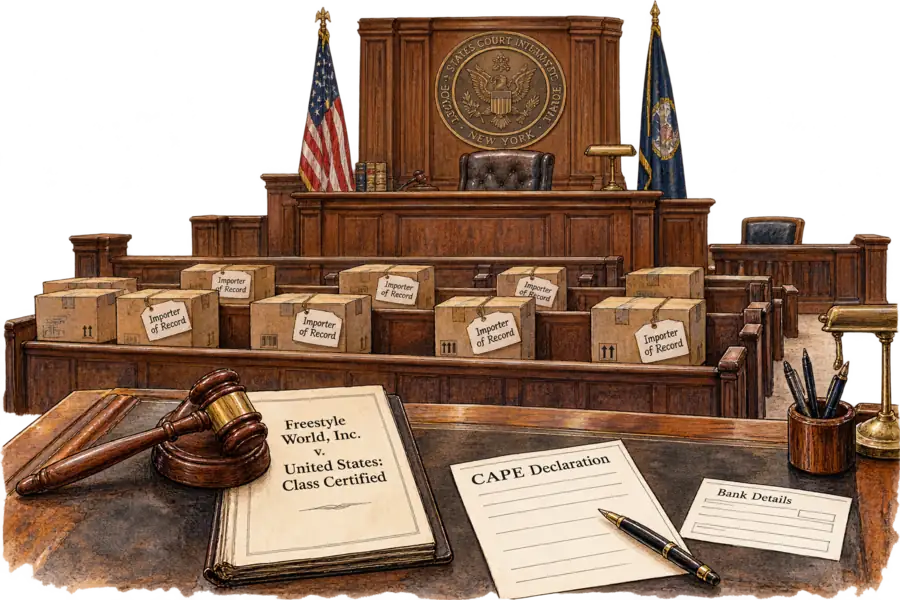
On 8 October the Court of International Trade certified a class of importers of record that paid the challenged IEEPA duties between 1 February 2025 and 19 February 2026 and have not sued, including the small ones Customs' CAPE refund portal never reached. The order pays nobody yet. The court's order in the individual refund suits still made reliquidation wait for a CAPE declaration.
Sir John Crabstone
In April we called the tariff refund a capability test with a cheque attached, and said brands without customs teams would be paid last. On 8 October the Court of International Trade turned to the stragglers, certifying a class of importers of record that paid the challenged IEEPA duties between 1 February 2025 and 19 February 2026 and have not sued. The class is certified; the cheque is not.
Customs’ refund portal, CAPE, has done most of the work. By 2 October it had repaid about $126bn including interest, Judge Richard K. Eaton’s opinion records, against a March estimate of $166bn in duties alone. The court believes those who have not used it are “overwhelmingly small importers”. Put off by cost or effort, or simply unaware, they “will never take advantage of CAPE”. Were the portal to stop today, about $30bn in duties would stay in the Treasury.
In February, two months before CAPE opened, Steve Lamar of the American Apparel & Footwear Association said Customs’ “fully electronic refund process should help to expedite” repayment. It suits importers with someone on staff to log in.
The government has not conceded the point. It has appealed the reliquidation order to the Federal Circuit, and it has insisted, Eaton notes, that entries whose duties are final can be recalculated only through “individualized court orders”. Yet it appears, he writes, that the government “does not object to the requested relief itself; it only opposes granting this relief on a class-wide basis.”
Washington asked for an order for each importer, and the court has answered with one class for all of them.
Membership, in Eaton’s words, is “mandatory and fixed”: under Rule 23(b)(2) nobody opts in or out, and notice is not required. The importer too small to have heard of CAPE is now a class member, bound by the outcome without being a named party. Whether anyone tells it is open; the plaintiff asked for “a comprehensive notice program”, and the order is silent.
The order asks nothing yet of Customs or the Treasury. The parties meet behind closed doors on 13 October and must propose a schedule by 22 October, Sourcing Journal reported. James Kim, a lawyer at ArentFox Schiff, sees “a potential path forward for non-litigants”.
The court’s own template is the worry, and the worry is ours rather than Eaton’s. He expects refunds to “follow automatically” once relief issues, “determined mechanically by Customs’ computers”. The order docketed in more than 4,000 individual suits, however, made reliquidation wait for Customs’ “acceptance of Plaintiffs’ CAPE declarations”. If that clause were copied into a class order, the importers who never filed would still have to file.
The class is also drawn around one role: importer of record. FedEx, which paid duties in that role, sued for its own refund in February, Supply Chain Dive reported. Having sued, it sits outside the class; so do brands that were not importer of record on its parcels. Whether they are repaid will be “worked out contract by contract”, Geoffrey Gertz of the Center for a New American Security said in February.
A refund also needs a bank account. The Liberty Justice Center, a public-interest litigator seeking its own class, reports that Customs still holds $1.1bn for missing ACH information, down from $1.6bn. Eaton could enrol the small importer without its knowledge. The refund, if it comes, will still need its routing number.