Kuaishou's AI Ad Tools Took More of What Merchants Still Spent
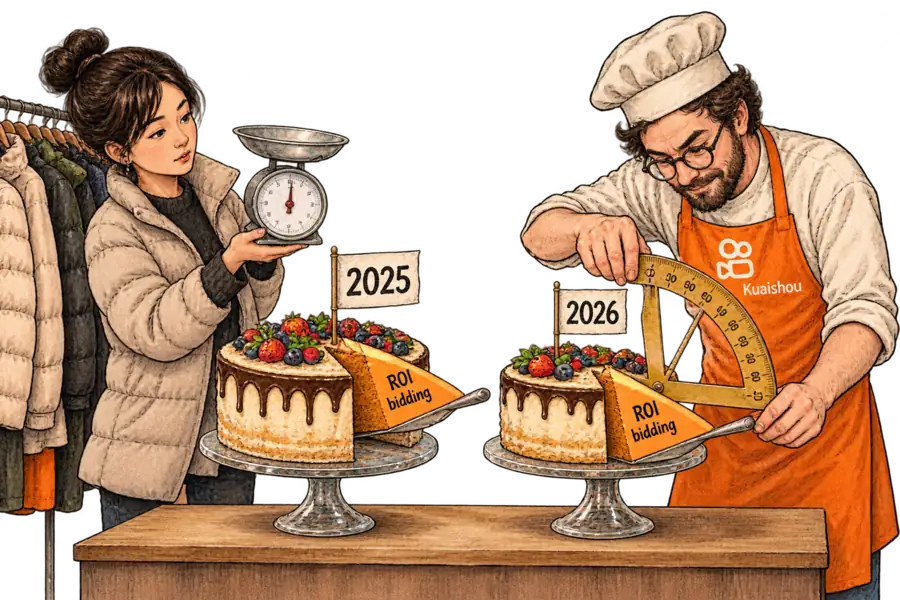
Kuaishou's net-transaction ROI bidding took 34.7% of e-commerce marketing spending in the third quarter, up from 28.0%, while that spending and online marketing revenue fell. Kuaishou had credited AI with its marketing growth and estimated its models' revenue uplift as recently as the first quarter; this quarter it switched from client penetration to a share of spending, which shows where merchants' money went and not whether the tools brought any in.
Neritus Vale
Kuaishou’s e-commerce merchants, in aggregate, cut their advertising in the third quarter, and more of what remained went through the platform’s AI-run bidding. Net Transaction ROI, which bids toward sales net of cancellations and returns, took 34.7% of e-commerce marketing spending, up from 28.0% in the second quarter, its results release says. That is a larger share of a smaller budget. It shows where the remaining money went, and cannot show that the tools brought any in.
Kuaishou has reported a share for this product before, and then changed the measure. The first-quarter release gave client penetration of 45.0%, and the second-quarter release gave 55.0%. The third quarter drops client penetration for a share of spending, so the two series do not compare.
Advertising, Kuaishou’s largest business, shrank with merchants’ budgets. Online marketing revenue fell 11.1% year on year, which the release puts down to lower e-commerce marketing spending amid “the dynamic consumer environment and intensifying competition”. The release names only outside causes; on the call Cheng Yixiao, the chief executive, added Kuaishou’s own subsidy cuts. Total revenue fell by the same rounded 11.1%, the filing’s tables show.
A second automation figure is also a share. Cheng said client and spending penetration of Universal Auto X, Kuaishou’s fully automated placement tool, both “exceeded 90%”, the call transcript shows. He did not name the base, which may cover all online marketing rather than e-commerce alone. If it is e-commerce, the tool is the default way to buy, which leaves little to compare it against.
From late 2025 to August, Kuaishou’s releases credited AI when marketing revenue grew. The third-quarter 2025 release put a 14.0% rise “primarily” down to “the use of AI technology to continuously upgrade marketing product solutions”. The fourth-quarter and first-quarter releases gave AI the same billing, and the second-quarter one credited its tools for generating ad materials. This quarter’s explanation of the fall leaves AI out.
Kuaishou also used to estimate what its models added. Its fourth-quarter 2025 release put the gain at roughly 5%, and its first-quarter 2026 release credited its recommendation and bidding models with “roughly 3.0%–4.0% growth in domestic online marketing services revenue”. That is a claim about money brought in to Kuaishou, which no share can make. The second-quarter release gave no such estimate; the third says instead that AI adoption “shifted from single-model efficiency gains to large-scale, system-level deployment”. Kuaishou put uplift percentages on two models taken together and none on the system.
No e-commerce GMV figure appeared, as in every release this year. The last came with its 2025 results. On the call, in its English interpretation, Cheng said GMV and e-commerce marketing revenue both declined year on year. E-commerce revenue, which Kuaishou books under other services, fell too, the release says.
Kuaishou does not publish the e-commerce marketing spending base, but online marketing revenue fell 13.4% from the second quarter, and the filing puts that fall, too, down to lower e-commerce marketing spending. A share of a shrinking base can rise while fewer yuan pass through the product. That happens if e-commerce marketing spending fell by more than 19.3%. The 13.4% figure covers all online marketing, including advertisers outside e-commerce whose spending rose, so the e-commerce fall could be steeper; Kuaishou does not say.
Part of Cheng’s account of the fall describes merchants buying certainty. Rising compliance costs, he said, have left merchants seeking certainty (经营确定性) and demanding a markedly higher return on every cent they spend, as 21st Century Business Herald reported. The release says the ROI product’s latest changes “further improved the certainty of transaction outcomes”. The merchants’ demand and the product’s pitch share a word.
A product can win share by being the last thing merchants stop buying.
Part of the shift came with incentives attached. The release lists “client incentive programs” among the means of raising the share, beside product changes. A share won partly with incentives measures the incentive as well as the product. Kuaishou does not say what the incentives cost.
Brand merchants’ marketing spending “continued to increase”, the release says, and Cheng said brands remain “a relatively small share of the platform’s overall GMV”. Brand spending rose while total e-commerce spending fell, so the cut presumably fell on merchants without brands. Kuaishou does not break it out. In clothing, unbranded sellers may be most of the trade: at a Kuaishou marketing salon in September 2025, 财经社 reported, white-label merchants were said to hold more than half of its apparel business, with no period given. That is a Kuaishou claim made 14 months before the quarter in question.
For small and mid-sized sellers, Kuaishou’s answer is more automation, reported without numbers. A “fully managed AI operations solution”, launched in the quarter, “delivered initial business gains”, the release says. Spending on AI-generated ad materials grew over 70% year on year in the second-quarter release and 20% on the third-quarter call. The AI shop staff we described in October came with sales shares counted by their own channel.
National Business Daily read the e-commerce figures as AI holding a floor (托底型落地). Its analysis argued that their significance does not lie in how much new GMV AI brought (不在于AI带来了多少新增GMV). What they show, it wrote, is AI doing work small merchants could not, so that retention did not stall. Penetration measures neither retention nor returns; it records where spending went.
The strongest defence is that the tools kept the fall from being worse. Kuaishou says the product makes outcomes more certain and, in its second-quarter release, that it was “effectively helping merchants reduce product return rates”. Cheng said overall e-commerce monetization efficiency “remained relatively stable”, and the third-quarter release says new-merchant retention and the growth of scaled existing merchants “improved steadily quarter-over-quarter”. Money that moved into the product might otherwise have left Kuaishou. For the argument here to fail, the product must have raised returns enough to hold spending that would otherwise have gone.
Kuaishou has the data to test this and printed no figures. A product bidding on net sales tracks what spending returns, and Kuaishou estimated its models’ revenue uplift as recently as the first quarter. Incentives would lift the share whatever the product did. Merchants staying with it may reflect trust in its certainty, though a certain return can be a small one. Its ad researchers, we found this month, reported revenue and no advertiser return for their ad generator.
Kling, Kuaishou’s video model, explains much of the rise in costs and none of the fall in advertising. Research and development spending rose 41.9%, mainly on Kling, the filing says. Kling’s revenue sits in other services beside e-commerce, so the two need reading apart. Kuaishou says that revenue grew but, unlike for the second quarter, gives no figure.
If merchants keep cutting and the ROI product keeps gaining, each new share figure will be weaker evidence of how well it bids. Kuaishou has estimated uplift before, for its own revenue and, in the first-quarter release, for merchants’ sales through e-commerce search, and it can for the ad tools. Until it does, a clothing seller weighing ROI bidding can see where other merchants’ money went and nothing of what it earned them.