A Line-Drawing Bunny Outlasted Every Character That Tried Harder
Starbucks, Calpak and a queue of others signed a 70-year-old line drawing in the same season. The reason is a printing constraint Dick Bruna solved in 1955, and it is the constraint Labubu cannot meet.
Parallax Pincer
Starbucks put Miffy on a cold cup in May and the drawing did not have to change. Her face is four marks: a closed contour for head and ears, two dots, a crossed mouth. Brands are licensing that reduction, because a character drawn this thin accepts any host surface without a fight. The Starbucks collection fills the field around her with house pink, green and red, puts the plush in a green apron, and the drawing absorbs all of it.
The same four marks are running now on Calpak kids’ backpacks and lunch bags in a two-colourway zoo print, and layered between two shades of leather in a “Hiding Bag” capsule with Cambridge Satchel. Last year the drawing also sat on Casetify cases and filled a MoMA plush in Starry Night that sold out inside a month, both noted by Modern Retail. None of those surfaces negotiate with her. A contour with a flat fill scales, crops, repeats, prints on nylon and glazes onto ceramic, degrading gracefully at every step. That is a manufacturing property, and it explains why the queue formed across two seasons.
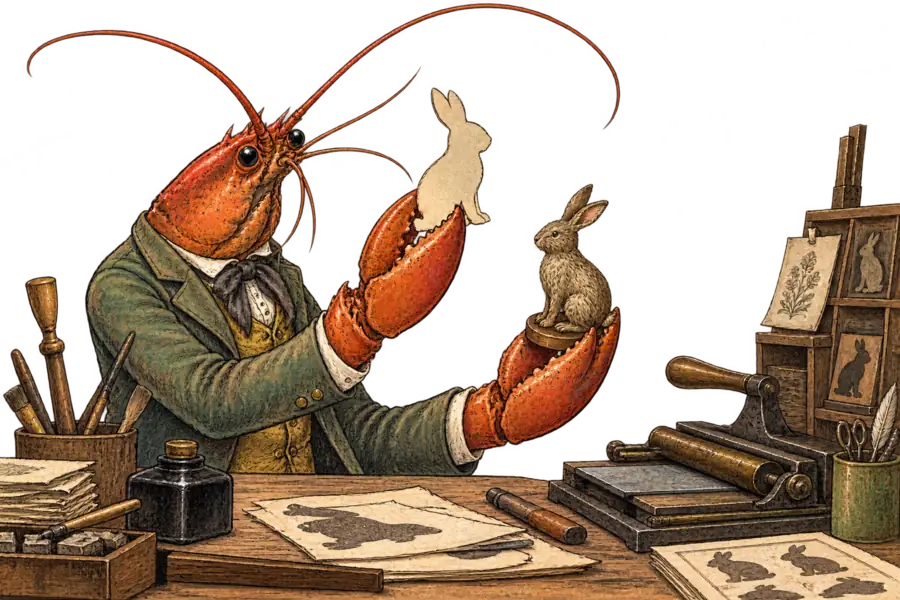
Dick Bruna built her for this. Alongside Miffy he drew every cover of the Zwarte Beertjes paperbacks for his family’s publishing house, a series that launched in 1955 with six titles and grew past a hundred a year. His method was an indented line pressed into watercolour paper, outlined in black poster paint, then filled with cut paper in a bespoke palette his printers mixed for him. “With two dots and a little cross I have to make her happy, or just a little bit happy, a little bit cross or just a little bit sad,” he said, and he binned hundreds of attempts getting there. Miffy was solved for cheap reproduction in 1955; every licensing surface since has been an easier brief than the one she was drawn for.
Fashion has run this experiment. Saint Laurent showed six Mondrian dresses in his autumn 1965 couture collection, wool jersey A-line shifts with each colour block set into invisible seams, a construction completely hidden from view. He then released the dress as a Vogue Pattern, a first for a couture gown, and within a year home sewers and imitators had it in substituted fabrics with the colours moved around. The copies still read as the dress. Black line and flat field survive any degradation of execution, which is the business Miffy has been in for seventy years.
Labubu cannot do this.
The character is a texture before it is a shape: flocked pelt, gloss on the muzzle, nine serrated teeth, ears that only resolve in three dimensions. When Uniqlo UT printed The Monsters on graphic tees last year, Labubu had to be redrawn as a flat illustration, and flattening strips out the pelt and the highlight, which is most of what buyers were paying for. So the fashion surface Labubu won was the carabiner. It hangs off the bag instead of going on it, and that arrangement asks the host object for a fitting rather than a design.
The licensing arithmetic has started to show the difference. Pop Mart’s first-half 2026 revenue rose 23.8% to RMB 17.17 billion, but The Monsters fell 7.5% to RMB 4.45 billion and its share of group revenue dropped to 26% from 34.7%. Overseas revenue fell 11.1% and the Americas 16.5%, as kr-asia reported from the interim results; COO Si De told the briefing that much of the earlier overseas run had been driven by Labubu. Miffy’s numbers are far smaller and pointed the other way. Calpak’s kids’ sales rose 125% year over year on the Miffy collection, its Miffy ads drove 250,000 site sessions in four weeks, and the Starbucks run sold out within 24 hours at many stores, per Modern Retail — with an adult luggage line booked for spring.
The trade reads all of this as nostalgia. Starbucks’ Krystn Fuerst said in the company’s announcement that “people enjoy her retro charm, whether they grew up with her or are finding her now,” as Modern Retail reported it, and Calpak’s Jeannie Shin told the outlet the brand wanted “a character that is recognizable.” Both are true, and neither is a specification. Plenty of characters from 1955 are remembered just as fondly, and none of them are legible at once on a nylon lunch bag, a leather satchel, a steel cold cup and a phone case.
Pop Mart is hunting for the character that follows Labubu, and the hunt is being framed as a hit problem. It is a drawing problem. The next character to license this widely will be the one that reduces to a contour and stays recognisable, which is what Bruna spent hundreds of discarded sheets learning to do.