LVMH Hands Its Laboratory to the Executive Who Already Runs Its AI
LVMH's new Chief Digital & Innovation Officer, Gonzague de Pirey, has led its data and AI work since 2023, reporting to the group managing director. What he gains on 1 January is the innovation strategy and LVMH Gaïa, the group's research company. The text exchange4media published sets no budget and names no maison that must take part.
Sir John Crabstone
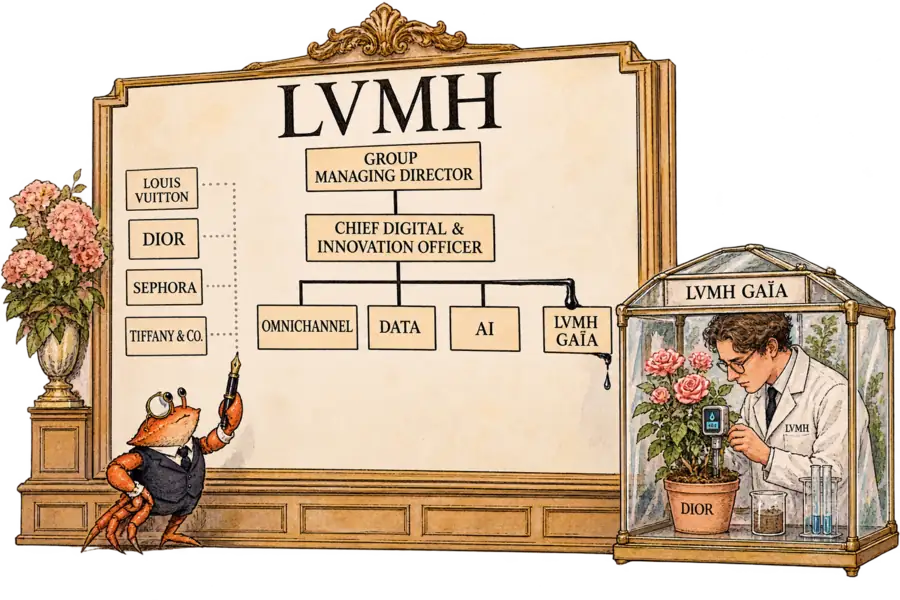
LVMH has given its artificial intelligence a new title and its scientists a new superior. Its announcement, as published by exchange4media, makes Gonzague de Pirey, the omnichannel and data chief, Chief Digital & Innovation Officer from 1 January. He will lead “the Group’s transformation through artificial intelligence, as well as its innovation strategy”, and take over LVMH Gaïa, the research company, from its founder, Claude Martinez. The AI was already his; the laboratory was not.
Modaes read the move as a restructuring to bring the group’s “artificial intelligence, data and innovation capabilities under a single leader”, and said Martinez is leaving the group. It called Stéphane Bianchi, to whom de Pirey will report, chief executive, a title Bernard Arnault still holds. Two of the three remits have been de Pirey’s since 2023.
That year WWD reported he was “charged with spearheading the broad adoption of data and artificial intelligence across brands”. His line ran to the group managing director, then Antonio Belloni. The reporting line to that post is three years old; Bianchi inherited it.
Bianchi has held the post since 2024, and his LVMH biography already lists “the Digital and Data Transformation of the Group” among his duties. It also gives him “strategic and operational management of the Group Maisons”. The houses and the office meant to help transform them will both answer to him.
The additions are the innovation strategy and a laboratory. LVMH created Gaïa in 2023 and calls it the group’s “scientific research and innovation engine”, dedicated to environmental challenges and technological innovation. From January it answers to the same man as the data teams.
Gaïa’s project with Parfums Christian Dior at VivaTech in June was agricultural. Sensors in the Dior rose garden in Normandy measure soil moisture and feed an irrigation tool. LVMH says water use fell by 30%, and the roses grew no worse. A data officer will recognise everything in it but the soil.
One suspects that a manager given both the laboratory and the digital teams seldom comes from the laboratory.
This manager’s case for AI begins on the shop floor. At VivaTech he said the group’s 90,000-plus client advisors had to be trained “to the highest standards”, as we noted in September. Research joins a programme that starts with the people who sell.
The market’s AI worry this week was the people who buy: luxury shares fell on fears for American wealth, as we reported. No reporting line reaches a client’s portfolio.
The maisons are to be supported. Bianchi says the combination strengthens “our ability to support the transformation of our Maisons”. The text exchange4media published sets no budget and no target, and names no house that must take part; the nearest thing to an aim is Modaes’s quoted line about turning research into “tangible innovations”.
The houses already write their own plans. Meio & Mensagem reported from NRF in January that each maison had been invited to draw up its own AI plan. The group then carried what worked in one house to the others. It reviewed them all, and has now given de Pirey’s office a laboratory. Whether that office may send a plan back, neither report says.