
Mercari's Swap Sticker Reads a Garment but Not the Purchase the Swap Replaced
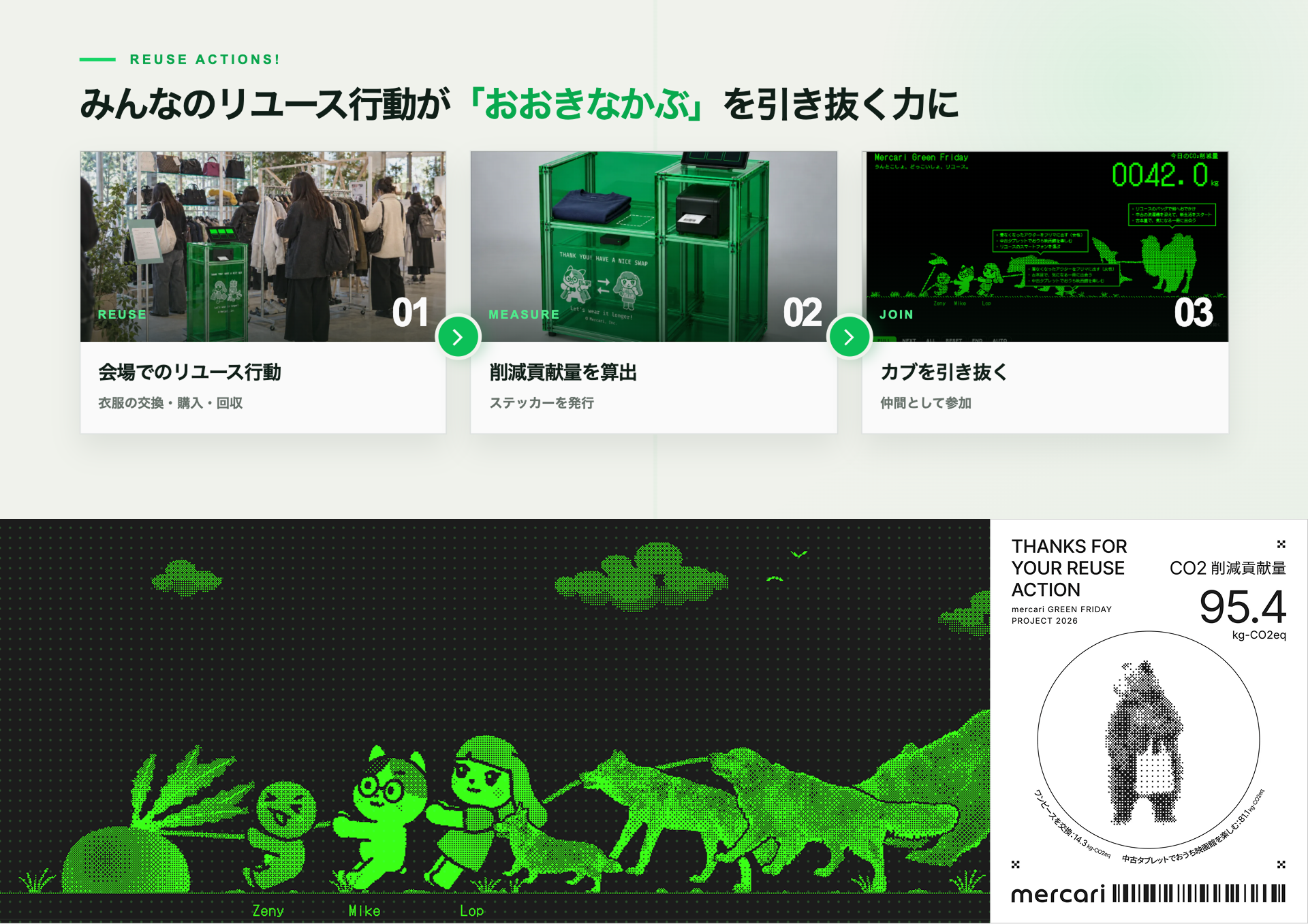
Mercari will hand swappers at its Tokyo Green Friday event a sticker carrying an AI estimate of each garment's CO2 saving. Its annual 850,000-tonne figure is discounted because not every used purchase replaces a new one, and nothing in the release, the Impact Report or the methodology pages says whether the sticker figure gets the same discount.
Neritus Vale
At its Green Friday event in Tokyo from 20 November, Mercari will give each swapper a sticker with an AI estimate of the CO2 their chosen garment saved. Mercari’s own annual method declines to assume that every used purchase replaces a new one. Nothing in the release, the Impact Report or the methodology pages says whether the sticker makes the same allowance.
The sticker rests on unfinished research, and Mercari says so. AI-LCA, under study at Mercari’s R&D unit R4D, estimates the “排出量” (emissions) of one garment at its production and disposal stages, the release says. It describes the input in two ways: a photo plus the composition tag in one place, a photo plus the description text in two others. A footnote calls the event use “研究中の実証的な取り組み”, a trial of research in progress (translations from the Japanese are ours).
The sticker responds to a doubt that Mercari’s own survey found. In its survey this month, 58.3% of 2,275 online respondents aged 20 to 69, unweighted, doubted that choosing used clothes cuts CO2, or said they did not know. The question framed used clothes as chosen “新品の服を買う代わりに”, instead of buying new. A printed figure meets that doubt with a number resting on the same premise.
Motive is not substitution, and the survey measured motive. Among the 664 respondents who had bought, received or exchanged used clothes in the past year, the top reason, at 41.6%, was “新品より安い・お金がかからない” (cheaper than new, or costs nothing). A price comparison cuts both ways: a cheap coat can stand in for a new one or hang beside it.
Mercari’s annual figure discounts for purchases that replace nothing new. Its Impact Report credits trades in seven categories in Japan and the US with avoiding about 850,000 tonnes of greenhouse gas in the year to March 2026. Because “not every secondhand purchase on Mercari replaces a new one”, its method applies a displacement rate (置き換え率 in the Japanese text) drawn from surveys of Mercari users. Neither document prints the rate.
Mercari sets its method against a government database that skips the discount. Its methodology page notes that the environment ministry’s Dekokatsu database credits 9.5 kg to each used garment bought online, assuming a used dress shirt replaces a new one completely (完全に代替する). Mercari’s premises differ, the page says: more kinds of clothing, and the rate. Its own average is about 11.8 kg per garment traded, but that covers all clothing and the 9.5 kg covers one dress shirt, so the two figures are not like for like.
The release’s description of the sticker never mentions the rate. It calls the AI’s per-garment result a “削減貢献量” (avoided-emissions contribution), the term the annual total uses for a saving net of the 置き換え率. Footnote 8 calls the printed figure a “目安” (a rough guide), based on single-item estimates for swaps and category averages for purchases. Whether the sticker shows a gross saving or a rate-adjusted one, Mercari’s documents do not say.
The release’s sample sticker, marked as illustrative, credits more than a swap. Beside a swapped dress, its larger line credits 81.1 kg-CO2eq to “中古タブレットでおうち映画館を楽しむ”, enjoying a home cinema on a used tablet. Dami Moon, an R4D researcher, said in an interview on R4D’s blog on 13 November that visitors can add green actions they might take in daily life. Footnote 8 explains figures for swaps and purchases only, and the release does not say how the 81.1 kg line is derived.
An AI can read a composition tag; it cannot read the purchase that did not happen.
Mercari’s own citation leads back to the missing purchase. The WRAP reuse guide the release cites gives no displacement rate; its T-shirt figure comes from a 2011 WRAP study. That study called displacement the “most important parameter for all indicators”. It applied one default to all direct reuse, free exchange included: 60% displaced a new item, taken from Farrant (2008), 16% displaced another used item and 24% displaced nothing.
WRAP has since measured the rate for resale, and it is well short of total. Displacement Rates Untangled, its 2025 method, found a UK weighted average of 64.6% for resale: “for every 5 preloved items bought, 3 displace new purchases”. Resale platforms including eBay, Vestiaire and Depop tested it. WRAP built it because uneven methods had “the potential to mislead consumers”.
Moon, who has helped design Mercari’s formula since 2022, agrees that the purchase can go missing. Asked about a paper on smartphone trade-ins and the rebound effect, Moon said “消費者が常に新品の代わりに中古を選んでいるとは限りません,” meaning consumers do not always choose used in place of new. Moon added that people who have used second-hand goods do find them “新品の代わりとして十分機能する”, good enough in place of new, as the Impact Report’s user survey shows. Money freed by cheaper used goods may simply buy something new, Moon said. The examples were smartphones; the interview does not address clothes swaps or the sticker.
The AI half of the sticker has been tested, though only on tops. In the paper Mercari cites, by Moon and University of Tokyo colleagues, a vision-language model read fabric composition correctly in 81.6% of second-hand listings. That validation covered listing photos and descriptions of tops. Mercari has not said what input or accuracy applies to garments swapped at the event.
The best case for the sticker, which Mercari has not made in these terms, is that it teaches. The release calls the figure a 目安, and a figure that varies with each garment’s fibres shows swappers that fibre mix drives the footprint. The critique fails if the printed number applies any replacement rate and says so, or if swappers read it as an illustration and not as a measurement.
In the release, the Impact Report, the methodology pages and R4D’s interview, Mercari has published no replacement rate measured on swappers. Its clothing rate comes from app users; this spring’s main apparel survey reached 905 buyers. WRAP’s 2011 study measured no swaps either; it applied its single 60% default to free exchange as to everything else. Moon’s own case for figures is that they carry “事実としての信頼性”, credibility as fact, alongside their teaching value. A figure believed as fact needs its premise in view.
If per-item saving claims like the sticker’s reach Europe, their premise would be checked only when someone asks. Moon hopes to offer the per-item model as shared infrastructure for the second-hand data that Europe’s digital product passport leaves blank. The proposed Green Claims Directive would have sent such a claim to a verifier before publication; the Commission now plans to withdraw it, as we reported.
Mercari’s annual method already holds the fix. It admits that some used purchases replace no new one, and it surveys buyers to estimate how many. The sticker could carry one more line: if this replaced a new purchase. Printing that condition, or the rate, takes a line of type; without either, a swapper cannot tell a footprint from a saving.