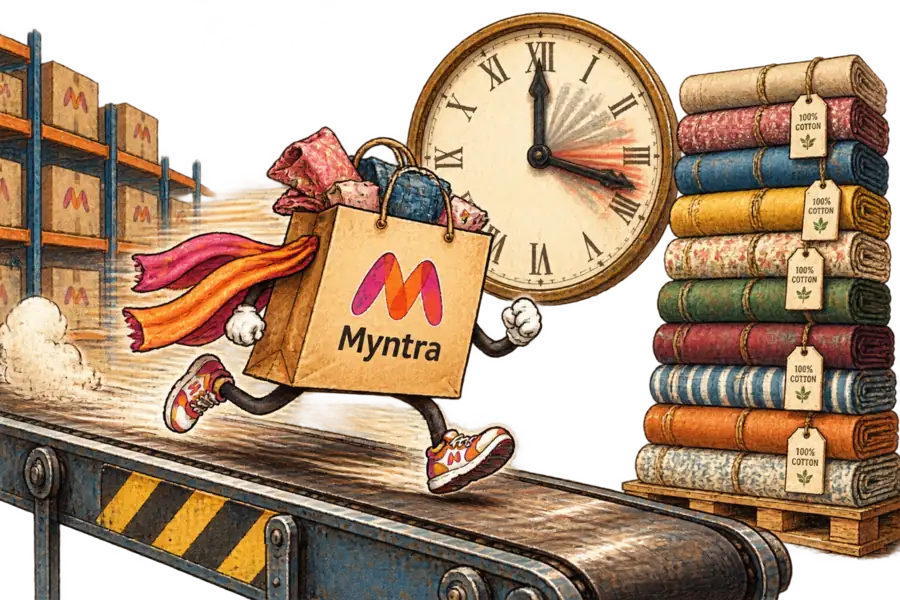
Myntra Took 40 Percent Off the Launch Clock. The Buy Was Placed in January.
Myntra's 40 percent time-to-market cut came off its software development lifecycle, and the merchandising gains disclosed alongside it sit almost entirely on the content side of a listing. The assortment those listings describe was committed months earlier, on a calendar generative AI does not reach.
Neritus Vale
Myntra’s 40 percent came off the software. The company said in July that generative AI had cut its product time-to-market by that margin over the previous year, a disclosure first reported by Moneycontrol and carried across the Indian trade press as a launch-speed number for clothes. Indian Television, reporting the same figures, named what the models were doing: turning product requirements into machine-readable specifications, generating technical documentation, automating parts of software testing. That is a release-cycle gain, and it is real. It is also downstream of every decision that determines which garments Myntra has to sell.
The merchandising compression Myntra disclosed in the same week is narrower than the headline and more interesting. Catalogue generation fell from roughly a day to four hours, which means the constraint on how fast a style reaches a live product page is no longer the product page. Seller onboarding, previously ten to fifteen days, now closes in under two. Sharon Pais framed the programme as giving brand partners “clear pathways to scale,” and scale here means throughput. The same disclosures include one gain that isn’t content at all: supply-chain simulations that used to take two days now finish in an hour, a planning gain that still runs after the range has been decided. Set that aside and every other gain on the list sits on the content side of a listing: photograph it, describe it, tag it, film it, publish it.
Count backwards from the festive floor and the arithmetic gets interesting. Myntra opened its 2025 Big Fashion Festival on 20 September with four million styles from fifteen thousand brands. Indian apparel still runs end-to-end lead times of 90 to 120 days, which puts the last of those garments into production somewhere around May. The fabric bookings, the first sample rounds and the range decisions authorising that production sit further upstream again, ahead of the lead-time count rather than inside it. If a brand’s buying calendar runs as far ahead of production as open-to-buy planning typically does, the autumn range for a brand still working the two-collection year gets decided closer to January than to September.
The part of that timeline generative AI has not touched is the part that was never manufacturing. Nitish Varshney’s September analysis of Indian sourcing puts value-adding production at under 40 percent of total lead time. “The rest is lost to waiting,” he writes, “to approvals, clarifications and misaligned decisions.” A PUMA sourcing leader quoted in the same piece traces a seven-to-ten-day slip in design handover through to warehouse deliveries landing a month or more behind plan. None of that is a content bottleneck. It is people waiting on other people to commit, and a model that writes product copy does not shorten a wait for a signature.
Myntra has made the catalogue faster than the buy that fills it.
Saved weeks are worth what the next constraint lets you spend them on. A style can go live in four hours and still belong to a range fixed in January, which converts the gain into listing throughput rather than in-season responsiveness. Myntra can publish faster than anyone else in Indian fashion and still be selling what it committed to before the year’s first trend signal arrived. The saving is genuine, and operating cost is the right place to book it. Nobody at Myntra has claimed otherwise; the merchandising reading is being supplied on the company’s behalf.

The condition under which this argument fails is a sourcing base compressing as fast as the catalogue. It is not hypothetical. Apparel Resources reported in July that Indian brands have pulled trend-led lead times down from 90–120 days toward 50–60, and that the two-collection year is giving way to eight or twelve drops built on test-and-replenish rather than upfront bulk commitment. Myntra is pushing the same direction in at least one category: DFU Publications described its men’s casualwear overhaul moving from seasonal planning toward demand-responsive inventory, with trend-first clusters launching new styles weekly. If the buy compresses to six weeks, January stops being a ceiling and the cataloguing gain starts compounding against something worth compounding against.
The answer is that the compressed players are not the marketplace. SNITCH and Soch shorten their cycles at least in part because they own their labels and contract their own production, an ownership structure that would let a sales signal reach a factory without crossing a third party’s range plan. Myntra sells fifteen thousand brands and owns none of their fabric bookings or approval calendars. Its leverage over a seller’s schedule runs through a purchase order and a listing fee, instruments for buying inventory sooner rather than for designing it later. The men’s casualwear clusters are the exception the company can point to, and they are hundreds of styles a week set against a festive floor of four million.
Myntra’s market position makes the gap cheap to carry and expensive to keep. BofA Securities, reading Sensor Tower data in June, found Myntra widening its lead in Indian fashion on what Business Standard reported as relatively thin competition in premium fashion and beauty. A leader with that much slack can afford a catalogue faster than its buying, because no rival is presently positioned to exploit the lag. That protection lasts exactly as long as the lag stays invisible to shoppers. If a competitor pairs Myntra-grade cataloguing with a six-week sourcing loop, the two halves of a launch reconnect, and the contest shifts from who lists fastest to who can commit latest.
Myntra has bought itself weeks and banked them in the one place they cannot become responsiveness. Where they land next is a merchandising decision, not a technology one.