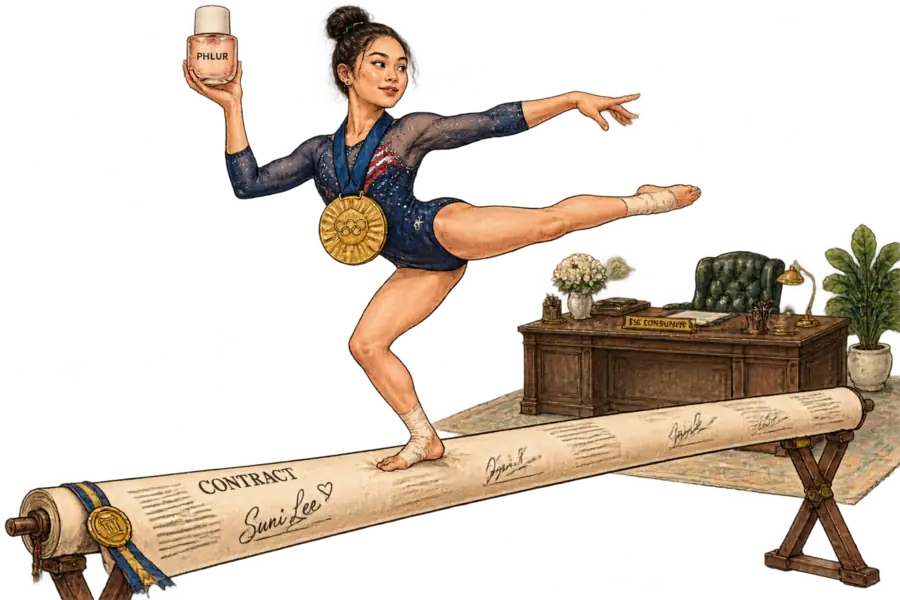
Phlur's Ambassador Is Easier to Underwrite Than Its Founder
Ten months after selling to TSG Consumer Partners, Phlur handed its first celebrity ambassadorship to Olympic gymnast Suni Lee. The appointment converts demand built on one founder's biography into something an owner can contract for, price and eventually sell.
Sir John Crabstone
Phlur named the Olympic gymnast Suni Lee its first celebrity ambassador ten months after TSG Consumer Partners agreed to buy the brand. Three fragrances account for 40% of Phlur’s sales, and the campaign is built around exactly those three. This is an ownership decision, filed under marketing.
What TSG bought was a brand assembled out of one person’s biography. Chriselle Lim relaunched Phlur, in Lim’s own telling, “during a really transformational time, when I was going through my divorce”. The fragrance that made the company, Missing Person, sold on that story years before TSG owned a share of it. An owner can commission a fragrance; it cannot commission the life that sold the last one.
A founder comes with a life; an ambassador comes with a fee and an expiry date.
TSG’s announcement kept Lim as creative director with a meaningful stake, which is how a buyer holds on to a founder’s face while arranging not to need it. The campaign, Icons with an Icon, launches no product. It adds a second face to a brand that had only ever required one.
The org chart moved first. Phlur installed a chief executive from Moon Juice in May 2024, and the founder kept the creative title. TSG did not invent the distance between the brand and the person who built it. TSG paid for it.
The exit is the point. Whoever buys Phlur from TSG will ask what those three scents do if the founder stops supplying the story, and nobody can answer that today. An ambassador does not answer it either. It gives the file a second name to point at.
Geography explains the timing. Phlur is projected to reach $175 million in retail sales this year, and in the spring began a rollout into more than 300 Sephora doors across 15 European countries. A creator’s following is a domestic asset, tied to a platform and an audience that skews American. An Olympic gold medal needs no translation, and it does not depend on what its holder posted on Sunday.
The trade press read the appointment as a milestone for Phlur, which it is. It is also the second time in roughly a year that the same athlete has been installed as a brand’s first celebrity face; Tatcha did it in June 2025. The novelty belongs to the owners, not the athlete. That is not a brand pattern — it is a post-acquisition one.
Lim signed with CAA in April, for representation across brands rather than one. The timing reads less like ambition than hedging: a founder building a career that outlasts the brand she is best known for, in the same season its new owner builds a marketing plan that outlasts her. Owner and founder spent the same spring reducing their exposure to each other. Only one of them had to call it a campaign.