
Pinduoduo Pays Sellers Without Proof but Gives No Count of Appeals Upheld
Pinduoduo says it now repays merchants' losses on complaints and refunds its systems and reviewers judge abnormal, sometimes before they appeal; merchants it cites needed no extra evidence. Its release gives no share of appeals upheld, and a general clause in its user terms would put the burden of proof on any user it judges abnormal.
Sir John Crabstone
Pinduoduo now repays merchants, sometimes unasked, for goods and postage lost to complaints and refunds it judges abnormal. Its release, carried by Cailian Press on 16 November and attributed to an unnamed merchant-service official, cites unnamed merchants who were paid the day they appealed, “无需额外提供举证材料” (no extra evidence needed). The proof has not vanished. It sits in a platform verdict whose accuracy the release does not report.
The service, 申诉优赔, runs on two channels: merchants appeal, and the platform steps in, the release says. Pinduoduo says technical means and manual review identify and verify the appealed orders, and it pays once they are verified. The release’s opening line adds that the platform itself flags abnormal complaints and refunds.
A screenshot Cailian ran shows the merchant’s view. On an order for a women’s cotton-linen T-shirt, a pop-up says the merchant’s responsibility is relatively small and reports ¥29.60 returned. It adds that the merchant need not appeal, because the platform already has.
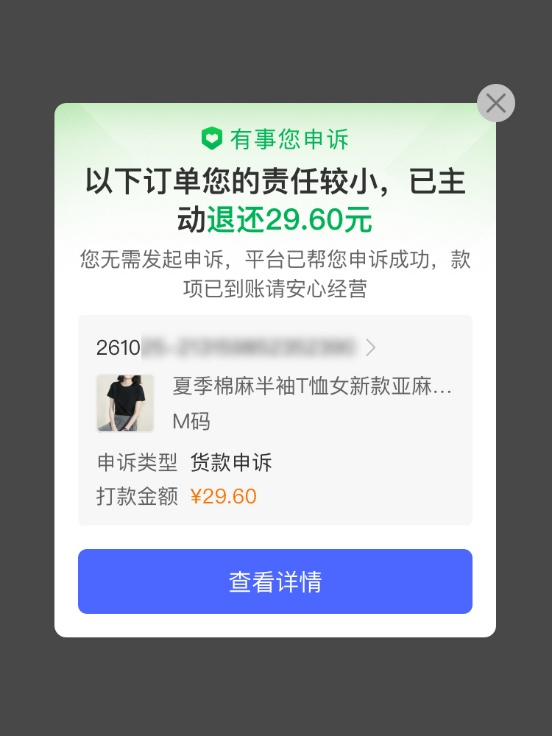
Pinduoduo can now file a merchant’s appeal and grant it.
By Pinduoduo’s count, single-day appeals reach “达百万级” (the million level) and daily payouts exceed ¥10m. China News Service headlined annual payouts of “数十亿元” (several billion yuan), dropping the release’s “可达” (can reach). Both figures measure throughput, not whether a verdict was right.
The release gives no share of appeals upheld and no count of buyers flagged. It does not define “异常” (abnormal), mention refund-only claims, or date the launch beyond “近日” (recently). Its headline calls the million a daily average; its body calls it a single day.
In September 2024 Pinduoduo said it would pay for goods when a merchant’s appeal succeeded; a frozen-chicken seller told the Economic Observer he had appealed dozens of refund-only orders. Until that month, he said, a limit of 100 failed appeals a year made him contest “仅退款” orders selectively, weighing pass rates. His account of the change describes a test among some merchants, inside a round-up of Pinduoduo’s merchant support measures. He weighed pass rates; the release gives none.
Buyers behind verified abnormal claims face “风控标识、信用降级、权限限制” (risk-control flags, credit downgrades and restricted permissions), the release says. It calls the penalties graduated and applies them to related accounts. It mentions no appeal and no compensation for a buyer wrongly flagged.
Pinduoduo’s user agreement holds a standing clause, §6.6 of version 4.2 (effective 16 February 2026), that covers every kind of breach. It lets the company judge a user abnormal from factors including “海量用户数据的关系” (relations within vast user data) and “生活常识” (common sense). A user so judged must give “充分举证和合理解释” (sufficient evidence and a reasonable explanation) or may be found in breach. No source ties the clause to 申诉优赔; were it applied to a flagged buyer, the merchant would be spared the proof and the buyer would not.
Photographs are weaker proof than they were. A sock seller we cited in October reported refund claims pictured with AI-made holes and stains.
Sellers’ pictures draw the same doubt. Clothing, shoes and bags topped a China Youth Daily poll of categories where respondents said AI images mislead, at 53.8%; the poll measures perception, among 1,334 online respondents, and our write-up covers the detail.
At a 10 November meeting, Peng Zengtian, a deputy head of China’s market regulator’s enforcement bureau, suggested that platforms “积极协助消费者举证维权” (actively help consumers prove their claims), Cover News reported. The remark came in a passage on consumer redress for counterfeit and shoddy goods, not abnormal-refund rulings.
China Consumer News reported Peng saying that if platforms act as “守门员和裁判员” (goalkeeper and referee), many consumer disputes can be settled at source; Cover News’s account carries only the goalkeeper. Pinduoduo’s own release invokes the same meeting. A referee is judged by the calls it gets wrong; the release gives only how many it makes.