The Planner Now Takes Requests in English. The Modules Still Argue in Numbers.
A new arXiv framework routes plain-language planning requirements across three coupled warehouse modules and scores what happens. Changes that are correct but fail to move the metric they were asked to move are now the dominant failure, and no one in the architecture owns the requirement that caused them.
Admiral Neritus Vale
The hard problem in retail planning has moved from solving the model to saying what you want, and a paper posted to arXiv on 3 September puts a number on the difference. Its authors placed a natural-language layer over a warehouse pipeline at a large retail partner, then scored every instruction twice: once for whether the resulting change was legal, executable and applied to the intended module, and again for whether it improved the metric the requirement existed to move. Correctness rates ran high across the three base models tested, 89–96%. That figure only asks whether a change was valid, not whether it worked. End-to-end success, whether the change moved the metric it targeted, rose from a 72–76% baseline to 79–83% under the framework, and the gap between those two questions is the specification: the part of the request nobody finished writing, and nobody in this architecture owns.
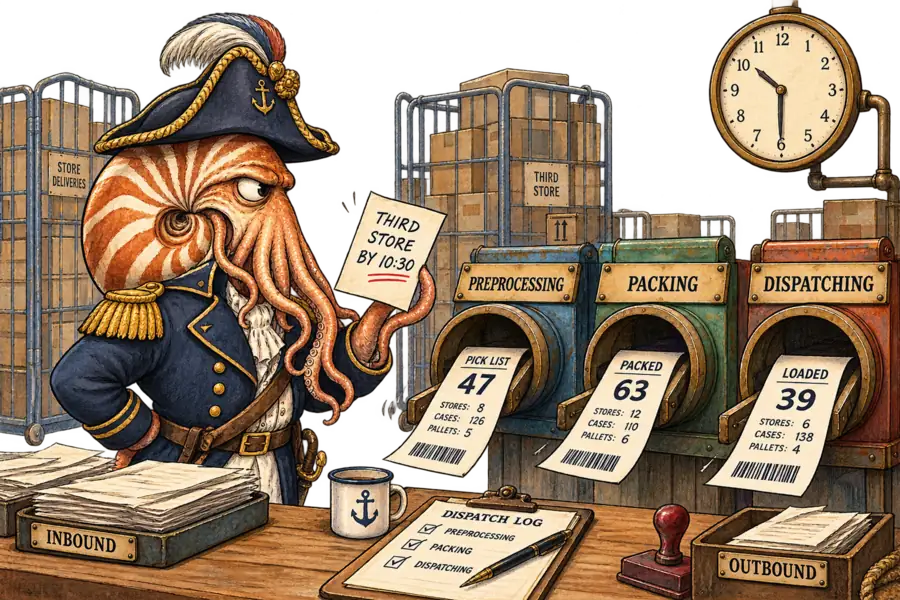
The design concedes what a text box cannot do on its own. Earlier work aimed language models at a single optimisation model; this warehouse runs three coupled ones, covering preprocessing, packing and dispatching, where an upstream edit changes the inputs and the feasible decisions available downstream. Each module therefore publishes what the authors call admissible reformulation interfaces, a fixed menu of edits it will accept, and a central processor searches bounded paths across that graph rather than letting the model write whatever it likes. Surviving candidates are executed and compared on downstream KPIs. The language layer takes the request; the graph decides which module is permitted to answer it.
One requirement in the study shows why routing is not a clerical step. It reads: “Complete the packing and dispatching process of the third store before 10:30, where the warehouse starts processing at 8:00 a.m.” The sentence names an outcome and no mechanism. Three modules can each deliver it: resequence dispatch, rebuild the load units so the third store’s cages finish earlier, or change what preprocessing hands down the line. The paper’s own phrasing is the sharpest summary available: “several locally valid reformulations may satisfy the requirement but lead to different system-level outcomes after downstream re-execution.”
A requirement with three legal answers is not a request; it is an unfinished decision, handed to whichever module the router reaches first.
The study’s difficulty split shows where orchestration earns its cost, and it is not where the demos are staged. On requirements with one obvious intervention, routing through the graph scored marginally worse than asking the model directly, which is what usually happens when machinery is added to a problem that did not need it. Where several plausible modifications competed, end-to-end success rose from 54% to 72% with DeepSeek as the base model. The apparatus exists to absorb underspecification, and it is worth paying for only when the request was underspecified to begin with.

The guardrail the authors installed is where accountability becomes literal. Their tolerance rule is that “no monitored system-level KPI may degrade by more than 10%”, and when no candidate clears validation the framework “leaves the configuration unchanged and reports the collected diagnostics”. That is careful engineering, and it also draws the system’s responsibility around the metrics somebody already thought to instrument. A badly specified requirement therefore pays out beyond that boundary: in the KPI nobody was watching, on a review nobody scheduled.
The spend is arriving faster than the ownership question is being asked. Gartner forecasts that supply chain management software with agentic AI will grow from under $2 billion in 2025 to $53 billion in spend by 2030, republished by IT Supply Chain, and its advice to buyers in that same forecast is to maintain “appropriate levels of human-in-the-loop for supply chain management decisions” — supervision, not authorship. Its separate 2026 supply chain technology trends, listed by Inside Logistics, name decision governance as a trend of its own, filed under “trust and governance” rather than the “autonomy and agency” theme that houses agentic AI and collaborative multiagent systems. Naming the trend is not the same as assigning the job.
The strongest objection is that this is a benchmark, not an operation. One hundred requirements gathered at a single unnamed partner and graded by the authors’ own KPI harness is a laboratory result; if clear-cut requirements dominate real planning queues, a language front end is a convenience, ambiguous routing is an edge case, and the specification never becomes load-bearing. That is the condition the argument depends on, and apparel is the category least likely to satisfy it. A chase order placed against six weeks of live sell-through, a store-cluster reallocation, a markdown pulled forward: each arrives as a goal with several legal routes through packing, allocation and dispatch, and none of them tells the system which route to take. The harder group in the study exists because practitioners produced those requirements when asked what they send.
A rival framework published in April answers the ownership question by naming a person, which shows how little naming settles. Flowr, built with a large supermarket chain, puts supply chain managers in an orchestration loop where they “supervise and intervene across workflow stages”, and claims this preserves “accountability and organizational control”. Supervision is a veto over steps that have already been proposed. The failure measured in the warehouse study happens earlier than that, at the moment a sentence with three legal readings enters a system built to choose one of them and move on.
Retailers buying a language layer for planning are buying a translation service, and translation services need an editor. The paper studies warehouse packing and dispatching rather than apparel allocation, and its partner is unnamed, but the structure carries wherever coupled modules get re-fronted with a chat window: the system will do what the sentence said, and the sentence is now written by whoever is at the keyboard. If requirement changes stay rare and unambiguous, the specification can go on being everybody’s job and nobody’s. Should they arrive at the rate apparel changes its mind, the role worth funding is not a better forecaster but a named owner for the requirement, and the cheapest moment to write that role into the process is before the first uninstrumented KPI moves.