Qwen Haggles With Taobao Shops, and Alibaba Has Not Said Whether It May
Shoppers in China are sending Alibaba's Qwen into Taobao shops' customer-service chats to ask for discounts. As of 20 November Alibaba has not said publicly whether its agent may; Taobao's rules time larger shops' human replies, and in one newspaper test a Taobao page stopped Qwen's second haggle before, Qwen said, a single bargaining message went out.
Sir John Crabstone
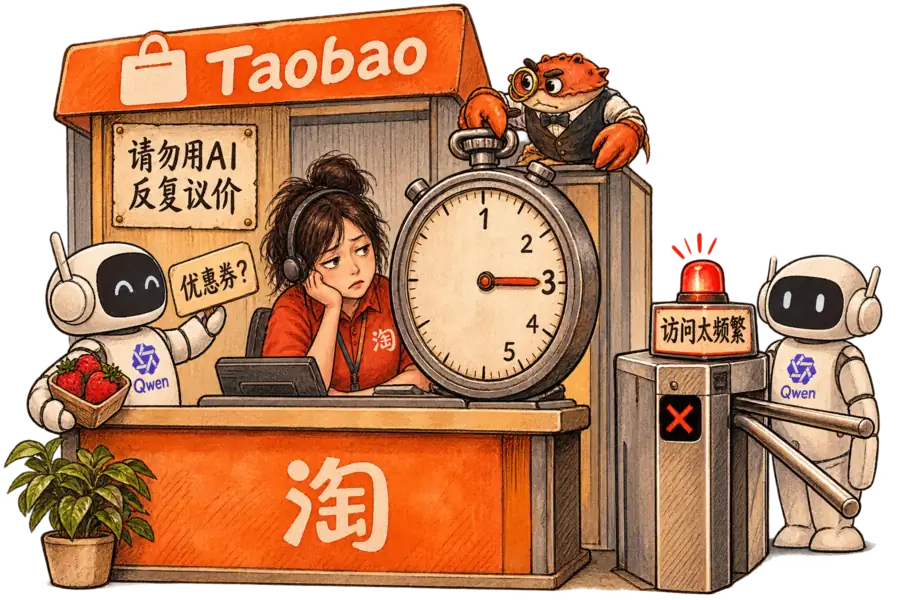
Chinese shoppers are sending Alibaba’s Qwen into Taobao shops’ chat windows to ask for discounts, and at least one shop has asked them to stop. As of 20 November, Alibaba has not said publicly whether its agent may haggle with its own merchants. A Taobao page stopped one of a newspaper’s two test haggles, citing visits that came too often.
On 16 November 新京报 (Beijing News) reported a shop notice circulating online. The paper’s summary says customers bargaining through Qwen had caused the shop some trouble (一定困扰), and that it asked them to stop letting AI bargain repeatedly. The Qwen team had not responded at the time.
The savings are the posters’ own. In a 极目新闻 (Jimu News) round-up carried by 大众网, one user said Qwen combed their cart and got 200 yuan off a 2,099-yuan floor-washer, plus a 199-yuan gift. The round-up also named one such shop: 歪瓜出品, which sells anime goods and welcomes friendly bargaining.
When the Qwen Go! agent launched on 13 October, 新京报 found it could pursue delayed-flight compensation and claim Taobao price-protection refunds. The paper’s list was illustrative, and included pressing an airline’s service desk for cash. Taobao shops were not among the examples.
Those refunds, which we covered in October, run on a rule: the system computes the difference and the merchant pays. A haggle usually lands on a shop assistant, who must read it and decide.
The news app 南方+ (Southern Plus) tested Qwen on 17 November. Asked to bring strawberries down from 50 yuan a jin (500 g) to 40, Qwen was refused. It then asked twice for a shop coupon or a special price-change link (专属改价链接). The haggle took about ten minutes and failed.
The garment haggle failed sooner. Taobao’s page said visits were too frequent (访问太频繁), 南方+ reported. Qwen told the reporter that its third visit in a row to the service window had tripped a frequency limit. It then asked for human verification, which the reporter completed, and then for a fresh login. Qwen said Taobao’s risk control had blocked the window before a single bargaining message went out. Taobao has not explained the block.
Taobao’s legal notice, in force since 7 October, bars third-party agents lacking prior written permission and tells them to answer human-machine checks truthfully. Qwen is Alibaba’s own app; the notice says that permission comes from Taobao’s service provider and its affiliates. It does not say whether a shopper’s agent may bargain in a merchant’s chat.
The notice sets a rule about permission; the page that stopped Qwen spoke only of frequency.
A shop’s side is timed. Taobao’s customer-service standard, dated April 2024, grades larger shops on the share of buyer conversation turns a person answers within three minutes, and sets the bar at 80%. Conversations the platform judges abnormal do not count toward the score. The standard predates these agents and does not say how their chats are classed.
National Business Daily (每日经济新闻) relayed netizens weighing the token cost of a haggle against the time it saves the shopper. It also quoted Qwen’s own account: AI that contacts merchant customer service by itself (AI自动沟通商家客服). What the shops’ complaint costs them in staff time, none of these reports measures.
Alibaba’s 11 May release linking Qwen to Taobao’s catalogue pledged “trillions of tokens” to Dianxiaomi, its customer-service AI for merchants. The aim: replace scripted chatbot replies with agents that can close sales. If Dianxiaomi answers bargaining chats, Alibaba’s agent will be haggling with Alibaba’s agent over the merchant’s money.