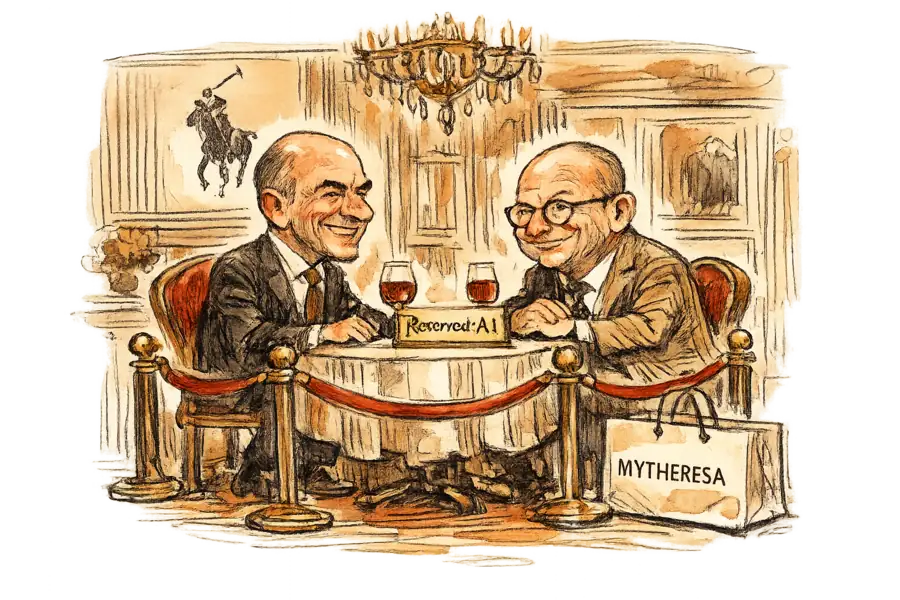
Ralph Lauren and LuxExperience Reserved the AI Table. It Seats Ten Percent.
Ralph Lauren and LuxExperience walked Wall Street through their AI roadmaps two days apart, both scoping the spend to the top decile of customers. The democratization pitch the sector has run on since 2023 is finished.
Sir John Crabstone
The democratization pitch is buried. Within two days of each other, Ralph Lauren and LuxExperience walked Wall Street through their AI roadmaps and scoped them, without apology, to the customers who already spend most. That is not retail AI as the vendor decks sold it; it is clienteling with better tooling.
Glossy caught both calls in the same brief and treated the symmetry as routine. It is not routine. For three years, vendor decks promised AI as a great leveller: any shopper, anywhere, served with the attention once reserved for the woman with a private styling appointment. Both houses last week confirmed the inverse.
Ralph Lauren gave the game away first. Patrice Louvet credited a Q4 in which the company added 1.4 million DTC customers and tilted further toward “more elevated, younger, less price-sensitive consumers,” with AI deployed against full-price selling and “iconic styling at our consumers’ fingertips.” The CFO was franker about the outlet channel: AI will make promotional offers “more precise and more targeted.” Targeting promotions precisely is the polite term for not giving them away.
LuxExperience said the part on the slide. On the Q3 call, Michael Kliger named the top-tier cohort as 9.7% of customers at Mytheresa and 10% at Net-a-Porter, with the stated ambition of “4% making 40%.” The generative AI work — newsletter recommendations, on-site search, product imagery — delivers personalised content to that cohort, directed by predictive customer-value models that Kliger, as reported by Glossy, first described publicly in 2021. The 4% are the only audience the math was ever for.
This is the moment to bury a piece of received wisdom.
The claim that AI would democratise luxury service was never a forecast. It was a sales pitch from vendors who needed the buyer pool to be larger than the buyer pool turned out to be. Luxury operators have always served two customers: the ones who spend and the ones who scroll. AI has only made the cost of separating them collapse.
What is left to argue is who is willing to name it. Ralph Lauren framed its AI through full-price selling and elevated demographics, which is the same admission in a more decorous suit. LuxExperience put the percentage on the slide. Anyone still describing AI in retail as a great equaliser is reading from a 2023 deck; the operators have already moved.
The democratization story did one job: it justified the spend. What the other ninety percent were sold instead is the question no transcript will answer.