Reformation's Prospectus Says Carbon Neutral. Its Risk Factors Say Offsets.
Reformation's registration statement states the same fact twice, once as a virtue and once as a purchased offset. The listing did not change how the company makes clothes; it changed who can sue over how the company describes them.
Admiral Neritus Vale
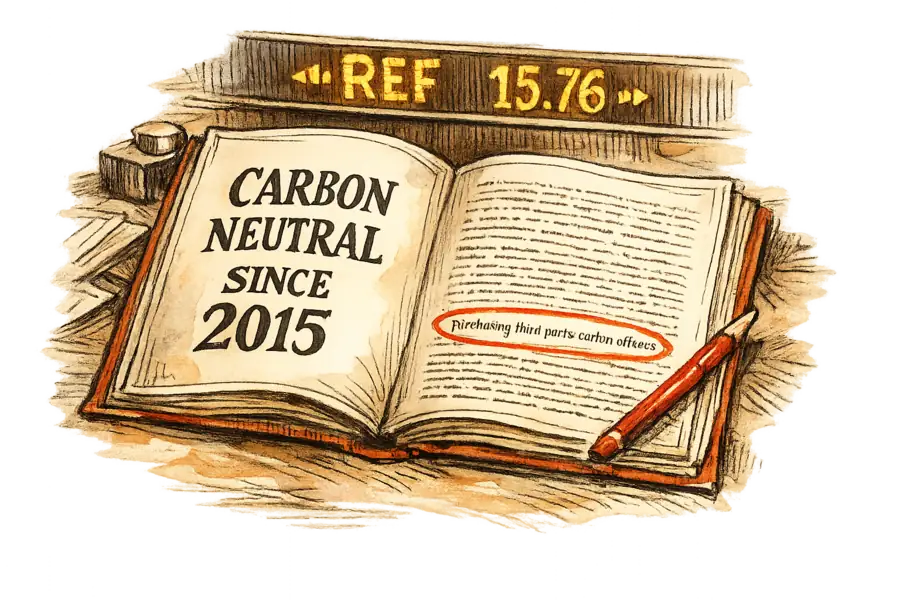
Reformation’s registration statement records the same fact twice, and the distance between the two versions is what a listing does to a values brand. The business section says its products “have been carbon neutral since 2015”; the risk factors say that in 2015 the company “began purchasing third party carbon offsets with the intention to make up for our environmental footprint.” Both are true, and the second is what the first turns into once a securities lawyer has been through it. Trading since 30 July, Reformation makes clothes exactly as it did in June. What changed is who can sue over the description.
The safe harbour that shields public-company forecasts does not cover the document that made Reformation public. Cooley’s IPO handbook states it flatly: the PSLRA shelter “applies only to reporting companies and therefore does not apply to forward-looking statements made in connection with an IPO.” Section 11 of the Securities Act holds an issuer liable for material misstatements in a registration statement without any showing of intent, which leaves cautionary drafting as the primary defence. The 2030 circularity commitment, the RefScale figures printed on every product page, and the Climate Positive claim are now resting on that drafting rather than on the brand’s standing with its customers. The filing concedes the exposure in its own words: those metrics “receive limited or no assurance from and/or verification by third parties,” involve “a less rigorous review process” than a traditional audit, and “may not identify errors or protect us from potential liability under the securities laws.”
The prospectus is the first document in Reformation’s seventeen-year history where both sentences had to sit between the same covers.
The market set its price on this before any regulator or plaintiff did. Reformation priced at $15, the bottom of a marketed range that ran to $17, and closed its first day essentially unchanged. A company that describes itself in its own filing as “the largest sustainable womenswear brand on the planet (that we know of, anyways)” was underwritten as a profitable specialty retailer and nothing further. Six sessions later it closed at $15.76, worth slightly under twice trailing net revenue. The premium the story once carried has already been taken out of the price, which means the cost of maintaining the story now sits on the expense side with no matching line opposite it.
The comparison that matters is the last cohort to sell this story to public markets. Allbirds priced at the identical $15 in November 2021 and closed its first day 91% higher, worth roughly $4.1 billion. It was losing money, and the valuation rested on the sustainability narrative rather than the income statement. Rent the Runway, public six days earlier that same autumn, is now worth roughly a tenth of its listing valuation. Reformation arrives profitable and growing and is valued at a fraction of what an unprofitable Allbirds fetched, which is the market paying for the operating model and declining to pay for the adjective.

The next test of the claim has a date on it. On 27 September 2026 the EU’s Empowering Consumers for the Green Transition directive starts to apply across member states, and it bans outright any claim that a product is carbon neutral on the basis of offsetting. Reformation trades in France, names the United Kingdom and France in its own risk disclosure, and points to Western Europe as its next growth market. The filing has seen this coming: it warns that its definitions of “sustainable,” “climate positive,” “circular” and “deadstock” “may evolve or change, including across geographies,” and it cites the 2024 EU greenwashing rules. If the directive is enforced as drafted, a product-level claim the company has made since 2015, and which the filing traces to purchased offsets, becomes unlawful in a market it is expanding into less than two months after listing. The company can keep the practice or keep the sentence; the rule does not let it keep both in that market.
The strongest case against all of this is that greenwashing litigation does not work, and the record supports it. Allbirds beat the consumer class action over its sustainability marketing, then in February 2026 won final dismissal with prejudice of the securities case brought over its IPO registration statement, after three amended complaints. For the argument here to fail, that outcome would have to be both repeatable and cheap. It was neither. The defence ran more than four years and turned partly on a traceability ruling whose facts do not transfer cleanly from one float to the next. By the time the last dismissal landed, Allbirds had sold its shoe business for $39 million and repurposed the listing as an AI shell, which is what winning looked like.
The consensus reading of this listing is that values and profit have been shown to coexist, and the use of proceeds says something narrower. FashionUnited framed the debut as evidence that investors will back women-centric, sustainability-led brands, quoting a wealth advisor’s line that “growth, profitability, and sustainability do not have to be competing priorities.” Over 90% of the net proceeds go to repaying term loans. A large share of that debt is recent: the filing discloses that the company drew $92.0 million of fresh term loan commitments on 17 June and paid its shareholders a dividend of $1.63 a share, and the registration statement followed weeks later. The offering did not fund the circularity roadmap. It refinanced a payout to the owners, which is the plainest demonstration of what a prospectus does to a brand story.
The price of a ticker is that every sentence in the brand book acquires a reader with subpoena power. Reformation can carry that: a business with $507.1 million in revenue and a real net income line can buy audit-grade assurance for its carbon accounting if it decides the claim is worth the cost. Most of the brands watching this listing before choosing a 2027 window are smaller, and for them the arithmetic runs the other way. If assurance stays expensive and the EU rule is enforced as written, the rational response is not to stop making clothes this way but to stop saying so in language a plaintiff can quote. Watch for that outcome rather than for a lawsuit: the practice intact, the claim quietly withdrawn, and shoppers left without the one instrument they had for telling brands apart.