The Shell Was Worth More Than the Brand
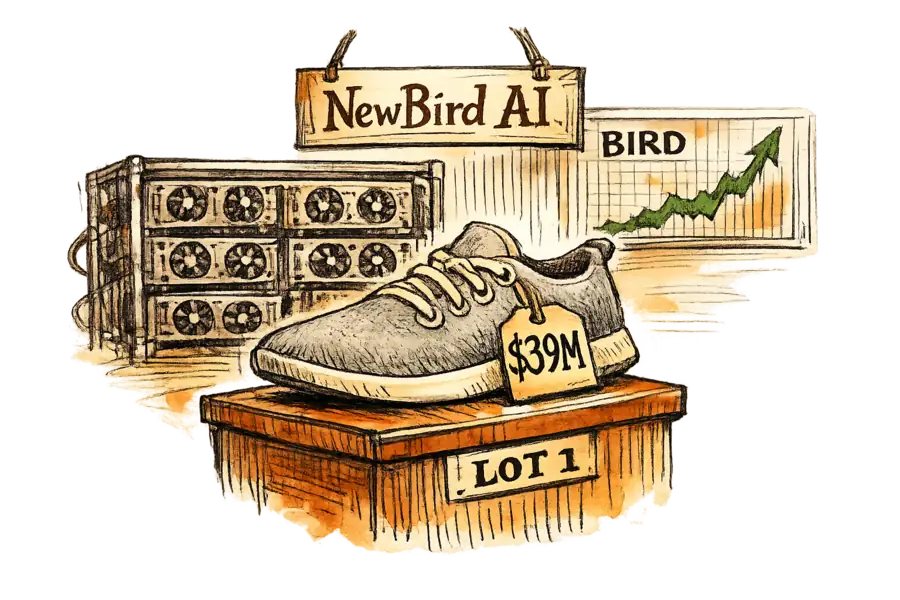
Allbirds has agreed to sell its shoe brand for $39 million and announced a GPU-as-a-service pivot that lifted the shell's market cap by roughly $122 million. The spread is a referendum on how public capital prices AI exposure against consumer brand equity.
Neritus Vale
Allbirds signed a deal to sell its shoe business to American Exchange Group for $39 million in March — both that transaction and the new financing remain subject to a shareholder vote scheduled for May 18 — and this week announced it would rebrand as NewBird AI and use new convertible financing to buy GPUs. The empty shell added roughly $122 million in market value on the news. That spread is the thesis: public capital is pricing a vague claim on AI compute above a functioning consumer brand, and if this pricing holds, apparel founders with liquid stock will run the same play.
The brand was not the asset; the listing was. The shoe brand and its accumulated footwear IP went to a rollup buyer for under $40 million — the U.S. full-priced stores had already been closed in February, a separate wind-down that preceded the deal. Nasdaq ticker BIRD, the corporate charter, and the investor relations scaffolding around it stayed with the seller and were repriced as an acquirer of graphics processing units. An unnamed institutional investor committed $50 million in convertible financing against that premise, more than American Exchange Group paid for everything Allbirds actually manufactured.
The public playbook for this trade was written in 2017. Long Island Iced Tea Corp. renamed itself Long Blockchain, watched its stock leap 380% on the day, and was eventually delisted; the SEC later charged insiders with trading ahead of the announcement. Every pivot cycle produces a few of these — dot-coms that added dot-com to their names, cannabis shells, crypto shells — and in each case the move works once, pricing in an option that the shell almost never exercises. The Allbirds case differs in one respect. The option is at least more plausible this time, because GPU-as-a-service is a real business that real customers are buying from real incumbents.
Apparel founders with damaged public stock now have a template. The brand and operations can be sold to a private rollup at whatever multiple operators will pay, while the remaining equity vehicle is relisted against an AI thesis the market will fund at a multiple of the business it replaced. The gating requirements are a small float, a depressed price, and a narrative sparse enough to reposition but credible enough to clear the first wave of due diligence. Allbirds’ founders cleared that bar by asking shareholders to strike references to environmental conservation from the corporate charter, the exact concession a mission-driven brand used to refuse. What is left to sell, after a brand is unbuilt, is the right to be listed in the sector the market wants to be long.
The $4 billion valuation Allbirds carried in 2021 is now visible only as the gap between what the brand sold for and what the ticker is worth without it.
The counter-argument is that this is a microcap curiosity and nothing more. Allbirds’ market cap before the pivot was roughly $21 million, and a doubling or tripling of that figure says almost nothing about how the market would price the same trade at a larger apparel business with positive cash flow. Steve Sosnick of Interactive Brokers read the reaction as froth, and Thursday’s sharp reversal supports him. For that reading to hold, demand for GPU-as-a-service exposure would need to stay confined to shells too small for institutions to care about. The convertible already signed against this shell suggests at least one institution cared, and once one desk has underwritten a pivot at this scale, the next apparel CEO to run this trade will not need to argue from first principles.
What the convertible actually funds is a small cluster against competitors running balance sheets two orders of magnitude larger. The stated use of proceeds is GPUs and related high-performance computing infrastructure, the same shopping list as CoreWeave, Lambda, and Nebius, and one that requires power contracts, data center leases, and hardware that depreciates at the rate of the next Nvidia cycle. The operating case rests on a tight compute market and on enterprise customers being willing to buy capacity from a vendor whose prior experience is sustainable sneakers. That is a thin premise, and the market may yet punish it. None of that reverses the trade that was already run.
The price of this trade is a capital markets lesson in what consumer brand is for. Allbirds’ 2021 valuation was underwritten by a story about conscious consumption sold at a tech multiple, and public markets are unlikely to pay that way again for a shoe company any time soon. The fastest route back to the lost multiple is to rename the container, not rebuild the product. If more apparel founders run this trade, the category loses its argument that footwear and clothing businesses deserve equity capital on their own terms. What the shell sells now is exposure to the label. That is the referendum.