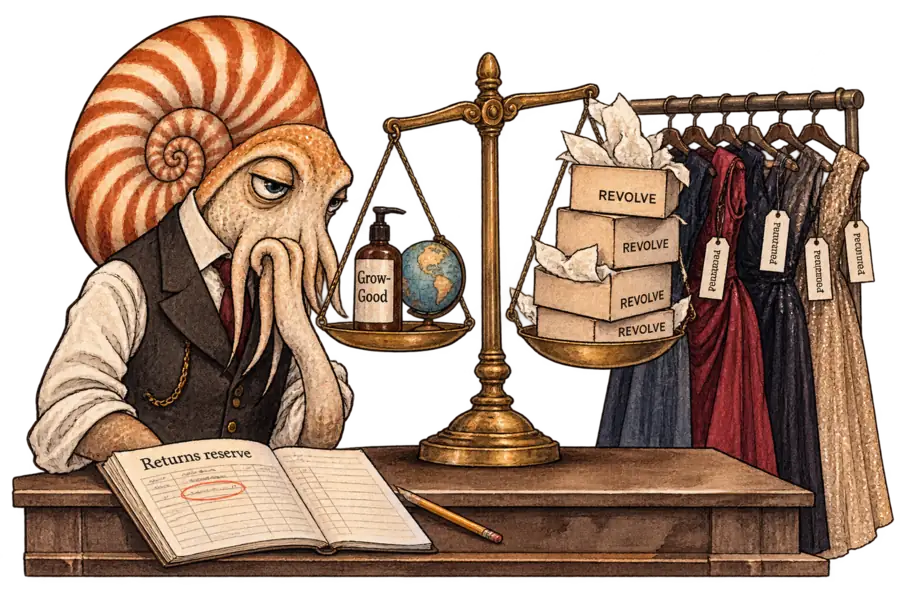
Much of Revolve's Lower Return Rate Owed Nothing to Better Fit
Revolve's 10-Q implies a third-quarter return rate 2.3 points lower, at about 55.6% of sales before returns. Cardi B's hair care, a smaller share of dresses and slightly more sales abroad plausibly explain somewhat under half; the rest mixes a 'core' fall Revolve has not itemised with mix the filing does not show, so the quarter is evidence for no particular fit or AI tool.
Neritus Vale
Revolve’s return rate fell by 2.3 percentage points in the third quarter, by the arithmetic of its own 10-Q. The same filing shows where part of that came from: Cardi B’s hair care, a smaller share of dresses and, barely, more sales abroad. Those shifts plausibly account for somewhat under half the fall, and none of them means a dress fits better. The rest includes what Revolve calls “core” declines and any mix the filing does not itemise, such as men’s, stores and shifts within categories.
The results give the return rate only as a change, but the 10-Q prints the reserve booked against returns. Divide the quarter’s provision for returns by sales before returns, which is net sales plus that provision, and 55.6% of what customers bought was expected back. It is a dollar estimate, not a parcel count. A year earlier, the same sum gave 57.9%.
The method checks out against a level Revolve has stated. For the second quarter of 2023 it gives a shade under the 60% that the chief financial officer, Jesse Timmermans, cited on the call, Sourcing Journal reported.
The explanation had two parts, and neither was measured. In prepared remarks, co-chief executive Mike Karanikolas called category diversification “a big driver, along with initiatives to reduce returns in ways that are good for the customer”. Asked for detail on the call, Revolve put “a meaningful portion” down to category mix, “especially with the grow good ramping up”. But “a very meaningful portion”, it said, came from “what I’d call core return rate decreases”.
Glossy’s account kept the mix and dropped the core. It reported Karanikolas crediting a greater share of sales from “categories such as beauty” and from international markets, and noted he “did not quantify each factor’s contribution”. The 10-Q undercuts both examples.
Beauty, as the 10-Q defines it, lost share of sales. What grew was Grow-Good, the hair care Revolve developed with Cardi B, and the 10-Q books it under “Other”. Grow-Good launched in the second quarter on its own site, and every product retails under $20. Its customers are “nearly all incremental”, co-chief executive Michael Mente said in August.
Grow-Good can explain about half a point, and only if nothing booked under “Other”, which also holds shipping revenue, rentals and wholesale, ever comes back. That is a ceiling, since nothing can be returned less often than never. Timmermans has put beauty’s return rate at “a low single digit return rate”, so the ceiling sits close to the truth.
International sales help even less. They grew only slightly faster than domestic sales, lifting their share of net sales from 21.7% to 22.1%. Revolve has said both things about their return rate: lower in the third quarters of 2025 and 2026, yet in March 2025 Timmermans called international “the one offset” to falling return rates as markets localise. The sign does not change the conclusion, because a 0.4-point shift in share moves the blended rate by less than a tenth of a point either way.
The largest shift in the table is one the call never spelled out. Dresses lost about three points of share, while Karanikolas said faster growth was “led by wardrobe essentials like tops, pants, shorts and outerwear”. Timmermans told a UBS conference in March 2025 that dresses have “the highest return rate”. How much their slide lowers the blend depends on a gap Revolve does not publish.
The disclosed mix explains somewhat under half the fall. Weight categories by sales before returns, calibrate to the reserve a year earlier, and give dresses a return rate 15 points above the rest of apparel and accessories. Treat everything under “Other” as never returned, and give Beauty the rate of the rest of the business. The “Other” figure is a ceiling and the dress gap a guess. On those assumptions, the disclosed shifts, abroad included, add up to about 1.0 points.
Only if dresses came back about three times as often as the rest of Revolve’s range would the shifts in its 10-Q approach the whole fall.
The remainder is also wider than Revolve’s “core”. The prepared remarks say men’s and beauty “are also contributing to the reduction in our return rate”, and Timmermans told UBS that men’s and physical stores return less. Shifts toward wardrobe essentials inside a category sit in the remainder too, so it holds mix the table cannot show alongside the core.
Management has described the core only loosely. In August the company said it did not “want to get into specific initiatives” on that quarter’s call. On this call, it cited work “partnering with brands” and said gains from “AI technology and visualization technology” were “maybe a little bit further out”. Its AI credits this quarter went to search, a store app and last year’s markdown margins, not to returns.
The strongest objection is that the core is the fit evidence. Revolve has credited “size and fit technology” before. Asked at the UBS conference how much of its work on returns was technology-enabled, Timmermans said “a meaningful portion of that is technology and AI”. If the third quarter’s core decline came from those tools, working within categories, the quarter would be a fit result after all.
Timmermans’ own list of what worked in 2024 argues against assuming so. He listed policy changes “focusing more on high return rate customers and being more stringent there”. He also cited “size and fit technology” and “less marketing to the high return rate customers”. Two of the three act on customers rather than on fit. A fall bought by advertising less to serial returners looks the same in the headline rate as one bought by better size advice.
Part of this year’s core may also be last year unwinding. In the third quarter of 2025 the rate rose, and Karanikolas blamed it partly on marketing channels with “unusually high increases in return rates”, alongside a negative mix shift in lower-return categories and higher average unit retail prices. Only the channel part can unwind as core; a mix reversal belongs to the mix share. By the 2025 10-Q’s figures, the rate rose 0.45 points that year, from 57.4% in the third quarter of 2024 to 57.9%. Even the whole of that rise is about a fifth of this year’s fall.
The two parts of the fall are not worth the same to Revolve. Timmermans told a William Blair conference in June 2025 that each point off the return rate brings “a 30 to 50 basis point benefit” in selling, distribution and fulfilment. Yet those two lines took a larger share of net sales than a year earlier. Revolve blamed “much higher fuel surcharges”, costlier international routes and Grow-Good’s small orders. A core fall removes return parcels; Grow-Good lowers the rate by adding small outbound ones.
A size-recommendation vendor that cited Revolve’s 2.3-point fall as a fit result would be citing a blend of hair care, dress mix and unnamed initiatives. If Revolve wants its core counted as fit, it could print a dress return rate for customers it already had. Until a retailer prints that, a falling headline rate records what it chose to sell, and to whom.