Senolytic Reached 1,500 Doors. The Definition Did Not.
A $59 senolytic moisturiser landed in more than 1,500 Ulta doors last week. The mechanism claim on the jar has no standing in American cosmetics law, no published method behind its headline number, and a human evidence base of nine trial subjects on entirely different drugs.
Sir John Crabstone
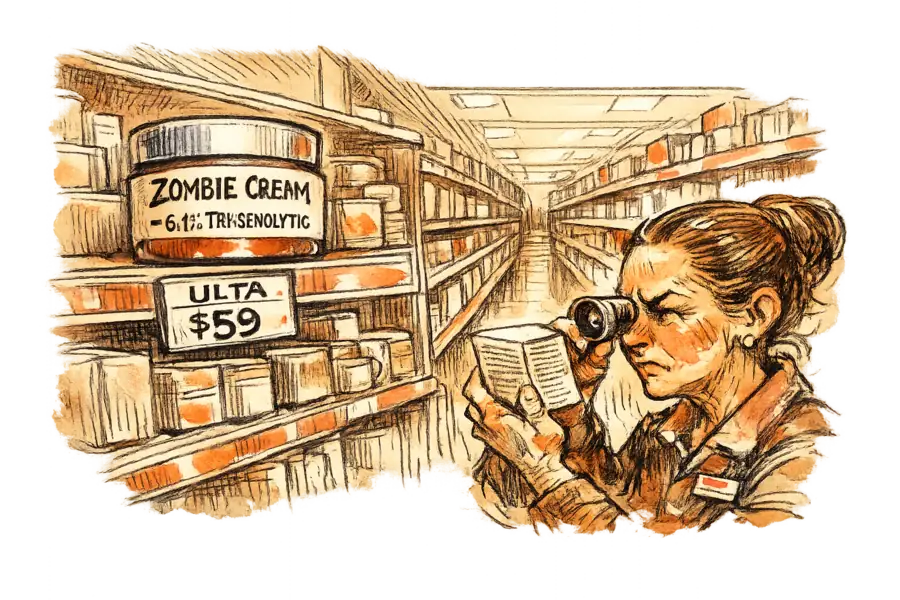
Peach & Lily’s Advanced Rebound BioGlow Zombie Cream reached more than 1,500 Ulta Beauty doors last week at $59, on a twelve-month exclusivity. The word doing the selling is “senolytic,” a term for compounds that clear senescent cells. Nobody in American retail has agreed what it means on a jar.
The brand is careful where care is cheap. The cream is sold as clearing the visible signs of zombie cell damage rather than the cells themselves; the front of the jar offers a mechanism, the footnote retreats to appearance. Both are true at once. Only one of them is why anyone picks it up.
The trade has filed this as an education problem. Peach & Lily’s founder told Glossy she wants to bring senescence into people’s consciousness, and she will; awareness is easier to manufacture than a standard. Teaching a word is not the same as being able to check it.
The 52 percent everyone will repeat belongs to a supplier. dsm-firmenich, which sells the alpine willowherb extract anchoring the formula, calls it a “true senolytic active” that clears excess senescent cells in vitro by 52 percent at a concentration of 0.03 percent. The same page claims the extract reverses skin appearance by six years in two weeks. Neither figure arrives with a published method. A cell count in a dish is not a face.
The human record is thinner than the shelf implies. The first-in-human senolytic trial gave nine people with diabetic kidney disease three days of oral dasatinib and quercetin, then counted senescent cells in fat and skin biopsies. The authors found fewer, and warned against using senolytics outside a trial. Those are different molecules, swallowed rather than spread on a face. The science is genuine and it is nine people deep.
A claim nobody can define is a claim nobody can disprove.
The regulator has already declined to supply the vocabulary. The FD&C Act does not recognise “cosmeceutical”; the term has no meaning under the law. Beauty’s own shorthand for science is itself undefined.
Where a line does exist, it is drawn at mechanism. A product claiming to affect the structure or function of the body is a drug, whatever it resembles on shelf. Senolysis reads as a structure-and-function claim under that test. That is not a technicality — it is the whole of the word.
The only substantiation American cosmetics law demands runs to safety. MoCRA requires the responsible person to keep records adequately substantiating that the product is safe, and asks nothing about whether the label means anything. That file will show the cream cannot hurt you. It will be silent on whether “senolytic” is a word or a mood.
Ulta’s SVP of merchandising allowed that “the term ‘senolytics’ may be new to many of our guests.” She then named the test she will actually use: repeat purchase, “often one of the strongest signals that an innovation is resonating beyond the initial buzz.” A definition will come. It will come after the reorder.