Simon-Kucher Counts Shoppers AI Sent to Rivals as Kept From Buying
Simon-Kucher's AI-shopping survey says nearly half of Germans have been kept from purchases, counting the 45% whom AI sent to another retailer. The figure nearest a sale lost to retail is the 12% whom AI persuaded a purchase was unnecessary, and the release gives no per-figure base or question wording.
Sir John Crabstone
Simon-Kucher’s KI-Shopping-Studie is headlined “KI vergrault Kunden” (AI drives customers away). Its lead finding: nearly half of Germans have abandoned purchases or switched retailers on AI’s advice. Only the first can cost retail a sale; the survey’s nearest measure of that loss is the 12% whom AI persuaded a purchase was unnecessary.
The consultancy and the pollster Appinio surveyed 1,200 people in Germany in November. The release calls the study representative without saying of whom. Neither text nor charts give per-figure bases or question wording. Further information and print-quality infographics go to media and partners “auf Anfrage” (on request); Rack & Reason has not seen them.
The release merges switching and abandonment. “Fast die Hälfte der Deutschen ließ sich demnach von künstlicher Intelligenz von Käufen abhalten,” it says (nearly half of Germans let AI keep them from buying). Its proof: 45% have switched retailer on AI recommendations, and 44% have abandoned purchases. The union of the two is at least 45%, so “nearly half” holds only if almost everyone who abandoned also switched; the release does not say so. Switching keeps nobody from buying. It moves the sale to another till.
Abandonment is a softer loss than it sounds. The release says the 44% stopped “komplett” (completely). Yet its largest stated reason, at 20%, is a cheaper alternative, which suggests buying something else. “Bereits” (already) sets no time window, so the 44% appears to count people who have ever dropped a purchase, not purchases.
The superlative goes to a smaller group. The “vielleicht größte Bedrohung für den Handel” (perhaps the biggest threat to retail) is AI talking shoppers out of buying: the 12%, plus 9% warned off fakes. Jens-Conrad Markert, a director, calls AI a “Kaufbremse” (a brake on buying).
Lebensmittel Zeitung, the grocery trade paper, headlined it on release day “Künstliche Intelligenz verscheucht Kunden” (AI scares customers away). Its standfirst has nearly half of Germans kept from purchases “weil künstliche Intelligenz vom Kauf abrät” (because AI advises against buying).
TextilWirtschaft, the fashion trade’s paper, ran the grocery desk’s copy that afternoon. Its text mentions switching, then quotes the threat line as the study’s verdict. It keeps the superlative, not the 12%.
Retail does not lose a customer who changes shops; a retailer does.
Simon-Kucher’s own figures also report gains: 21% found new retailers through AI, and 9% buy more overall. “KI bestraft nicht den Handel, sondern seine Untätigkeit” (AI punishes not retail but its inaction), says Tobias Maria Günter, a partner.
The headline figures are worded as shares of Germans. “Mehr als jeder dritte Deutsche” (more than one German in three) has bought at Amazon because ChatGPT, Gemini & Co. recommended it. Yet the switching reasons describe what drives “KI-User” (AI users) to rivals, a smaller group with an unstated size.
An IFH Köln survey fielded in the second quarter, produced with the leaflet-advertising firm MEDIA CENTRAL, sets a lower mark. Of 1,000 shoppers for groceries, DIY, electricals and furniture, 21% used AI to research products and offers, and 53% of those users had bought a product on an AI recommendation. That is about 11% of all respondents, against Simon-Kucher’s 36% for Amazon alone. Panels, questions and dates differ.
The ranking chart’s label is weaker than the release prose. It reads “Händler, bei denen nach einer KI-Empfehlung eingekauft wurde” (retailers where people shopped after an AI recommendation), while the text says “weil … empfohlen” (because AI recommended it). “After” does not say the AI chose the shop.
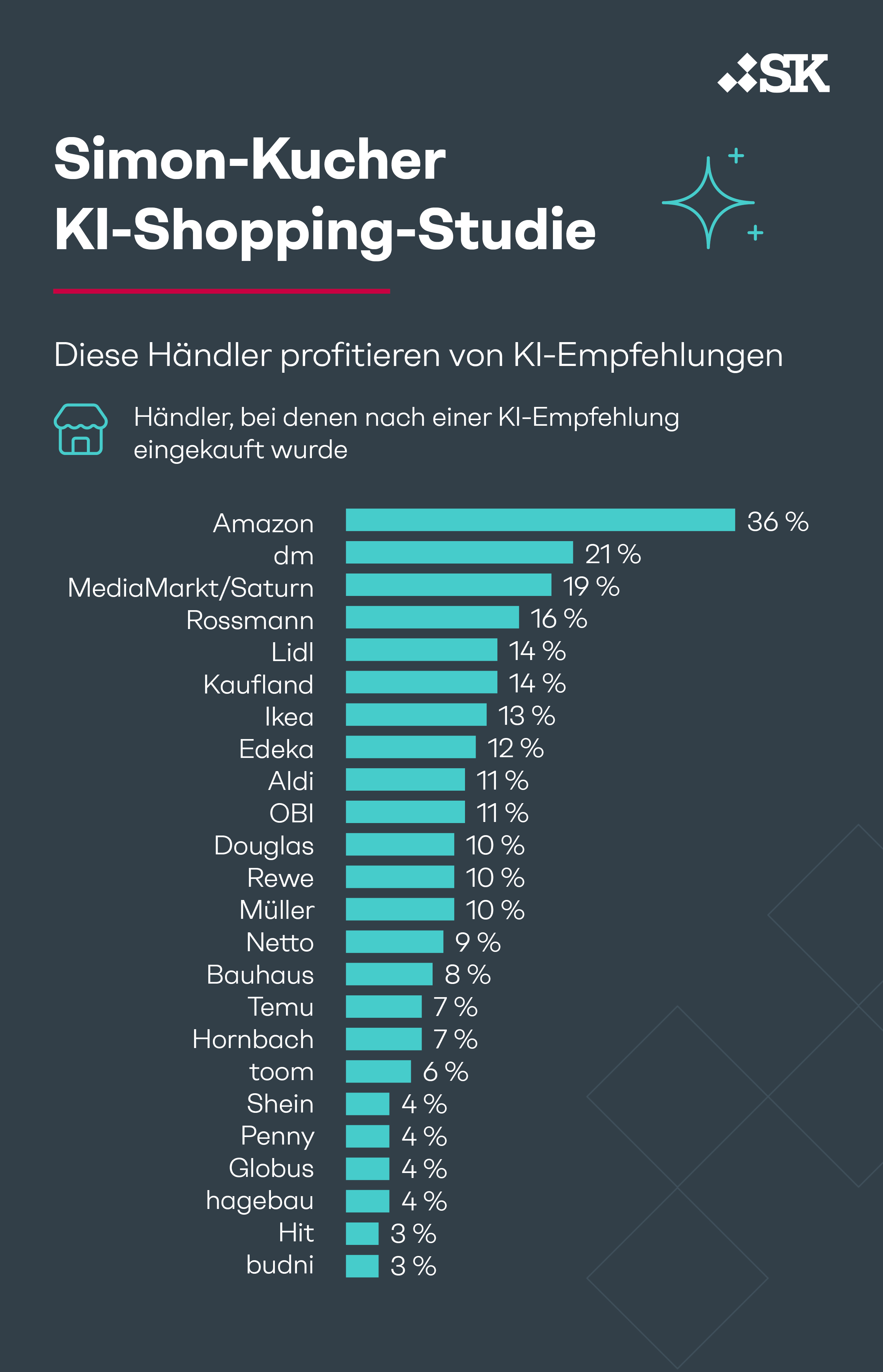
Amazon’s lead may reflect its hold on German shoppers: with its marketplace, it took about 63% of German online sales in 2025, a figure from IFH Köln’s Amazon study, as we reported in October. An assistant that sends shoppers where they already shop may have changed only the route.
Fashion retailers barely figure. Of the chart’s 24 retailers, only Shein, at 4%, is fashion-led; Zalando, H&M and Otto do not appear. Whether they were options is not stated.
Markus Goller, a partner, says retail must adapt, whether in “Lebensmittelhandel, Drogerie oder Baumarkt” (grocery, drugstore or DIY). This is episode 1 of 4, and episode 2 is due in about a week. Clothing may turn up in it. So, with luck, may a denominator.