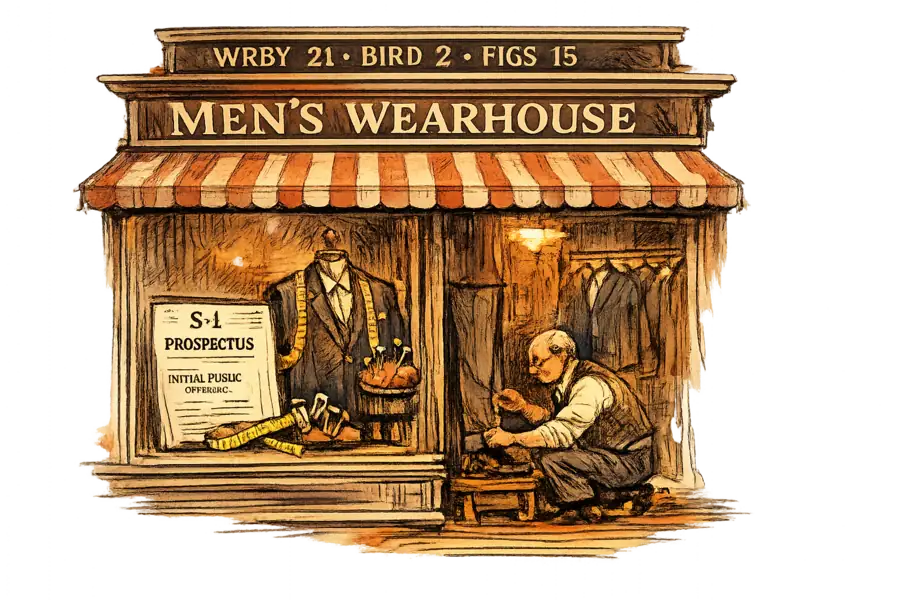
Tailored Brands Wants the Multiple the DTC Cohort Gave Back
Tailored Brands filed a confidential S-1 on April 21, testing whether public markets will pay more for a post-bankruptcy brick-and-mortar menswear operator than for the DTC pure-plays that went out at 2021 peak multiples and have traded below issue ever since.
Neritus Vale
Tailored Brands filed a confidential S-1 on April 21, submitting a brick-and-mortar menswear chain to the same public markets that spent the past four years repricing the 2021 DTC cohort below its issue prices. The company’s most recent disclosed year ran $2.6 billion in sales, the scale a mall-anchored retailer can still produce in 2026. Its adjusted EBITDA margin sits in the mid-teens, above anything the 2021 DTC class has sustained. The answer this filing gets will settle what the public market now thinks a store is worth when the customer-acquisition alternative has already been priced out.
The company Silver Point Capital took out of Chapter 11 in late 2020 is not the one that filed for bankruptcy the prior August. It closed hundreds of stores, reconstituted itself around a substantially smaller footprint, and within the past year installed a former JCPenney merchant as CEO and a former Foot Locker CFO to head finance. The appointment of a career merchant as CEO signals a chain managed for assortment and service. Tailoring revenue is the KPI that made the turnaround possible. The mall has not delivered meaningful traffic in a decade, but a tailored fitting is the part of the transaction a screen cannot return, an algorithm cannot fit, and a FedEx label cannot cross. A suit that needs hemming is the category’s moat, and the moat is local.
The 2021 fashion IPO class has documented with unusual precision what public markets no longer pay for. Warby Parker set a $40 reference price at its September 2021 direct listing and trades near $21 in April 2026, cut roughly in half after delivering its plan rather than missing it. The business got better; the multiple did not.
Allbirds is the limit case. The company came out at $15 and has agreed to sell its assets for $39 million in a deal pending shareholder approval — roughly one-ninth of what investors put in at the 2021 listing. The product still had customers; the multiple never did.
Figs is the counter-example, pointing to the same repricing from the opposite direction. The most operationally credible member of the 2021 class returned its business to profitability and still trades well below its issue price. The market has decided a healthy DTC brand is worth less than 2021 thought, which is the market Tailored Brands has chosen.
The timing tells the story. The IPO market reopened only recently after a three-year retail freeze, leaving Silver Point a narrow runway to exit an asset held for more than five years. Equities sit near all-time highs, but consumer confidence has been dented by an oil shock, meaning favorable market conditions and softening demand are arriving together. Waiting another year risks tariff-driven pressure the category cannot absorb; filing earlier would have meant pricing against unstabilized results. The calendar wrote this S-1 as much as management did.
The filing is a bet that public investors, having learned to distrust the funnel, will remember how to price the floor.
The serious objection is structural and historical. Tailored Brands already failed as a public company once: it missed NYSE listing thresholds, filed Chapter 11 in August 2020, and dealt with liquidity problems after exiting before Silver Point and the current executive bench stabilized the business. Menswear is also in secular decline, as twenty years of office-casual have demonstrated, which means margin gains from closed stores and renegotiated leases are one-time absorption rather than compounding operating leverage. For the thesis to fail, one of two things has to hold: the management team fragments before the IPO prices, or TAM erosion accelerates fast enough to swamp the margin structure already in place.
The answer is that the thesis does not depend on TAM expansion; it depends on margin durability inside a consolidating category. Nordstrom has gutted its men’s floor, Macy’s has thinned suiting, and the DTC alternatives never solved the fit problem — which is the problem that refills the store. Tailored Brands’ margin structure survives TAM erosion so long as share gains and service revenue absorb the shrinkage, a narrower claim than the 2021 cohort made and the reason it may clear a higher price.
What Silver Point is underwriting is a proposition about retail scarcity value. If public markets decide that the knowable mid-teens EBITDA of a stabilized menswear chain is worth more than the story-dependent multiples they have finished unwinding, Tailored Brands will price above the DTC comps and invite the next wave of brick-and-mortar filings. If not, this filing will confirm what the 2021 cohort already demonstrated: the channel was never the problem. It was always the price.