Temu's Lead Isn't in the Parcels Brussels Is Taxing
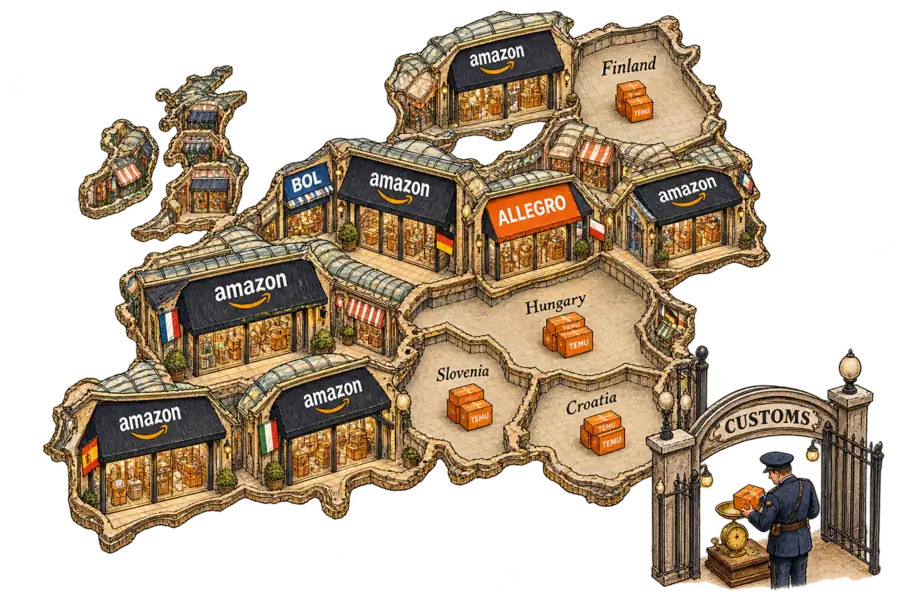
ECDB ranks Temu first in Croatia, Finland, Hungary and Slovenia, four markets with no Amazon store and no domestic marketplace of scale. Allegro sold out of two of them this year, and the EU handling fee due on 1 November charges Temu's parcels while leaving the vacancy open.
Admiral Neritus Vale
Temu is the largest online retailer in Croatia, Finland, Hungary and Slovenia, four countries where Amazon has never opened a store. None of them has a domestic marketplace “operating at the scale of a Bol.com or an Allegro” either, in the words of ECDB, whose 2025 ranking Ecommerce News Europe reported this week. Temu’s European lead marks the places where nobody built a local marketplace, not the places where it beat one. The EU handling fee on low-value parcels, due from 1 November, charges the parcel and leaves that vacancy where it was.
ECDB’s own analysis offers two explanations, and only the structural one fits its table. In that account Temu “leads where the domestic sector never consolidated around a dominant platform.” It places second in eight markets including France and Austria, “where a single incumbent holds the top spot.” Every one of those second-place markets except France also lacks an Amazon storefront, which makes Amazon’s absence necessary for a Temu first place but not sufficient. The other explanation credits Temu’s offer, which “undercuts established retailers on price and beats them on product variety.” Temu makes broadly the same offer in every market, so the offer can explain why it reaches the top ten from London to Athens, but not why it is first in Slovenia and second in Austria next door.
Where a European marketplace did hold ground in these countries, its accounts show what holding it cost. Allegro, which calls itself “the largest online marketplace of European origin,” took over Slovenia’s Mimovrste and Croatia’s Mall.hr when it bought the Czech Mall Group in 2022. In the first nine months of 2025, the year Temu finished first in both countries, the two sites’ combined adjusted EBITDA loss narrowed to PLN 23.8 million from PLN 26.2 million a year earlier, xyz.pl reported — an improving business Allegro chose to leave anyway. On 7 January 2026, Allegro agreed to sell both to Mutares, a German private-equity group, with completion expected in the first quarter of 2026. Allegro took a one-off loss on the sale, xyz.pl reported.
Hungary and Finland show the vacancy in its other two forms: the marketplace that arrived late, and the one that never arrived. Allegro’s Hungarian marketplace carries a newer name over older infrastructure. Mall.hu, inherited when Allegro bought the Czech Mall Group in 2022, had already traded under the Allegro brand for two years before Allegro.hu launched under its own name, though neither reached the scale of Allegro’s home market. In October 2024, XpatLoop reported research by the Hungarian firm GKID showing Temu had become the country’s leading online retailer by volume and value, and ECDB still has it there a year later. Finland got neither a domestic platform of scale nor Amazon, which runs a Swedish store and has never opened a Finnish one. In all four, ECDB notes, shoppers “were already used to buying from foreign sites,” which left Temu facing far less entrenched rivals.
Customs law cannot open a marketplace in Helsinki.
Brussels has aimed its answer at the parcel. Since 1 July a flat €3 customs duty has applied to each category of goods in a low-value consignment entering the EU. It ended the duty exemption that the direct-parcel model was built on. From 1 November member states must also collect a handling fee on small parcels, which a Commission draft sets at €2, Agence Europe reported. Its stated purpose is to pay for monitoring those parcels.
Germany’s retail federation, the HDE, objects to the size of the bill. Its chief executive, Stefan Genth, told t-online that “Temu, Shein and whatever the rest of them are called will adapt, and they will carry on,” in remarks carried by dpa and TextilWirtschaft. “Five euros, my God,” he said of the duty and fee combined. “We had imagined considerably more.” Genth is right that the charges will not stop Temu, but the reason has nothing to do with their size.
The fee lands on the direct-parcel business that Temu itself is trying to shrink. Temu has said it will eventually route as much as 80% of its European sales through local warehouses, Ecommerce News Europe reported. An order filled from stock already inside the Union crosses no customs border on its way to the shopper. A separate fee on goods leaving customs warehouses for distance sales starts only in July 2028, at a level the Commission has not yet set. The move changes where Temu pays its costs and leaves the four countries’ shortage of local marketplaces untouched.
The strongest objection is that price is the whole story: Temu leads in Finland because it is cheapest, and dearer parcels will erase the edge. France’s reported fall of 30 to 40% in such shipments since July, which Genth cited, would be the first sign. For that reading to hold, Temu’s orders would have to keep arriving as parcels, and the shoppers it loses would have to move to a local seller. A falling parcel count cannot tell lost sales from sales that now arrive in containers, and Temu’s warehouse plan exists to produce the second. If shoppers do leave Temu in the four markets, no domestic marketplace of scale is there to take them, so the gain would go mostly to other foreign sites. ECDB calls its 2025 table a baseline for tariff effects, and if Temu still leads Finland and Hungary in the 2026 edition, the charges will have raised its costs without moving its rank.
Brussels chose the lever it holds, which is the border. The lever that decides Temu’s first places sits elsewhere: in someone’s willingness to run a marketplace in a small country at a loss for longer than Allegro would. In two of the four, that someone is now Mutares, which bought Mimovrste and Mall.hr calling them “the leading e-commerce platforms in the Balkans.” Should it build them up, Temu’s lead in Slovenia and Croatia will narrow without a euro more collected at the border. In the meantime, Europe’s answer in those markets is a charge on the parcels Temu is already replacing with warehouse stock.