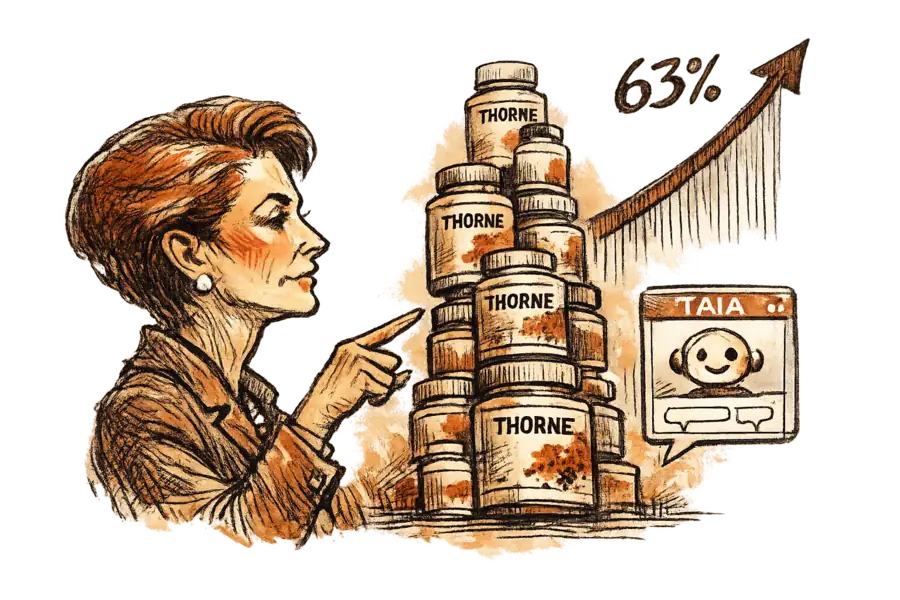
Thorne's 63 Percent Bills AI As Brand's Multiplier
Thorne grew DTC sales 63 percent by layering AI tools on top of a brand awareness push, settling whether AI marketing functions as a multiplier on brand spend or as a substitute for it.
Neritus Vale
Thorne grew direct-to-consumer sales 63 percent year over year, on a customer base that grew 75 percent to seven million. The reading most operators are taking from the result is that AI tools work when paired with a brand push. The sharper read is that Thorne ran the opposite of the play AI marketing has been pitched under for two years, with the multiplier only showing up because the brand spend went first.
AI marketing was sold as a substitute for brand spend, a route around the post-cookie CAC math that has broken most DTC P&Ls. The average DTC customer acquisition cost has risen 222 percent over eight years, per ProfitWell data cited by Blueprint Media. Finding a buyer now costs multiples of what it cost when third-party data signals did the targeting for free. Agentic stacks have been pitched as the way to recover what cookies took away by skipping the awareness budget entirely. Tidy reading for any CFO who wants the marketing P&L to look like a software P&L. Thorne’s number is the empirical case against it.
Mary Beech, chief growth officer since August 2024, ran the opposite play. The campaign volume reached six creative pushes through Project 3 Agency, Modern Retail reported. The “Now I Know” anchor ran January 20 through April 5 across Connected TV (Prime Video, Hulu, Paramount+, Tubi, ESPN), out-of-home in New York, Los Angeles, Miami, Dallas, and mountain resort markets in Colorado and California, plus Reddit AMAs and YouTube influencer work. The whole sequence sat on top of October 2025 Censuswide research showing more than half of consumers were unsure which wellness products to choose, MediaPost detailed. Brand work created the consideration — the AI tools captured it.
Taia, the LLM wellness advisor Glossy covered at launch in January 2026, is where the multiplier shows. Those who engage with it show higher average order value and lifetime value than those who do not, though conversion start rates remain on the lower side; Taia lifts what the brand-built audience spends, not how many arrive. The brand spend went first; Taia harvested the intent it created, compressing a research step most supplement buyers had been doing manually anyway.
Branded search on Thorne.com and Amazon, trust and consideration scores, now go to the board alongside revenue, backed by a 13-year-old blog and a Mayo Clinic content partnership that pre-loaded the corpus answer engines like ChatGPT and Claude now cite. Performance dashboards used to stop at last-click attribution. Thorne reports upper-funnel signals as financial metrics because the funnel itself has stopped having a clean bottom.
The strongest counter is that the supplements category lifted everyone, and Thorne caught the tide. The Make-America-Healthy-Again surge and structural Gen Z demand for daily wellness have expanded the category; a skeptic can argue the AI stack is correlation, not cause. The condition that would have to hold for that read to survive is share-neutral growth across the category. Thorne added millions of new customers while competitors swam in the same Gen Z pond, and category tides do not move customer counts that fast.
The cleaner reading is that Thorne built demand with brand spend and harvested it with AI — the 63 percent is the product of both lines, not either one.
What Thorne’s number prices is sequence. If AI marketing is a multiplier on brand awareness rather than a substitute for it, the brands trimming awareness budgets to fund agentic stacks are buying capture capacity for demand they have stopped creating. The Taia AOV lift, the answer-engine visibility built on a decade of editorial, and the CTV-and-DOOH push in front of both are one stack with an order of operations. Reverse the order and the multiplier has nothing to multiply. The next set of DTC operators will discover that the AI tools themselves are now table stakes; the open question is whether they still own the brand surface for those tools to amplify. The cost is not wasted AI spend — it is efficient harvesting of a field that was never planted.