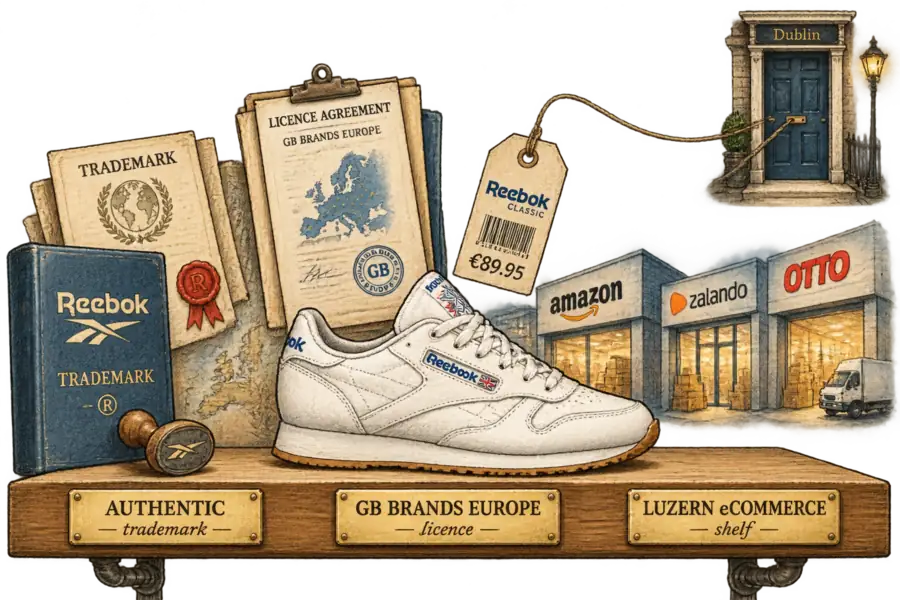
Three Companies Stand Between Reebok and Its European Buyer
Authentic's expanded Luzern deal hands its European operators the marketplace shelf and the advertising accounts, but not the pricing decision. The licensor keeps the trademark, the royalty, and progressively less of the customer.
Sir John Crabstone
Authentic Brands Group has finished the work of owning nothing it has to operate. On 20 August the company expanded its partnership with Luzern eCommerce, giving its operators and licensees access to Luzern’s marketplace and retail media services across Amazon, Zalando, OTTO, ABOUT YOU, Allegro, ASOS and TikTok Shop. The trademark stays with Authentic. The shelf does not.
Count the parties between the trademark and the shopper. Authentic licensed Reebok’s European operation in February 2025 to GB Brands Europe, the joint venture Galaxy Universal formed with Batra Group. Luzern has spent the past year working Europe’s marketplaces on behalf of Reebok’s operating partners. Amazon handles the transaction. Three companies stand in the gap, and the brand is none of them.
The arithmetic was always lopsided. Authentic’s brands turn over more than $36 billion in systemwide retail sales through 1,700 licensees and partners across 150 countries, and the company itself touches none of the inventory. Its announcement promises operators control over “strategy, merchandising, inventory and distribution,” four nouns chosen with evident care.
Price is not among them.
Tim Derner, Authentic’s global head of marketplaces, calls it “a flexible marketplace ecosystem that empowers our operators.” Flexibility of that kind lets an operator choose which vendor it depends on. It does not let the operator decline to depend on one.
Luzern is candid about why price might have been left off the list. It consigns stock rather than buying it and charges a shared-success fee, which it offers brands as protection against discounting: stock it never owns is stock it has no reason to mark down. A promise not to cut prices is only worth making by the party that could.
The trade read the deal as reach. WWD’s Sourcing Journal filed it as better access to European markets, which is the frame the announcement invites. Access was not scarce. What Authentic supplied was a default, and a default is the most durable thing a platform can hand out.
The credentials that open those shelves belong to the vendor. Luzern is an Amazon Ads Advanced Partner and a Zalando Marketing Services preferred partner, managing over €750 million in GMV for a roster running from Panasonic to Stokke. A licensee can be replaced in a quarter; an accreditation cannot be handed over at all.
In May we called this structure an operating system for intellectual property. Operating systems do not decide what a trainer costs on a Tuesday in Warsaw. Somebody does, on commission, and it is not Authentic.
Authentic collects its royalty either way, and the royalty line reads the same whether a brand owns its demand data or rents it. That is why this particular handover rarely gets priced. The question is what Authentic will know about its customer when the licence comes up for renewal, and whom it will have to ask.