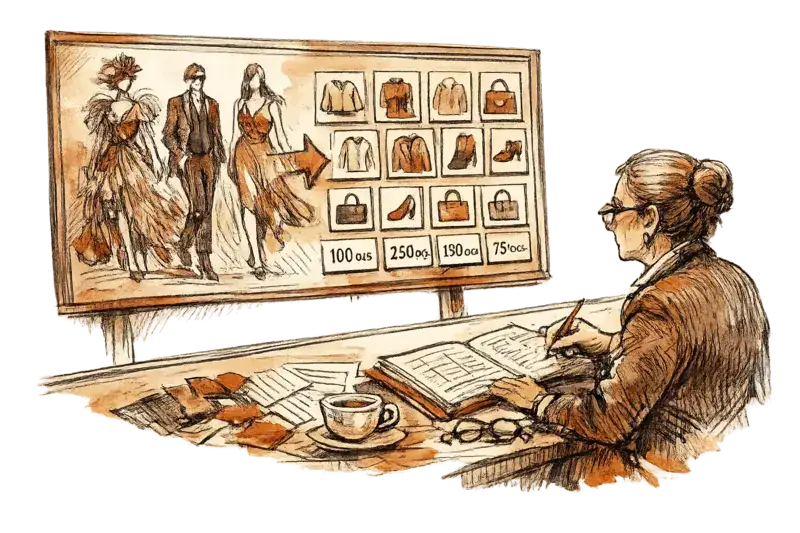
The Trend Report Has Learned to Take Orders
JOOR’s move to make trend imagery shoppable for Spring 2026 pushes the wholesale report out of the inspiration business and into the transaction stack. For buyers, the image is no longer a cue card for later; it is becoming the interface where the buy begins.
Parallax Pincer
A trend report used to stop at the page edge. A coat, a shoulder, a color family, a clipped runway image, then the real work happened somewhere else in a showroom, a spreadsheet, or a buyer’s notebook. JOOR is collapsing that distance. In October 2025, the company launched a fully shoppable Spring 2026 women’s trend report, a move also described in a FashionUnited press item. Fashion imagery is being asked to do a different job: not to inspire a buy later, but to help execute one now.
That matters because JOOR already sits inside a large piece of wholesale plumbing. Its platform says 675,000 retail buyers use JOOR, and the same page describes 14,000-plus brands and $100 billion-plus in wholesale transactions processed. In a January 12, 2026 recap, JOOR said its network had reached 692,000 buyers across more than 150 countries. The company has also been training buyers to trust visual software as an operating layer, not a presentation layer. Its Visual Assortment tool lets teams organize product imagery across brand, color, category, and delivery window; its 2025 recap says the JOOR Discover prospecting tool was built for “trend-led assortment needs,” helped generate 191,000 new brand-buyer connections in 2025, and in one beta test produced 55 new retailer connections and seven new orders in four months.
Most people will read this as a nicer trend report, or a smarter forecasting aid. That is too soft. The meaningful change is interface compression. The old sequence was linear: runway image, seasonal interpretation, shortlist, line sheet, order. JOOR is trying to stack those steps inside one visual surface. The trend page starts behaving less like editorial merchandising and more like wholesale software.
The historical echo is not consumer e-commerce at all. It is the old trade-fair wall: swatches pinned in rows, silhouettes grouped by mood, buyers circling what might travel. The difference is that the wall can now resolve directly into purchasable inventory. What used to be a visual argument is becoming a transactional menu.
That is why the scale of trade-show infrastructure matters here. FashionUnited reported that CHIC Spring 2026 would bring 1,091 exhibitors, 1,135 brands, 117,200 square metres of floor space, and an expected audience of more than 160,000. The same report described CHIC as an order platform. That is the real context for JOOR’s shoppable report. Wholesale buying already runs on giant machines for translating aesthetic signals into orders. JOOR is simply trying to move more of that translation into the image itself.
Others in fashion tech keep talking about AI in buying as better prediction, cleaner inventory, tighter planning. That is true, and you can see the wider pattern in coverage of AI tools across merchandising and buying in outlets like Fashionista. Where that framing falls short is on form. The interface is changing before the forecast is fully perfected. Buyers do not need a perfect oracle for Spring 2026 to alter behavior. They need a visual surface that cuts friction between recognition and order.
Once that happens, fashion imagery stops being a mood board with good posture. It becomes wholesale middleware. The report is no longer there to summarize the season after the runway. It is there to route capital through it.