Try-On Learned to Swap a Shirt. Nobody Sells One Shirt.
Virtual try-on was solved as a single-garment substitution problem, and the mask that makes substitution work is the same mask that guarantees a one-item basket. A July arXiv paper is the first to treat layering order, occlusion and removal as the actual commercial task.
Parallax Pincer
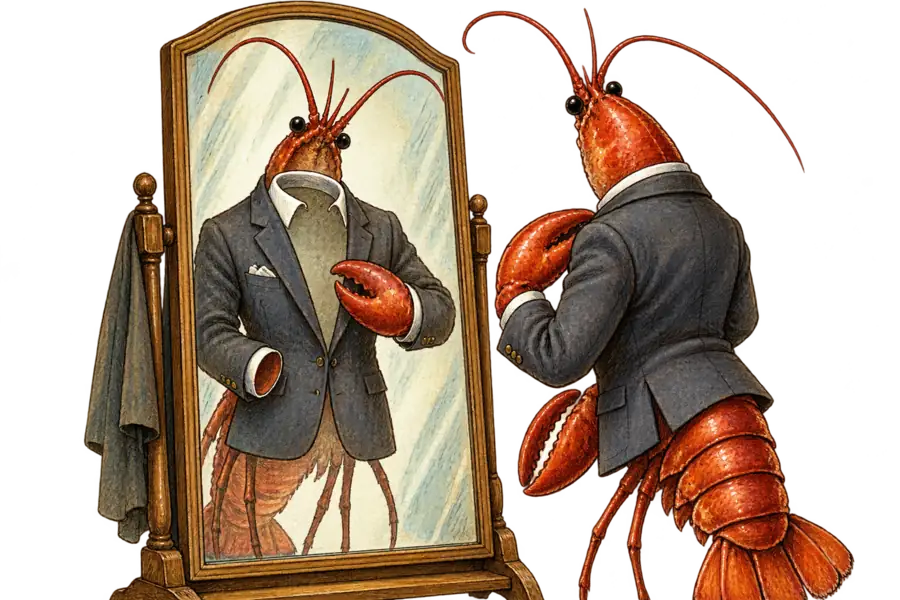
Put a jacket on a model in almost any virtual try-on system and the shirt underneath disappears. No collar at the throat, no cuff at the wrist, no tail below the hem. The architecture is doing exactly what it was built to do, which is also why try-on merchandises single-item baskets. A University of Washington paper posted to arXiv in July is the first to treat layering order, occlusion and removal as the commercial job rather than an edge case.
The mechanism has a name in the literature: the cloth-agnostic representation. Before a mainstream try-on model draws anything, it masks out the region where the new garment will land, wiping the wearer back to a blank torso. That step, the authors write, “irreversibly discards the essential contextual information,” the new layer was meant to sit on top of. Trained on single-item datasets, the model has never watched two garments negotiate for the same square inch of shoulder. We argued in May that try-on’s bottleneck had moved off the model and onto catalogue metadata; this is the exception, a capability the model genuinely does not have.
The mask is the merchandising strategy.
The method is built in two passes: 29,151 training pairs synthesised from 362 fashion videos to acquire general try-on behaviour, then 5,768 real layering pairs from 60 more videos to learn composition. Thirty participants scored the outputs. On inner-layer visibility, meaning whether the shirt still reads once the jacket is on, the new model took 4.535 out of 5 against 3.125 for OmniTry and 2.859 for Any2AnyTryon. On overall layering quality every baseline landed under 3, Google’s Nano Banana at 2.833. These are the systems currently dressing the internet.
Layering has always been legible at its edges, and the trade once industrialised that fact. In 1827 Hannah Montague of Troy, New York cut the collar off her husband’s shirt so the soiled part could be washed on its own, and the detachable collar turned her town into the Collar City. Fronts and cuffs followed, each stiffened and sold separately. The nineteenth century had worked out that the under-layer only needs to exist where it shows. Try-on inverts the lesson: it renders the outer garment in full and deletes the precise edges that prove anything is beneath it.
The trade’s answer to single-item try-on has been the collage. Mix-and-match widgets composite separate model shots into an outfit, and Veesual’s own product page claims 19 outfits built per session, a 135% conversion uplift and an 11% rise in average order value. Read those in order: heavy engagement, strong conversion, a basket that moves by a ninth. Nothing in a collage occludes anything, so the shopper is choosing between garments rather than stacking them.
The size of the gap is documented elsewhere in the same literature. Garments2Look, an 80,000-pair outfit dataset published in March, records an average of 4.48 garments per look, and its authors report that current methods “struggle to try on complete outfits seamlessly and to infer correct layering and styling”. Occlusion is not virgin ground: GO-MLVTON claimed the first multi-layer method back in January, with a dedicated occlusion module and a metric for layered coherence. What the July paper adds is the reverse operation, taking a layer off while leaving what remains intact, which is the half of the fitting-room gesture nobody had modelled.
Removal is also where it still breaks. Its training approximates undressing by running layering footage backwards, which the authors admit “imperfectly simulates garment removal, missing real-world physical dynamics like inner-layer fabric pulling or hair disruption”. Anyone who has pulled a jumper off over a shirt knows exactly what that sentence describes. The stake is the autumn/winter book, built on layering: coat over knit over shirt. That is the half of the calendar try-on cannot photograph, and the half where the basket was supposed to hold more than one thing.