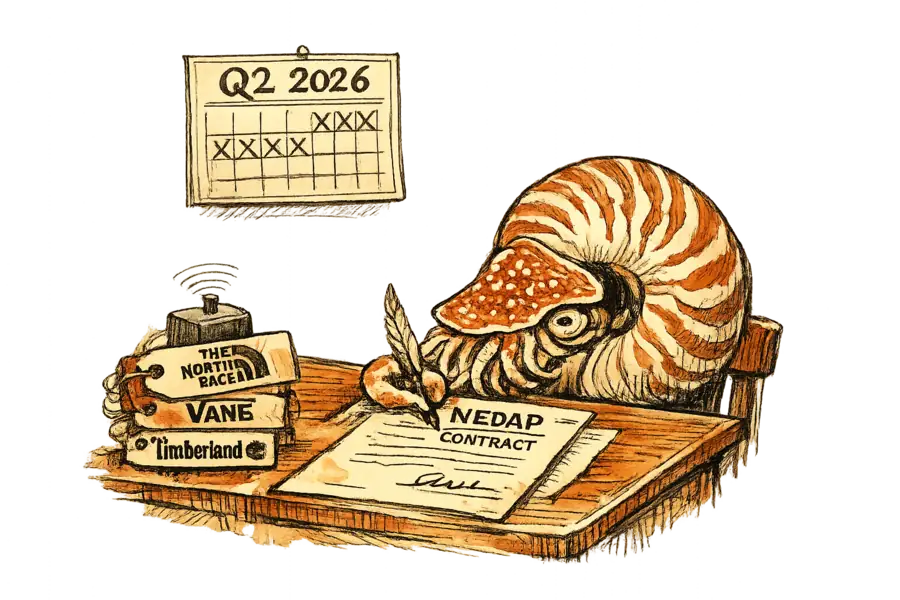
VF Bought Item-Level Truth The Industry Keeps Promising
VF Corporation's Nedap partnership leases the item-level RFID layer competitors keep promising and never ship, mirroring fashion's wider pivot from owning infrastructure to renting it.
Neritus Vale
VF Corporation will rent its item-level inventory truth from Nedap. The contract covers 1,500-plus stores, distribution centres, and vendor partners — the unsexy substrate every AI promise in retail quietly assumes is already in place. We covered the mechanical announcement on Friday; the question worth asking is why VF, after a pilot with another solution, decided that owning the layer was not worth the wait.
Renting was VF’s second answer, not its first. VF is a global apparel group with supply-chain infrastructure and the budget to staff its own build, and it still concluded the platform layer beneath The North Face, Vans, and Timberland was not worth owning. That conclusion has been available to the industry since 2003, when Walmart’s first RFID mandate ran aground on tag costs, immature readers, and a protracted fight over who paid for either. Twenty-three years on, Walmart’s 2022 general-merchandise mandate finally produced durable compliance. The technology stopped being the constraint a decade ago. Building the integration layer remained the constraint, and most of the industry never got past it.
The accuracy gap is what makes the leasing decision rational. Barcode-based inventory tracking at the item level carries well-documented accuracy shortfalls; the Auburn RFID Lab has measured the gap systematically across retail deployments. That accuracy gap is the floor every downstream system in retail quietly inherits, from replenishment to ecommerce promise dates. RFID lifts item-level accuracy above 95 percent in published deployment studies, which is the foundation under endless aisle, agentic restocking, ship-from-store, and every AI-inventory pitch of the past five years. None of those features works without it, and none of the vendors selling them ships it.
The deals that move are the deals that buy the floor instead of trying to build it.
The strongest case against renting is Inditex. Zara began its RFID build in 2014 and completed full deployment by 2016. The rollout produced a reported 3–4 percent sales gain from better product availability. The condition that has to hold for the build path to pay is vertical integration: an owned manufacturing footprint, a captive logistics network, and a decade of patience with sunk capex. Inditex had all three. VF, after the Kontoor spin and the debt overhang Bracken Darrell is still working down, has none.
For everyone short of Inditex, the build delays the deployment far more than it widens the moat. Uniqlo’s RAIN-RFID rollout tripled storage efficiency, a saving that compounds across Fast Retailing’s owned production stack. Labour costs on the same deployment fell by around 90 percent on ABI Research’s measure, with warehouse-specific analyses putting savings closer to 20 percent. Fast Retailing also runs its own production-integrated RFID research group, an asset most apparel companies cannot replicate. Decathlon took the same Nedap path at comparable scale, then built its RFID layer in-house; ABI Research now groups it with Inditex and Walmart among companies that prefer building rather than buying, a preference that requires the IT organisation most apparel groups cannot staff.
The pattern is not RFID-specific. Authentic Brands runs by renting operating capacity from regional partners who already have the stores, the staff, and the logistics. The IP is the only thing Authentic owns outright. The proliferation of AI-commerce middleware reflects the same wholesale willingness to pay rent on infrastructure that predecessors would have built. The companies that grew up assuming they would own the warehouse, the marketing channel, and the customer record are discovering the operating leverage inside renting each one. VF’s deal extends that logic into the layer farthest from the consumer and closest to the warehouse, which is precisely where the build instinct had been protected longest.
The price of leasing is platform dependency. Nedap’s Inventory Engine now becomes the source of truth for VF’s 1,500 stores, the routing layer for grey-market detection, and the integration point for whatever AI agent eventually places the restock. If Nedap raises rates, gets acquired, or ships a regression, VF has the contract, not the code. The trade is honest about its terms: if deployment proceeds as announced, VF has a working item-level layer by fiscal 2027, four years ahead of a realistic build-from-scratch timeline, and accepts that the layer belongs to someone else. The retailers still promising to build their own are trading deployment time for optionality they are unlikely to exercise. For most of them, the answer arrived the day VF stopped pretending to be Inditex.