France Ranked Vinted First. The Brands Compete For The Second Sale.
The Institut Français de la Mode ranked Vinted first among clothing retailers in France by sales volume for the first quarter of 2025. The brands whose garments stock its catalogue no longer set the floor of the market they made.
Sir John Crabstone
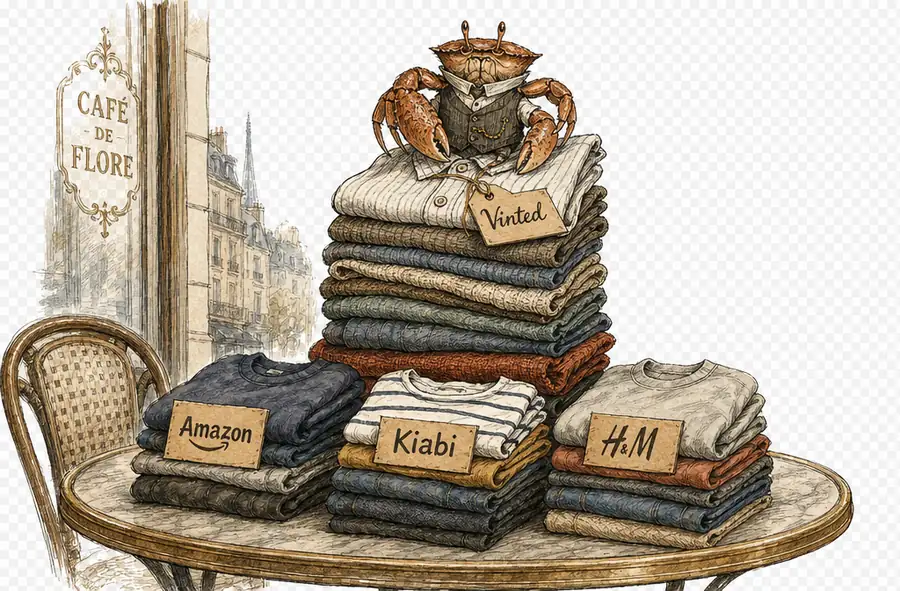
The Institut Français de la Mode ranked Vinted first among clothing retailers in France by sales volume for the first quarter of 2025. Amazon placed second; Kiabi, third. The platform owns no garment it sells. The brands that do now stock its catalogue without billing for the work.
Resale claimed 10.9% of all French clothing volume that quarter, and 16.3% among Gen Z. Neither Vinted nor Amazon, the institute’s second-placed retailer, commissioned most of the clothing they moved. Kiabi, in third, did.
Vinted closed 2025 with €1.1 billion in revenue against a gross merchandise volume of €10.8 billion, up 47% year on year. None of the inventory it moved was bought, designed, or photographed by anyone on its payroll.
A retailer that owns nothing cannot be undercut by anyone who owns something.
Among Gen Z, the resale share is 16.3%, already half again the national average. The cohort that will replace the brand’s customer in France is moving into second-hand at a rate the brand cannot match without competing with itself.
Every unit a primary brand ships into France now arrives with a second listing already implied. The brand sets the first price; Vinted’s marketplace sets every price after that. By the time a garment reaches its second owner, the brand has booked all the revenue it will ever book; the platform is only beginning to invoice.
Brand teams will explain that resale extends loyalty and validates the original purchase. It does — for Vinted. The platform learns the buyer’s wardrobe trade by trade. The maker of the original garment learns nothing past the till receipt. The customer relationship the brand thinks it is extending has been migrated to a counterparty whose interests do not include the brand.
The proposed remedy is the own-brand resale programme, an initiative whose advocates rarely note that it competes for inventory the brand has already sold and shipped. Asking a Parisian to list her old Sandro on Sandro’s site rather than on the application her friends already use is not a strategy. It is a hope.
That is not a distribution problem — it is a pricing problem. When a tenth of the volume in one of Europe’s largest clothing markets is priced by sellers who paid wholesale years ago, the floor of the new-goods market is no longer the brand’s to set. It is set by the closet.
CEO Thomas Plantenga has told the press his strategy is to make Vinted the most cost-efficient and easy-to-use service available. The brands whose garments fill his sortation centres would do well to read that as a quotation, not a strategy. The cheapest version of any garment is the version someone else already bought.