Walgreens Is Buying Screens It Won't Run
Walgreens puts digital screens back into 1,200 stores in October, six years after its first in-store advertising network earned $215 a screen and ended in a $200 million lawsuit. The network this time belongs to Looma, which is the whole story.
Sir John Crabstone
Walgreens is putting screens back into 1,200 stores from October. It will not run a single one. The network belongs to Looma, and the chain has decided its shoppers are an audience worth selling but not worth running itself.
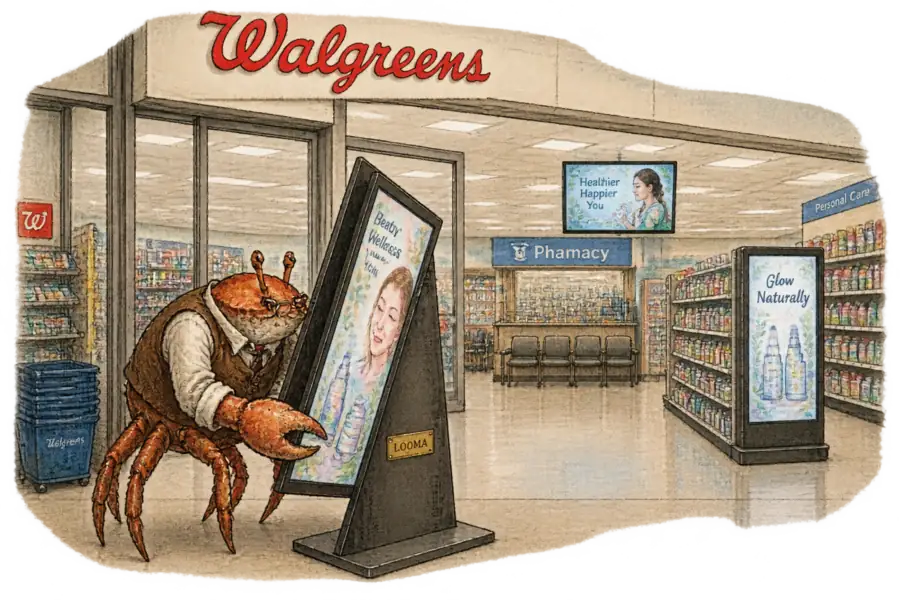
The deal looks unremarkable until you read the placements. Each store gets a screen at the entrance, a screen in the pharmacy waiting area and digital end caps; Looma runs more than 7,000 screens across ten banners and reaches 13 million unique shoppers a month. Walgreens is not building a network. It is joining one.
CVS sells the identical three placements itself. By January its media arm had almost 500 entrance screens, pharmacy screens in some 2,000 stores and end caps in 600 more, with roughly 11,000 screens planned for 2026. The architecture matches. The deed does not.
Walgreens has run the other version of this arrangement before. It signed a ten-year revenue share with Cooler Screens in 2019 and let roughly 10,000 advertising panels onto its refrigerator doors. They crashed, and sometimes they caught fire. Bloomberg put the yield at $215 a screen a year, under half the contract minimum; Cooler Screens sued for $200 million in 2023.
The industry filed that under customer experience. eMarketer concluded that retailers must keep advertising from disrupting the store, which is true and much too small. A screen that works and earns $215 a year is not a hardware failure; it is a price.
Walgreens has learned to distrust the vendor without learning to distrust the arrangement.
Looma won the account partly on measurement: it grades campaigns on full-funnel outcomes rather than how often an ad played, which is the better metric arriving from the wrong direction. When eleven networks pitched advertisers this month, none offered a figure a buyer could set beside a rival’s. Walgreens will now take its in-store numbers from the company that runs the in-store screens.
Dollar General looked at the same arithmetic in the spring and declined the screens outright, keeping its speakers and its margin. A refusal is at least legible. Walgreens has done the harder thing to read, which is to want the revenue line without running the equipment underneath it.
Sycamore Partners took the chain private in August 2025, and owners of that kind do not fund screen fleets. The terms this time were not disclosed. The last ones became public the hard way.