A Web Address Decides Whether €55 Billion Left the EU
ECDB sorts the €55.1bn EU shoppers spent at non-EU online stores by web address, so it cannot be set against the €3.9bn EU stores sold abroad as a trade balance. Counted as storefronts, it shows stores outside the EU holding about a third of EU online fashion spending and, on ECDB's projection, taking more than two-fifths of this year's growth in EU online spending.
Admiral Neritus Vale
EU shoppers spent €55.1bn last year at online stores based outside the Union, 13.1% of their online spending on goods. The figure comes from a cross-border dossier by the data firm ECDB, and Ecommerce News Europe reported it on 2 October as spending that “left the European Union”. ECDB decides where a store is based by its web address, so the figure counts storefronts rather than goods crossing a border. Set against what EU stores sell abroad, it makes a misleading trade balance. Counted as storefronts, it points to a harder fact for European retailers: ECDB’s projection has stores outside the EU taking a far bigger share of this year’s growth than of last year’s spending. Their strongest category is fashion.
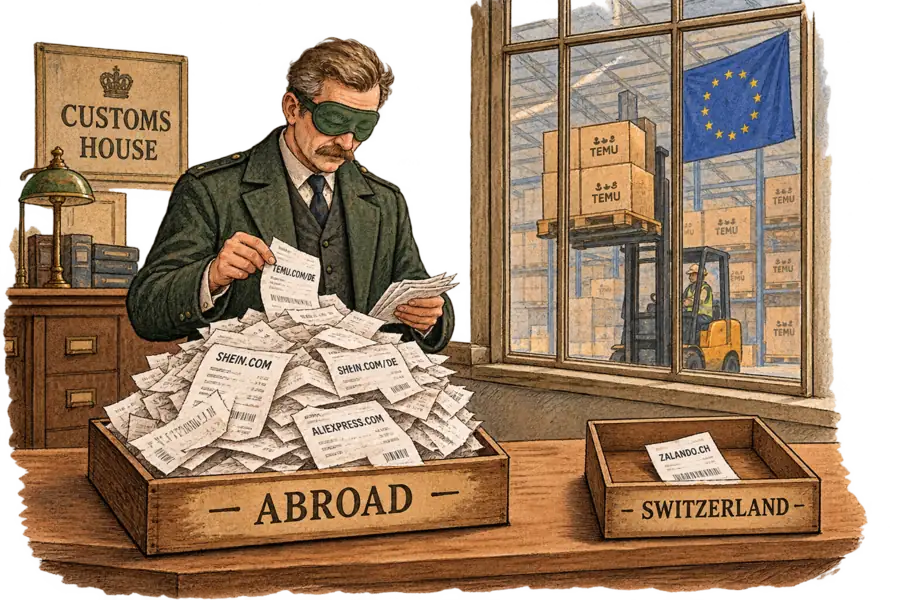
The dossier states the rule plainly: “a global domain counts as import, a local one does not.” Temu.com, shein.com and aliexpress.com are therefore foreign in every EU country, which is how the three come to “carry nine of every ten euros that leave the Union”. Zalando, a German company, sells to the Swiss through zalando.ch, which ECDB counts as a Swiss store rather than a German export. Country paths get different treatment: hm.com, apple.com and ikea.com are attributed to each buyer’s own country, while temu.com, whose German shop sits at temu.com/de, is foreign everywhere. Had Amazon served Europe from amazon.com rather than national sites such as amazon.de, the EU import share would exceed 40%. The metric, the dossier adds, “measures domain strategy as much as trade.”
ECDB’s dossier invites a comparison and then rules it out. One slide reports both numbers, giving €3.9bn as the “reverse flow” that shoppers outside the EU spent at EU stores. Side by side, the two imply fourteen euros out for every one back. The reading panel on the same slide says that “the two figures should not be netted”. Temu, Shein and AliExpress each sell through one global domain and are captured in full, while European retailers’ sales through local domains abroad, zalando.ch among them, are not.
Fourteen to one is a ratio of web addresses.
The strongest objection comes from ECDB’s own conclusion, which still calls Europe “a net importer of e-commerce”. On that reading, the domain rule distorts the size of the gap but not its direction, provided European retailers sell little outside the EU through storefronts of their own. The dossier’s retailer tables say otherwise: Zara, H&M and Zalando alone booked €8.4bn of online gross merchandise value outside the EU last year. The export figure skips sales through local foreign domains such as zalando.ch, and country-path domains such as hm.com are attributed to the buyer’s country, so a good part of that €8.4bn probably sits outside it. ECDB says GMV runs above revenue, yet even halved, those three retailers’ non-EU sales exceed the dossier’s entire export figure. Europe may still buy more through foreign storefronts than its retailers sell through theirs, but these two numbers cannot say by how much.
ECDB’s totals show how unevenly this year’s growth could be shared. If its projection holds, stores outside the EU would take more than two-fifths of this year’s growth in EU online spending on goods, from a base of an eighth of last year’s spending. The 2026 share is ECDB’s extrapolation, and slower growth would tilt the split further, provided imports still reach the projected share.
The industry’s own annual report cannot measure this shift. Ecommerce Europe and EuroCommerce’s European E-commerce Report 2026, which Ecommerce News Europe covered on 28 September, covers more countries than the EU-27, and its methodology warns that national turnover figures “may cover goods only or both goods and services”. Its 5% nominal growth forecast for Europe therefore cannot be set against the 7.6% or so that ECDB’s totals imply for EU goods spending. The report has no split by where a store is based, and TextilWirtschaft noted that this edition dropped the breakdown by product category that earlier reports carried, for lack of data. It can tell European retailers that online growth is slowing, but not whose storefronts collect it.
Fashion is where foreign storefronts hold the most ground. Clothing, shoes and bags make up 46% of what EU shoppers buy from stores outside the EU. ECDB estimates that share by applying the category mix of Temu, Shein and AliExpress to all non-EU purchases, US and UK stores included. On the same arithmetic, roughly a third of EU online fashion spending now goes to stores outside the EU. Because ECDB counts the storefront, that third measures where European fashion shoppers choose to buy, wherever the clothes happen to be stored.
The EU’s parcel charges can lower ECDB’s share only by pushing spending off stores outside the EU. ECDB’s projection predates any effect of ending the €150 exemption, which gave way to a €3 customs duty on 1 July; a handling fee follows on 1 November. Dearer direct parcels could therefore still pull the share below its trajectory. Moving stock into Europe cannot: an order Shein fills from its Wrocław hub still runs through shein.com, and ECDB counts the storefront. If parcel volumes fall after 1 November while the import share keeps climbing, Brussels and ECDB will both be right, about different things.
European fashion brands face a choice that the parcel debate hides. Temu has let companies with EU entities register as sellers since July 2024, FashionUnited reported at the time, citing Twinkle’s account of a Temu employee’s LinkedIn post. The model was built for sellers with overseas warehousing and fulfilment, which for a European label means stock held inside the EU. On ECDB’s method, such a label’s sales on Temu would add to the money recorded as leaving the Union, whatever its nationality or its warehouse’s address. Weighing its own site against a seller account on temu.com/de, a brand is choosing which side of ECDB’s count its sales will land on.