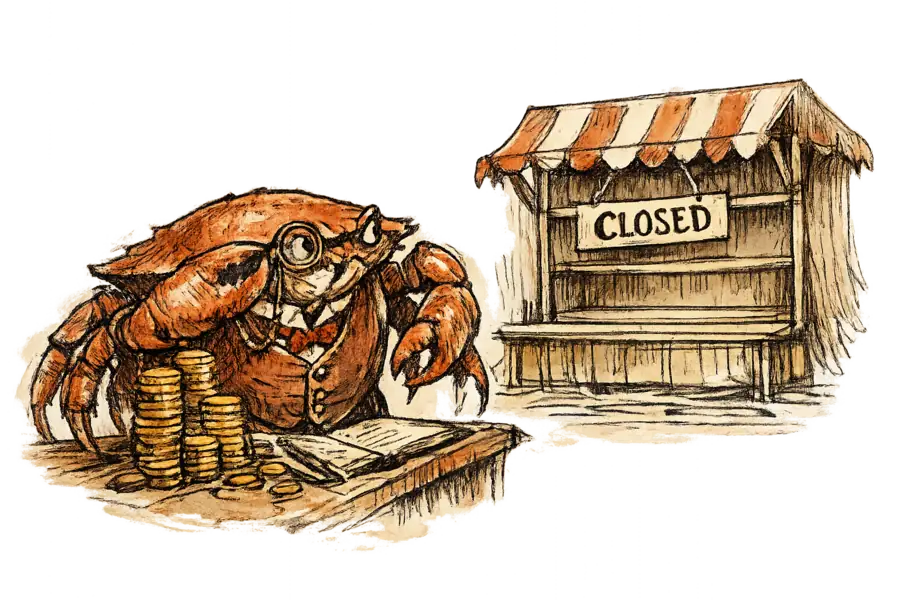
$33 Million in the Bank, Zero Market Left
Yupp.ai shut down nine months after launch because the AI evaluation market it built for pivoted to agentic systems faster than any product roadmap could follow. Every commerce-AI vendor whose moat depends on model limitations should note the speed.
Sir John Crabstone
Yupp.ai raised a $33 million seed round, launched in June 2025, and attracted 1.3 million users. Nine months later the founders shut it down. The company did not run out of money — the market it was built to serve ran out first.
The runway outlasted the category it was raised to capture.
Yupp.ai offered crowdsourced evaluation of AI models. Users compared outputs from 800-plus providers, generating preference data for reinforcement learning from human feedback. Several AI labs signed on as paying customers. a16z crypto led the seed round; Google DeepMind’s Jeff Dean and Perplexity’s Aravind Srinivas were among the backers. If insiders of that calibre misjudged the shelf life, the error was structural. The product was credible; the timing was not.
Two shifts collapsed the market before the product could find its footing. AI labs moved from crowdsourced feedback to expert-led evaluation; Scale AI had already reset the standard. The broader industry pivoted to agentic systems — models wired to tools and external services that rendered chatbot-level comparison pointless. Gupta wrote on X, as reported by TechCrunch: “The future is not just models but agentic systems.” He was explaining why his company no longer existed.
Commerce-AI vendors should read the obituary carefully. Discovery tools, personalisation layers — any feature that depends on the model remaining incapable is a bet against the rate of improvement. The model will catch up. The only question is whether the vendor’s roadmap is faster. We noted earlier today that Shopify’s absorption of AI discovery into the platform follows the same logic with a different executioner.
The distinguishing mark of Yupp.ai’s closure is the diagnosis. The founders announced the winddown and named the mechanism precisely: not product failure but category collapse. The distinction does not change the arithmetic for every commerce-AI vendor whose moat is the gap between today’s model and next quarter’s.